Brassica rapa subsp. rapa
L.
Turnip, Rapini, Seven-top turnip
iNaturalist· cc-by
(c) Kailey Alderfer, some rights reserved (CC BY)
iNaturalist· cc0
no rights reserved
iNaturalist· cc-by
(c) Mark Wagner, some rights reserved (CC BY)
Summary
Source: WikipediaBrassica rapa is an annual to biennial plant species native to Eurasia that is from the Brassicaceae family. It has been widely cultivated into many forms, including the turnip (a root vegetable), komatsuna, Chinese cabbage, bomdong, pak choi / bok choy, and rapini. Its domesticated forms include turnips and leafy greens, such as bok choy and napa cabbage. The oilseed types are grown for food and industrial uses. Genetic studies indicate that B. rapa was one of the earliest domesticated brassicas, with turnip-like forms arising first and additional morphotypes developing independently across Eurasia. Wild, feral, and cultivated populations are found worldwide, making the species important agriculturally, economically, and ecologically. Brassica rapa subspecies oleifera is an oilseed commonly known as turnip rape, field mustard, bird's rape, and keblock. Rapeseed oil is a general term for oil from some Brassica species. Food grade oil made from the seed of low-erucic acid Canadian-developed strains is also called canola oil, while non-food oil is called colza oil. Canola oil can be sourced from Brassica rapa and Brassica napus, which are commonly grown in Canada, and Brassica juncea, which is less common.
Description
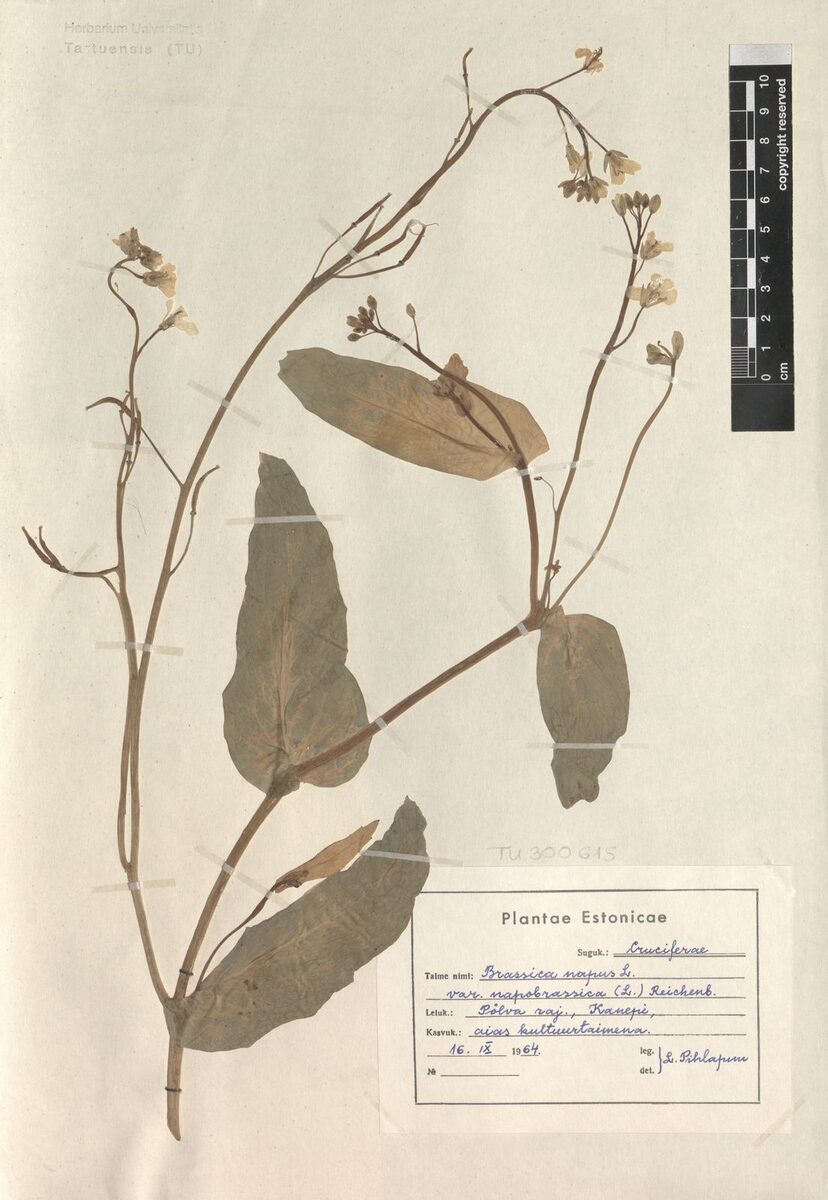
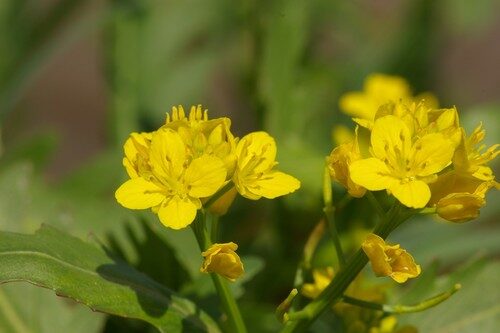
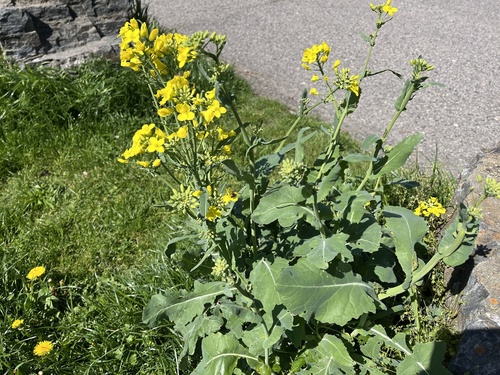
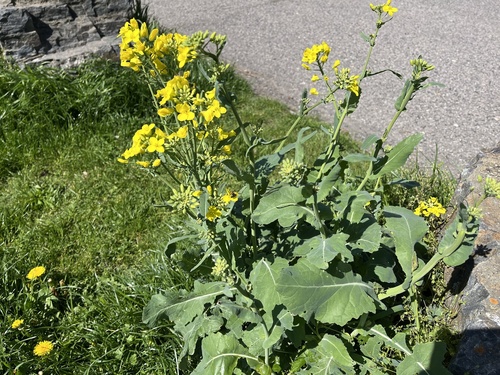
A cabbage family herb. It is an erect annual plant. It has a round white fleshed taproot. It is often tinged purple. The leaves are divided and have hairs. Where the leaves join the root it is not raised into a "neck". There are Asian or more tropical varieties. These will produce seed in warmer places.
Edible Uses
The swollen root is cooked and eaten. Leaves are eaten cooked or used for sarma (Turkish rolled leaves filled with rice or minced meat). Seeds can be ground to a powder and used as a seasoning.
Traditional Uses
The swollen root is cooked and eaten. The leaves can be eaten. The leaves are used for sarma in Turkey. They are rolled around a filling of rice or minced meat. The seeds can be ground to a powder and used as a seasoning.
Medicinal Uses
Cultivated varieties of B. rapa are consumed commonly as vegetables, such as turnip roots, napa cabbage, komatsuna, pak choi, and other leafy greens, particularly in East Asian, South Asian, and Mediterranean cuisines. The young leaves are a leaf vegetable eaten raw, while older leaves are typically cooked. The taproot and seeds can also be eaten raw, although the seeds contain an oil that can cause irritation for some people. Rapeseed oil from the plant is also used to make canola and colza oils. B. rapa is also commonly used as a rotational cover crop for vegetables due to its ability to prevent erosion and deter disease. Because of their fast life-cycle and genetic diversity, the B. rapa cultivar Wisconsin Fast Plants is widely used in genetics and plant biology education.
Distribution
It is a temperate plant. It will grow in both the lowlands above 700 m and highlands in the tropics but does best in the highlands between 1700 and 2600 m altitude. In Java it can be grown above 1,000 m above sea level. It is frost resistant. A temperature of 9-16°C is best. Also short daylength and cool weather are important. It grows in Nepal to 2500 m altitude. It suits hardiness zones 9-11. Tasmania Herbarium.
Where It Grows
Africa, Albania, Argentina, Asia, Australia, Austria, Balkans, Bangladesh, Britain, Canada, Caucasus, Central Asia, China, Dominican Republic, East Africa, Europe*, Falklands, Georgia, Haiti, Indochina, Italy, Korea, Kyrgyzstan, Madagascar, Mediterranean, Mexico, Myanmar, New Zealand, North America, Pacific, Pakistan, Papua New Guinea, PNG, Philippines, Puerto Rico, SE Asia, South Africa, Southern Africa, Tajikistan, Tasmania, Thailand, Turkey, Türkiye, USA, Uzbekistan, West Africa, West Indies, Zimbabwe,
Cultivation
It is grown from imported seed. In the lowlands they are best grown in the shade. Plants are spaced 10-15 cm apart. This can be achieved by thinning out plants.
Production
The roots are ready after 8-10 weeks. They need to be harvested when young to avoid becoming hard and fibrous.
Notes
There are about 30 Brassica species and many cultivated varieties. The naming of Brassicas is still unclear.
Nutrition
| Part | Moisture | kJ | kcal | Protein | Vit A | Vit C | Iron | Zinc |
|---|---|---|---|---|---|---|---|---|
| Root - raw | 93.3 | 86 | 21 | 0.8 | 0 | 25 | 0.4 | 0.3 |
| Root - boiled | 94.5 | 60 | 14 | 0.7 | 0 | 17 | 0.4 | 0.2 |
| Leaves - boiled | 92.8 | 48 | 11 | 2.7 | 600 | 40 | 3.1 | 0.4 |
Synonyms
Also Known As
Chou navet, Chou rave, Gantemula, Shalgom, Talgamura, Tepar
References (47)
- Ali, A. M. S., 2005, Homegardens in Smallholder Farming Systems: Examples from Bangladesh. Human Ecology, Vol. 33, No. 2 pp. 245-270
- Anderson, E. F., 1993, Plants and people of the Golden Triangle. Dioscorides Press. p 204
- Bianchini, F., Corbetta, F., and Pistoia, M., 1975, Fruits of the Earth. Cassell. p 74
- Bodkin, F., 1991, Encyclopedia Botanica. Cornstalk publishing, p 169
- Brouk, B., 1975, Plants Consumed by Man. Academic Press, London. p 142
Show all 47 references Hide references
- Bourke, R. M., Altitudinal limits of 230 economic crop species in Papua New Guinea. Terra australis 32.
- Burkill, H. M., 1985, The useful plants of west tropical Africa, Vol. 1. Kew.
- Bussman, R. W., et al, 2016, A comparative ethnobotany of Khevsureti, Samtskhe-Javakheti, Tusheti, Svaneti, and Racha-Lechkhumi, Republic of Georgia (Sakartvelo), Caucasus. Journal of Ethnobiology and Ethnomedicine (2016) 12:4
- Bussman, R. W. et al, 2017, Ethnobotany of Samtskhe-Javakheti, Sakartvelo (Republic of Georgia), Caucasus. Indian Journal of Traditional Knowledge Vol. 16(1) pp 7-24
- Curtis, W.M., 1956, The Students Flora of Tasmania Vol 1 p 40
- Diaz-Betancourt, M., et al, 1999, Weeds as a future source for human consumption. Rev. Biol. Trop. 47(3):329-338
- Dogan, Y., et al, 2015, Of the importance of a leaf: the ethnobotany of sarma in Turkey and the Balkans. Journal of Ethnobiology and Ethnomedicine, 11:56
- Facciola, S., 1998, Cornucopia 2: a Source Book of Edible Plants. Kampong Publications, p 55
- FAO, 1988, Traditional Food Plants, FAO Food and Nutrition Paper 42. FAO Rome p 121
- Farooq, S., et al, 2012, Ethnobotanical Studies of the Flora of Tehsil Birmal in South Waziristan Agency, Pakistan. Pak. J. Weed Sci. Res. 18(3): 277-291
- Flora of Australia, Volume 8, Lecythidales to Batales, Australian Government Publishing Service, Canberra (1982) p 238
- French, B.R., 1986, Food Plants of Papua New Guinea, A Compendium. Asia Pacific Science Foundation p 120
- Hadfield, J., 2001, The A-Z of Vegetable Gardening in South Africa. Struik p 131
- Hedrick, U.P., 1919, (Ed.), Sturtevant's edible plants of the world. p 116
- Hussey, B.M.J., Keighery, G.J., Cousens, R.D., Dodd, J., Lloyd, S.G., 1997, Western Weeds. A guide to the weeds of Western Australia. Plant Protection Society of Western Australia. p 113
- Jardin, C., 1970, List of Foods Used In Africa, FAO Nutrition Information Document Series No 2.p 61
- Kays, S. J., and Dias, J. C. S., 1995, Common Names of Commercially Cultivated Vegetables of the World in 15 languages. Economic Botany, Vol. 49, No. 2, pp. 115-152
- Kiple, K.F. & Ornelas, K.C., (eds), 2000, The Cambridge World History of Food. CUP p 1873
- Low, T., 1991, Wild Herbs of Australia and New Zealand. Angus & Robertson. p 51 (Drawing)
- Mabey, R., 1973, Food for Free. A Guide to the edible wild plants of Britain, Collins. p 66, 102
- MacKinnon, A., et al, 2009, Edible & Medicinal Plants of Canada. Lone Pine. p 215
- Macmillan, H.F. (Revised Barlow, H.S., et al), 1991, Tropical Planting and Gardening. Sixth edition. Malayan Nature Society. Kuala Lumpur. p 370
- Manandhar, N.P., 2002, Plants and People of Nepal. Timber Press. Portland, Oregon. p 121
- Martin, F.W. & Ruberte, R.M., 1979, Edible Leaves of the Tropics. Antillian College Press, Mayaguez, Puerto Rico. p 187
- Ochse, J.J. et al, 1931, Vegetables of the Dutch East Indies. Asher reprint. p 173
- Paczkowska, G. & Chapman, A.R., 2000, The Western Australian Flora. A Descriptive Catalogue. Western Australian Herbarium. p 185
- Pieroni, A., et al, 2005, Food for two seasons: Culinary uses of non-cultivated local vegetables and mushrooms in a south Italian village. International Journal of Food Sciences and Nutrition, 56(4): 245-272
- Pieroni, A., 2008, Local plant resources in the ethnobotany of Theth, a village in the Northern Albanian Alps. Genet Resour Crop Evol (2008) 55:1197–1214
- Plants for a Future database, The Field, Penpol, Lostwithiel, Cornwall, PL22 0NG, UK. http://www.scs.leeds.ac.uk/pfaf/
- Plants of Haiti Smithsonian Institute http://botany.si.edu
- Plowes, N. J. & Taylor, F. W., 1997, The Processing of Indigenous Fruits and other Wildfoods of Southern Africa. in Smartt, L. & Haq. (Eds) Domestication, Production and Utilization of New Crops. ICUC p 186
- Purseglove, J.W., 1968, Tropical Crops Dicotyledons, Longmans. p 95
- Sharma, B.B., 2005, Growing fruits and vegetables. Publications Division. Ministry of Information and broadcasting. India. p 213
- Song, M., et al, 2013, Traditional knowledge of wild edible plants in Jeju Island, Korea. Indian Journal of Traditional Knowledge. 12(2) pp 177-194 (As Brassica oleracea var. glabra)
- Sp. pl. 2:666. 1753
- Tasmanian Herbarium Vascular Plants list p 16
- Terra, G.J.A., 1973, Tropical Vegetables. Communication 54e Royal Tropical Institute, Amsterdam, p 33
- Tindall, H.D., 1983, Vegetables in the tropics. Macmillan p. 129
- USDA, ARS, National Genetic Resources Program. Germplasm Resources Information Network - (GRIN). [Online Database] National Germplasm Resources Laboratory, Beltsville, Maryland. Available: www.ars-grin.gov/cgi-bin/npgs/html/econ.pl (10 April 2000)
- van Wyk, B., 2005, Food Plants of the World. An illustrated guide. Timber press. p 110
- Vieyra-Odilon, L and Vibrans, H., 2001, Weeds as Crops: The Value of Maize Field Weeds in the Valley of Toluca, Mexico. Economic Botany 55(3):426-443
- Zhou Taiyan, Lu Lianli, Yang Guang, Ihsan A. Al-Shehbaz, BRASSICACEAE (CRUCIFERAE), Flora of China.