Chelidonium majus
L.
Greater Celandine
iNaturalist· cc-by-sa
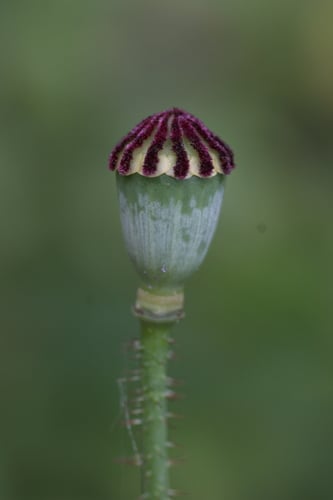
(c) Andreas Rockstein, some rights reserved (CC BY-SA)
iNaturalist· cc-by
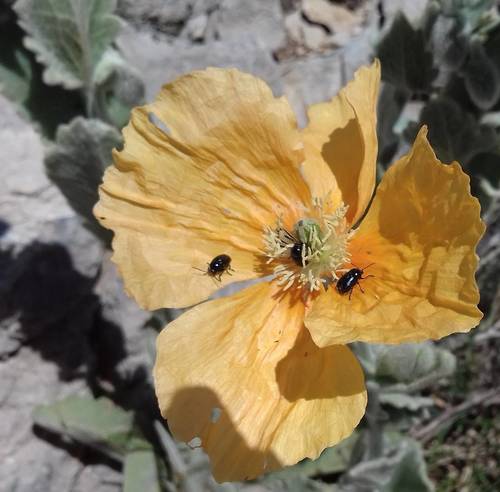
(c) Георгий Виноградов (Georgy Vinogradov), some rights reserved (CC BY), uploaded by Георгий Виноградов (Georgy Vinogradov)
iNaturalist· cc-by
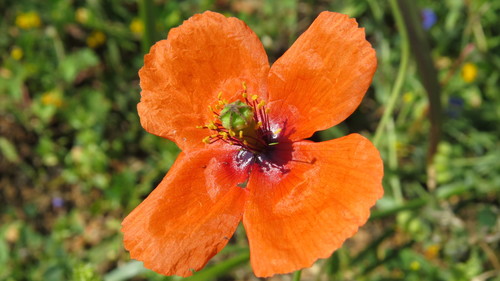
(c) Alexander Dubynin, some rights reserved (CC BY), uploaded by Alexander Dubynin
Summary
Source: WikipediaChelidonium majus, the greater celandine, is a perennial herbaceous flowering plant in the poppy family Papaveraceae. One of two species in the genus Chelidonium, it is native to Europe and western Asia and introduced widely in North America. The plant known as lesser celandine (Ficaria verna) is not closely related, as it belongs to the buttercup family Ranunculaceae.
Description
A small plant that grows for 2 or more years. It grows 90 cm high and spreads 50 cm wide. The stem is slender, smooth and swollen at the joints. It branches from the base. The leaf stems are brittle. The leaves have leaflets along the stalk. The end leaflet often has 3 lobes. The flowers are golden-yellow. They are 25 mm wide and have 4 petals. They are in loose clusters at the ends of the branches. The fruit are slender pod-like capsules. They are 5 cm long. The seeds are black and kidney shaped.
Edible Uses
The leaves can be eaten cooked, but only in small quantities due to their toxic alkaloid content. To prepare them, boil the leaves with clean earth, leave the mixture overnight, then wash thoroughly in several changes of water. This is very much a famine food, to be used only when nothing else is available. The seed contains 50–66% fatty oil, though no further details on its edible use are given.
Traditional Uses
CAUTION: The plant parts are poisonous and should only be used with caution. The leaves are thoroughly boiled with clean earth, allowed to stand overnight, then thoroughly washed in several changes of water and eaten with oil and salt.
Medicinal Uses
Greater celandine has a long history of herbal use. Traditionally it was applied as an ophthalmic to treat and improve eyesight; in modern herbal practice it serves more as a mild sedative, antispasmodic, and detoxifying herb that relaxes the muscles of the bronchial tubes, intestines, and other organs. Caution is essential, especially with internal use, due to the plant's toxic alkaloids. The leaves and sap are acrid, alterative, anodyne, antispasmodic, caustic, cholagogue, diaphoretic, diuretic, hydrogogue, narcotic, and purgative, and are used to treat bronchitis, whooping cough, asthma, jaundice, gallstones, and gallbladder pains. The plant is harvested in spring as it comes into flower and is best used fresh, though it can be dried for later use. Roots are harvested in autumn and dried. The plant has anticancer properties, is analgesic, and is an important component of a stomach ulcer drug. Its abundant acrid bright-orange sap stains skin strongly and is powerfully irritant; it is used externally to remove warts, ringworm, and corns, and has also been applied to remove films from the cornea of the eye. The plant contains the alkaloid chelidonine, which is similar to papaverine found in poppies and has antispasmodic and sedative effects on the bile ducts and bronchi, though results have been inconsistent, particularly with preparations that are not fresh. It also contains sparteine, which can restore normal rhythm to feeble arrhythmic myocardia. The German Commission E Monographs approve Chelidonium majus for liver and gallbladder complaints.
Known Hazards
The whole plant is poisonous. It is of very low toxicity and this is greatly reduced by drying the plant. The stem juice is highly irritating and allergenic, it may cause paralysis. Large doses cause sleepiness, skin irritation, respiratory tract irritation, violent coughing and dyspnoea. It also stains the urine bright yellow and may cause ulcers. May cause burning sensation in the mouth, nausea and vomiting. Avoid contact with eyes. Concerns of liver toxicity so avoid in those with liver disease. Not recommended during pregnancy and for children under 12.
Distribution
It is a temperate plant. It can grow in a range of soil types. It can grow in shade. It does best in rich moist soils and a sunny position. It is resistant to drought and frost. It suits hardiness zones 6-9. Hobart Botanical Gardens 1. In Sichuan and Yunnan.
Where It Grows
Africa, Andorra, Argentina, Asia, Australia, Austria, Balkans, Belarus, Britain, Canada, Central America, China, Estonia, Europe*, Finland, Germany, Guatemala, Ireland, Italy, Japan, Korea, Lithuania, Luxembourg, Macedonia, Mediterranean, Mongolia, Morocco, North Africa, North America, Norway, Russia, Scandinavia, Slovenia, South America, Spain, Switzerland, Tasmania, Turkey, Türkiye, Uruguay, USA,
Cultivation
Succeeds in any soil other than boggy conditions. Prefers a rich soil of a woodland nature. Shade tolerant. Plants grow well on walls if they are given a semi-shaded position and a pocket of soil into which to root. A short-lived perennial, but it self-sows freely and can easily become a weed. It quickly colonizes waste ground and thin woodland areas. Once established, the plant is very difficult to eradicate.
Propagation
Sow seed in situ from February to May or from August to November. Germination usually occurs within 1–12 months. The plant self-sows freely and generally needs little encouragement. Division can be done in March, though it is not recommended as the plant bleeds profusely when divided.
Other Uses
Plants rapidly form a ground cover but should only be used in wild places due to their invasive nature. The seed contains 50–66% fatty oil, though no further details are provided.
Notes
Probably as medicine only. It has proven anticancer properties There is only one Chelidonium species.
Synonyms
Also Known As
Erba di verouye, Kirlangicotu, Krvavi mlečnik, Swallow Wort
References (15)
- Abbet, C., et al, 2014, Ethnobotanical survey on wild alpine food plants in Lower and Central Valais (Switzerland). Journal of Ethnopharmacology 151 (2014) 624–634
- Bodkin, F., 1991, Encyclopedia Botanica. Cornstalk publishing, p 248
- Bremness, L., 1994, Herbs. Collins Eyewitness Handbooks. Harper Collins. p 239
- Brickell, C. (Ed.), 1999, The Royal Horticultural Society A-Z Encyclopedia of Garden Plants. Convent Garden Books. p 256
- Cundall, P., (ed.), 2004, Gardening Australia: flora: the gardener's bible. ABC Books. p 369
Show all 15 references Hide references
- Ertug, F, Yenen Bitkiler. Resimli Türkiye Florası -I- Flora of Turkey - Ethnobotany supplement
- Hedrick, U.P., 1919, (Ed.), Sturtevant's edible plants of the world. p 184 (As Chelidonium sinense)
- Hibbert, M., 2002, The Aussie Plant Finder 2002, Florilegium. p 66
- Irving, M., 2009, The Forager Handbook, A Guide to the Edible Plants of Britain. Ebury Press p 252 (Poisonous)
- Kintzios, S. E., 2006, Terrestrial Plant-Derived Anticancer Agents and Plant Species Used in Anticancer research Critical Reviews in Plant Sciences. 25: pp 79-113
- Pieroni, A.,& Giusti, M. E., 2009, Alpine Ethnobotany in Italy: Journal of Ethnobiology and Ethnomedicine. 5:32
- Plants for a Future database, The Field, Penpol, Lostwithiel, Cornwall, PL22 0NG, UK. http://www.scs.leeds.ac.uk/pfaf/
- READ,
- Sp. pl. 1:505. 1753
- Urgamal, M., Oyuntsetseg, B., Nyambayar, D. & Dulamsuren, Ch. 2014. Conspectus of the vascular plants of Mongolia. (Editors: Sanchir, Ch. & Jamsran, Ts.). Ulaanbaatar, Mongolia. “Admon“ Press. 334pp. (p. 79-90).