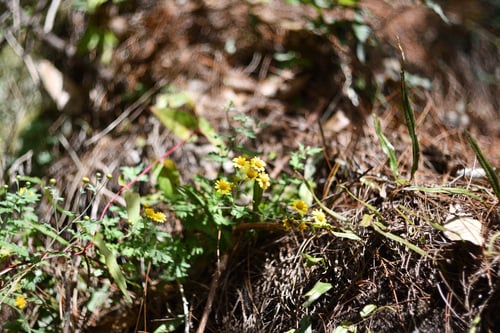
Anthemis nobilis
(L.) All.
Common Chamomile, Roman chamomile
iNaturalist· cc-by-nc
(c) georgetelehin, some rights reserved (CC BY-NC)
iNaturalist· cc-by-nc
(c) georgetelehin, some rights reserved (CC BY-NC)
iNaturalist· cc-by-nc
(c) georgetelehin, some rights reserved (CC BY-NC)
Description
A herb. It keeps growing from year to year. It grows 10-30 cm high and spreads 30 cm wide. It has a creeping stem which is much branched. The leaves are divided and downy. They are feathery. They have a scent. The flower heads occur singly. There are white ray florets and yellow disk florets. The base of the flower head is solid and this enables it to be distinguished from German chamomile (Matricaria recutita).
Edible Uses
The fresh or dried leaves are brewed as tea. The flower heads are harvested, dried, and steam-distilled to extract essential oil used to flavor liqueurs and herbal teas.
Traditional Uses
The oil is used to flavour liqueurs. The fresh or dried leaves are drunk as a tea. The flower heads are harvested and dried and the essential oil extracted by steam distillation. This oil is used to flavour liqueurs and herbal teas. CAUTION: It should be used only in small amounts as a flavouring agent.
Medicinal Uses
The essential oil extracted from flower heads has traditional uses in herbal preparations.
Known Hazards
Should be used only in small amounts as a flavoring agent.
Distribution
It is a temperate plant. It is drought resistant. It needs full sun. It suits hardiness zones 4-10. Tasmania Herbarium.
Where It Grows
Africa, Algeria, Asia, Australia, Argentina, Britain, Europe, France, Germany, India, Ireland, Italy, Lebanon, Mediterranean, Middle East, Morocco, New Zealand, North Africa, North America, Pakistan, Portugal, Portugal, Slovenia, Spain, Tasmania, USA,
Cultivation
It is grown from seed or rooted sections.
Notes
There are 4 Chamaemelum species.
Synonyms
Also Known As
English chamomile, Garden chamomile, Noble chamomile, Rimska divja kamilica, Russian chamomile
References (25)
- Ambasta S.P. (Ed.), 2000, The Useful Plants of India. CSIR India. p 44 (As Anthemis nobilis)
- Bircher, A. G. & Bircher, W. H., 2000, Encyclopedia of Fruit Trees and Edible Flowering Plants in Egypt and the Subtropics. AUC Press. p 33
- Blamey, M and Grey-Wilson, C., 2005, Wild flowers of the Mediterranean. A & C Black London. p 443
- Bodkin, F., 1991, Encyclopedia Botanica. Cornstalk publishing, p 88 (As Anthemis nobilis)
- Bremness, L., 1994, Herbs. Collins Eyewitness Handbooks. Harper Collins. p 159
Show all 25 references Hide references
- Brickell, C. (Ed.), 1999, The Royal Horticultural Society A-Z Encyclopedia of Garden Plants. Convent Garden Books. p 255
- Brown, D., 2002, The Royal Horticultural Society encyclopedia of Herbs and their uses. DK Books. p 164
- Burnie, G & Fenton-Smith, J., 1999, A Grower's Guide to Herbs. Murdoch Books. p 21
- Cheifetz, A., (ed), 1999, 500 popular vegetables, herbs, fruits and nuts for Australian Gardeners. Random House p 121
- Cundall, P., (ed.), 2004, Gardening Australia: flora: the gardener's bible. ABC Books. p 367
- Curtis, W.M., 1963, The Students Flora of Tasmania Vol 2 p 352 (As Anthemis nobilis)
- Esperanca, M. J., 1988. Surviving in the wild. A glance at the wild plants and their uses. Vol. 2. p 321
- Facciola, S., 1998, Cornucopia 2: a Source Book of Edible Plants. Kampong Publications, p 35
- Flora of Pakistan.
- Fl. pedem. 1:185. 1785
- Hedrick, U.P., 1919, (Ed.), Sturtevant's edible plants of the world. p 59 (As Anthemis nobilis)
- Hibbert, M., 2002, The Aussie Plant Finder 2002, Florilegium. p 65
- Huxley, A. (Ed.), 1977, The Encyclopedia of the Plant Kingdom. Chartweil Books. p 154
- Kiple, K.F. & Ornelas, K.C., (eds), 2000, The Cambridge World History of Food. CUP p 1890 (As Anthemis nobilis)
- Mabey, R., 1973, Food for Free. A Guide to the edible wild plants of Britain, Collins. p 157
- Michael, P., 2007, Edible Wild Plants and Herbs. Grub Street. London. p 56
- Morley, B. & Everard, B., 1970, Wild Flowers of the World. Ebury press. Plate 40
- Skinner, G. & Brown, C., 1981, Simply Living. A gatherer's guide to New Zealand's fields, forests and shores. Reed. p 43 (As Anthemis nobilis)
- Tasmanian Herbarium Vascular Plants list p 6
- van Wyk, B., 2005, Food Plants of the World. An illustrated guide. Timber press. p 128