Cetraria islandica
(Linn.) Acharius
Consumption moss, Iceland Moss, Lichen
iNaturalist· cc-by-nc
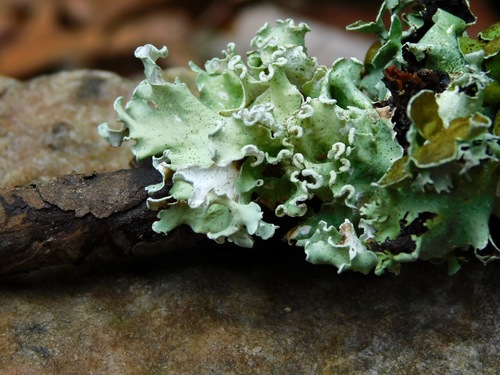
(c) Juha Kinnunen, some rights reserved (CC BY-NC), uploaded by Juha Kinnunen
iNaturalist· cc-by-nc
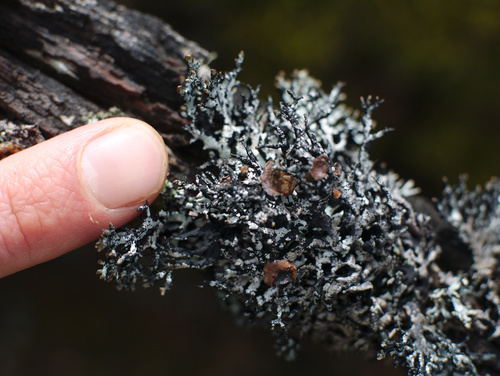
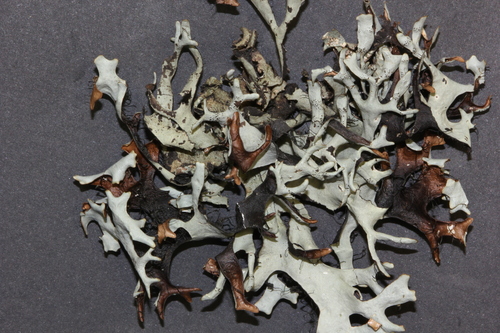
(c) seanbasquill, some rights reserved (CC BY-NC)
iNaturalist· cc-by-nc
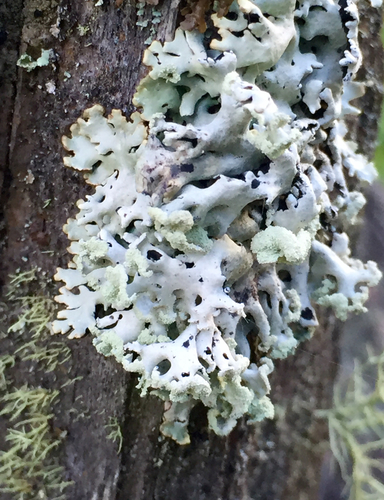
(c) seanbasquill, some rights reserved (CC BY-NC)
Summary
Source: WikipediaCetraria islandica, also known as true Iceland lichen or Iceland moss, is an Arctic-alpine lichen whose erect or upright, leaflike habit gives it the appearance of a moss, where its name likely comes from.
Description
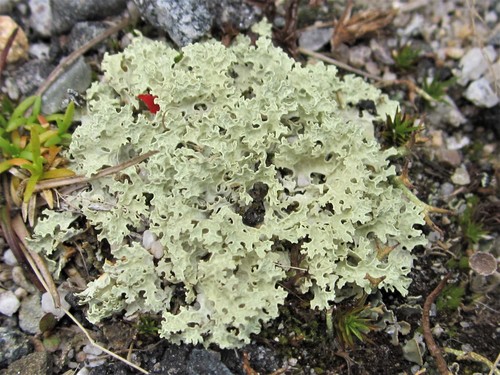
A lichen. It grows 2-6 cm high and spreads widely. The thallus lobes are brown and erect. The branches are leathery and crinkled. There are an very small projections along the edges of the branches.
Edible Uses
A nutritious and medicinal jelly is made by boiling the whole plant. The raw plant is quite bitter and requires leaching, achieved by changing the cooking water once or twice during cooking. The dried, powdered plant can be mixed with wheat flour for making bread, though the bitterness and the time-consuming leaching process make this impractical.
Traditional Uses
The thallus lobes are boiled and dried and ground into powder and used in baking a kind of bread. They need to be boiled to remove the bitter principle. The jelly like material is used for puddings and soups. They are mixed with cereals and mashed potatoes. They are also used for tea like drinks.
Medicinal Uses
Iceland moss has been used since ancient times as a cough remedy and in European folk medicine as a cancer treatment. In modern herbalism it is valued for its strongly antibiotic and demulcent properties, particularly for soothing the mucous membranes of the chest, countering catarrh, and calming dry and paroxysmal coughs — it is especially helpful for elderly people. It has a near-unique combination of demulcent and bitter tonic effects within the gut. The whole plant is strongly antibiotic, antiemetic, demulcent, galactogogue, nutritive, and tonic. It is used internally for chronic pulmonary problems, catarrh, dysentery, chronic digestive disturbances (including irritable bowel syndrome and food poisoning), and advanced tuberculosis. Externally it treats boils, vaginal discharges, and impetigo. The plant can be harvested throughout the year, preferably in dry weather, and dried for later use. Use with caution. The German Commission E Monographs approve Cetraria islandica for coughs and bronchitis, dyspepsia, inflammation of the mouth and pharynx, and loss of appetite.
Known Hazards
Indigestion and nausea with large doses. Rare liver damage. Herb bitterness possible in breast milk.
Distribution
It is a cold temperate plant. It grows on heather moors in northern regions. It is hardy to frosts. It suits stony barren cool areas. It can tolerate droughts.
Where It Grows
Alaska, Arctic, Australia, Austria, Balkans, Britain*, Canada, Czech Republic, Estonia, Europe, Finland, Iceland, India, Italy, Lithuania, Macedonia, Mediterranean, New Zealand, North America, Norway, Russia, Scandinavia, Sweden, Switzerland, USA,
Cultivation
There is no known information on the cultivation of this plant. It requires clean air and is very intolerant of atmospheric pollution so cannot be grown in towns. See the plants native habitat above for ideas on how it can be encouraged to grow. This species is a lichen, which is actually a symbiotic association of two different species, one an algae and the other a fungus. It is very slow-growing. This plant is often used in commercially produced disinfectants.
Propagation
This plant can only be reproduced vegetatively. Almost any portion of the plant can be separated and placed in a new location to produce a new plant.
Other Uses
A powerful antibiotic extracted from the plant is used as a core ingredient in a range of commercially produced disinfectants. A brown dye is also obtained from the plant.
Notes
There are about 40 Cetraria species. The plant is becoming rare.
Also Known As
Gratacoul, Islandi sammal, Liivasamblad, Mokh, Moura della yed, Nommesammal, Podrasammal, Puklerka islandska
References (24)
- Abbet, C., et al, 2014, Ethnobotanical survey on wild alpine food plants in Lower and Central Valais (Switzerland). Journal of Ethnopharmacology 151 (2014) 624–634
- Ambasta, S.P. (Ed.), 2000, The Useful Plants of India. CSIR India. p 118
- Beckstrom-Sternberg, Stephen M., and James A. Duke. "The Foodplant Database." http://probe.nalusda.gov:8300/cgi-bin/browse/foodplantdb.(ACEDB version 4.0 - data version July 1994)
- Bodkin, F., 1991, Encyclopedia Botanica. Cornstalk publishing, p 243
- Brown, D., 2002, The Royal Horticultural Society encyclopedia of Herbs and their uses. DK Books. p 163
Show all 24 references Hide references
- Christanell, A., et al, 2010, The Cultural Significance of Wild Gathered Plant Species in Kartitsch (Eastern Tyrol, Austria) and the Influence of Socioeconomic Changes on Local Gathering Practices. Chapter 3 in Ethnobotany in the New Europe. Berghahn Books.
- Crowe, A., 1997, A Field Guide to the Native Edible Plants of New Zealand. Penguin. p 164
- Etkin, N.L. (Ed.), 1994, Eating on the Wild Side, Univ. of Arizona. p 69
- Facciola, S., 1998, Cornucopia 2: a Source Book of Edible Plants. Kampong Publications, p 253
- Harter, J.(Ed.), 1988, Plants. 2400 copyright free illustrations. Dover p 6.17
- Hedrick, U.P., 1919, (Ed.), Sturtevant's edible plants of the world. p 182
- Heller, C. A., 1962, Wild Edible and Poisonous Plants of Alaska. Univ. of Alaska Extension Service. p 69
- Kalle, R. & Soukand, R., 2012, Historical ethnobotanical review of wild edible plants of Estonia (1770s-1960s) Acta Societatis Botanicorum Poloniae 81(4):271-281
- Kiple, K.F. & Ornelas, K.C., (eds), 2000, The Cambridge World History of Food. CUP p 1788
- Kolosova, V., et al, 2020, Foraging in Boreal Forest: Wild Food Plants of the Republic of Karelia, NW Russia. Foods 2020, 9, 1015; p 35
- Mabey, R., 1973, Food for Free. A Guide to the edible wild plants of Britain, Collins. p 120
- Pieroni, A.,& Giusti, M. E., 2009, Alpine Ethnobotany in Italy: Journal of Ethnobiology and Ethnomedicine. 5:32
- Plants for a Future database, The Field, Penpol, Lostwithiel, Cornwall, PL22 0NG, UK. http://www.scs.leeds.ac.uk/pfaf/
- Simkova, K. et al, 2014, Ethnobotanical review of wild edible plants used in the Czech Republic. Journal of Applied Botany and Food Quality 88, 49-67
- Svanberg, I., et al, 2012, Edible wild plant use in the Faroe Islands and Iceland. Acta Societatis Botanicorum Poloniae 81(4): 233-238
- Tozer, F., 2007, The Uses of Wild Plants. Green Man Publishing. p 63
- Whitney, C. W., et al, 2012, A Survey of Wild Collection and Cultivation of Indigenous Species in Iceland. Human Ecology 40:781-787
- www.lichen.com/usetype.html
- Yanovsky, E., 1936, Food Plants of the North American Indians. United States Department of Agriculture Miscellaneous Publication No 237. Washington, D.C. p 3