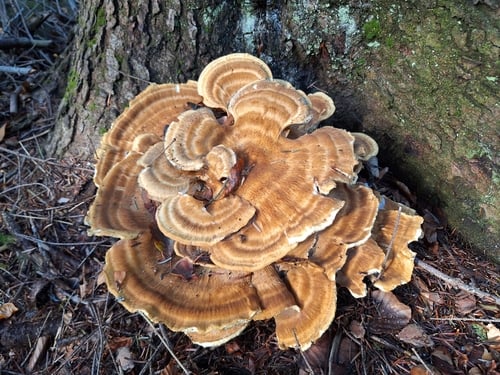
Bondarzewia berkeleyi
(Fr.) Bond. & Singer
Berkeleyi's polypore
iNaturalist· cc-by-nc
(c) Jack Steven Smith, some rights reserved (CC BY-NC), uploaded by Jack Steven Smith
iNaturalist· cc-by-nc
(c) Carlene Cliver, some rights reserved (CC BY-NC)
Summary
Source: WikipediaBondarzewia berkeleyi, commonly known as Berkeley's polypore, or stump blossoms, is a species of polypore fungus in the family Russulaceae. It is a parasitic species that causes butt rot in oaks and other hardwood trees. A widespread fungus, it is found in the Old World and North America.
Description
A mushroom in the family Bondarzewiaceae that grows on the ground in woods and forests.
This description is brief — help expand it
Edible Uses
The mushroom fungus is edible.
Distribution
It grows on the ground in woods and forests.
Where It Grows
Africa, Asia, Central Africa, Congo, Himalayas, Nepal, North America, Papua New Guinea, PNG,
Synonyms
Also Known As
Chamre, Huwsez
References (3)
- Boa, E. R., 2004, Wild edible fungi and their importance to people. FAO Non Wood Forest Products Booklet 17
- Christensen, M., et al, 2008, Collection and Use of Wild Edible Fungi in Nepal. Economic Botany, 62(1), 2008, pp. 12–23
- Rijal, A., 2011, Surviving on Knowledge: Ethnobotany of Chepang community from mid-hills of Nepal. Ethnobotany Research & Applications 9:181-215