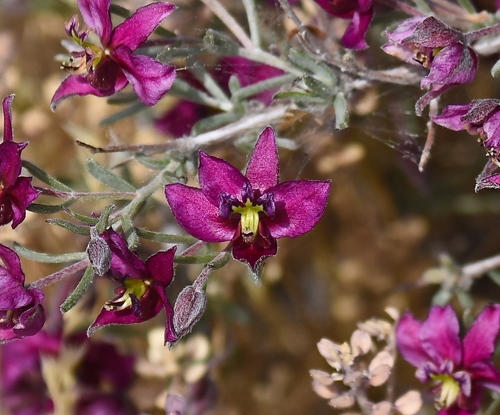
Krameria lappacea
(Dombey) Burdet & B. B. Simpson
Peruvian rhatany
iNaturalist· cc-by-nc
(c) Manuel Roncal, some rights reserved (CC BY-NC), uploaded by Manuel Roncal
iNaturalist· cc-by
(c) Matt Berger, some rights reserved (CC BY), uploaded by Matt Berger
Summary
Source: WikipediaKrameria lappacea, commonly known as para rhatany and Peruvian rhatany, is a plant species in the genus Krameria, native to Ecuador, Peru, Bolivia, northern Chile and northwest Argentina. It is a slow-growing shrub that grows in semi-arid areas of the Andean region. The Latin specific epithet of lappacea is derived from lappa meaning with burrs.
Description
A subtropical shrub with red flowers, native to Argentina where it grows between 300-4,500 m above sea level.
This description is brief — help expand it
Edible Uses
The root is used as a flavoring and spice, particularly in liqueurs.
Traditional Uses
The root is used as a spice for liqueurs.
This uses section is brief — help expand it
Medicinal Uses
Rhatany root is a strongly astringent, antimicrobial and tonic herb that checks bleeding; controls discharges and diarrhoea; and encourages healing. It is particularly valued for treating problems relating to the gastro-intestinal tract, especially diarrhoea and dysentery. It is also taken internally to treat haemorrhage and excessive menstruation. Externally, the root is used as a wash, or in the form of a suppository or ointment, to treat vaginal discharge, haemorrhoids, chilblains, wounds, varicose veins and areas of capillary fragility that are prone to easy bruising. It makes a good mouthwash and gargle for treating bleeding and infected gums, mouth ulcers and sore throats. The root contains 10 - 20% tannins.
Distribution
It is a subtropical plant. In Argentina it grows between 300-4,500 m above sea level.
Where It Grows
Andes, Argentina, Bolivia, Chile, Peru, South America*,
Cultivation
A plant of moderate elevations in the tropics, where it can be found from 900 - 3,000 metres. Prefers a well-drained, sandy or stony soil and a sunny position.
Other Uses
The root is used as a tooth preservative. It is powdered and added to proprietary mixes for oral hygiene. The root contains 10 - 20% condensed tannins. A red pigment is present in the root.
Synonyms
References (3)
- Seidemann J., 2005, World Spice Plants. Economic Usage, Botany, Taxonomy. Springer. p 193
- Thomas, E., et al, 2008, The Relationship Between Plant Use and Plant Diversity in the Bolivian Andes, with Special Reference to Medicinal Plant Use. Hum Ecol (2008) 36:861–879
- Thomas, E., et al, 2009, The relation between accessibility, diversity and indigenous valuation of vegetation in the Bolivian Andes. Journal of Arid Environments. 73:854-861