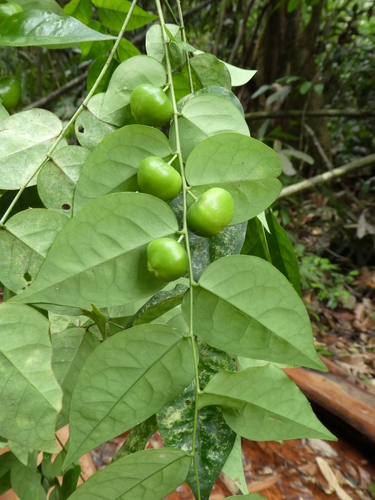
Glochidion zeylanicum
(Gaertn.) A. Juss.
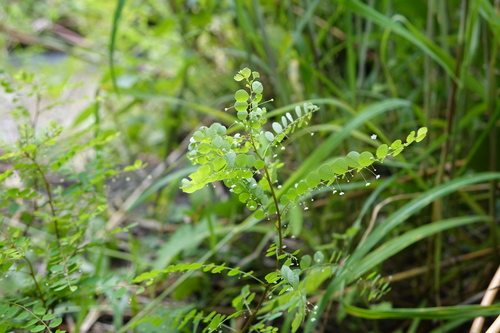
iNaturalist· cc-by-nc
(c) Nakatada Wachi, some rights reserved (CC BY-NC)
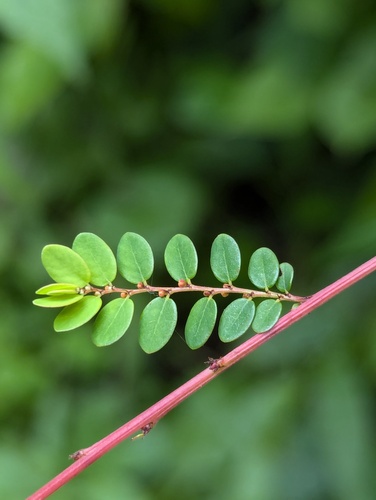
iNaturalist· cc-by-nc
(c) Nicola Newbery, some rights reserved (CC BY-NC), uploaded by Nicola Newbery
Summary
Source: WikipediaGlochidion zeylanicum is a species of flowering plant in the family Phyllanthaceae. It is a shrub or tree which ranges from the Indian subcontinent through Indochina, southern China, Taiwan, Japan, Malesia, and Papuasia to northern Australia and Vanuatu. The species was first described as Diasperus zeylanicus by Joseph Gaertner in 1791. In 1824 Adrien-Henri de Jussieu placed it in genus Glochidion as Glochidion zeylanicum. The species has a wide distribution and a large population. The IUCN assesses its conservation status as least concern.
Description
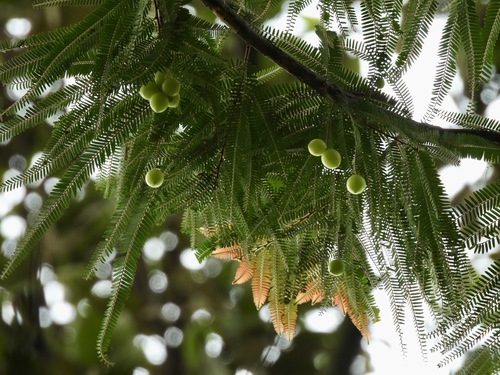
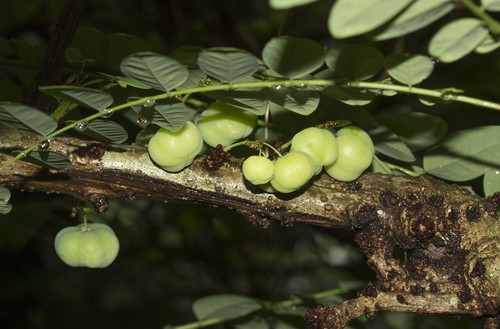
A shrub or small tree. It grows 1-6 m tall. The leaves are oval and 6-18 cm long by 4-8 cm wide. They are leathery. The flowers are in small branched groups The male flowers are in the lower part and female flowers higher up. The flowers are in the axils of leaves and are yellowish-green. The fruit is a capsule 8-10 mm long by 5 mm wide. There are 8-12 lobes. The seeds are red and half round.
Edible Uses
The young leaves and fruit are eaten.
Traditional Uses
The young leaves are eaten.
This uses section is brief — help expand it
Medicinal Uses
The roots are used as medicine for coughs and pneumonia. The leaves are astringent. The stem and leaves are used for treating abdominal pain, toothaches and traumatic injury. Applied externally, the leaves are used in the treatment of itches, scabies. The fruits are cooling and restorative. The bark is stomachic.
Distribution
It is a tropical plant. It grows in mountains and on the edge of forests. It grows between 100-600 m above sea level.
Where It Grows
Andamans, Asia, Bangladesh, India, Indochina, Indonesia, Japan, Laos, Pacific, SE Asia, Solomon Islands, Sri Lanka, Thailand, Vietnam,
Cultivation
Plants can be grown by seeds.
Other Uses
The bark contains up to 6.4% tannin. The tree produces a useful, general-purpose timber. (As Glochidion sumatranum)
Synonyms
Also Known As
Man pu, Siloni kachua
References (5)
- Dobriyal, M. J. R. & Dobriyal, R., 2014, Non Wood Forest Produce an Option for Ethnic Food and Nutritional Security in India. Int. J. of Usuf. Mngt. 15(1):17-37
- Nakahara, K. et al, 2002, Antimutagenicity of Some Edible Thai Plants, and a Biocative Carbazole Alkaloid, Mahanine, Isolated from Micromelum minutum. Journal of Agricultural and Food Chemistry. 50: 4796-4892 (As Glochidion perakense)
- Pasha, M. K. & Uddin, S. B., 2019, Minor Edible Fruits of Bangladesh. Bangladesh J. Plant Taxon. 26(2): 299–313
- Sukarya, D. G., (Ed.) 2013, 3,500 Plant Species of the Botanic Gardens of Indonesia. LIPI p 307
- Thoa P. T. K., et al, 2013, Biodiversity indices and utilization of edible wild plants: a case study of the Cham Island in Quang Nam Province, Vietnam. Journal of Research in Environmental Science and Toxicology 2(9) :167-174