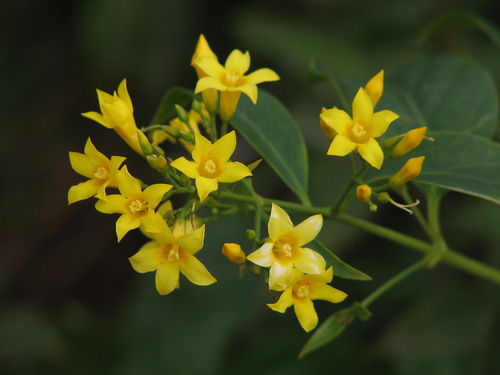
Mostuea hirsuta
(T. Anderson ex Benth.) Baill. ex Baker
iNaturalist· cc-by-nc
(c) Bart Wursten, some rights reserved (CC BY-NC), uploaded by Bart Wursten
iNaturalist· cc-by-nc
(c) Bart Wursten, some rights reserved (CC BY-NC)
Description
A small tropical shrub growing to about 1 m high, found in forests and woodlands in the Gelsemiaceae family.
This description is brief — help expand it
Edible Uses
The root is eaten.
Medicinal Uses
Mostuea hirsuta is taken as an analgesic. The ground young leaves are used as a dressing to treat initial stages of leprosy. The leaf pulp is massaged on painful areas caused by pulmonary infections, abdominal pains and umbilical hernia in infants. The leaf sap is applied to treat pain caused by caries. A root infusion is taken to treat colds. A root infusion is taken to treat rheumatism. The grated roots are used to dispel sleep or as an aphrodisiac with similar action to that of Tabernanthe iboga. It is consumed alone or mixed with Tabernanthe iboga; extended use may lead to cerebral troubles. The leaf or root sap is taken to treat pain. Mostuea hirsuta contains indole alkaloids, probably sempervirin and gelsemine or closely related compounds. Extracts of the plant have analgesic properties, lower heart action and stimulate respiration in low dosage; high dosage can cause death by paralysis of respiration.
Known Hazards
The roots are used as an ingredient of arrow poison.
Distribution
It is a tropical plant. It grows in forest and woodland.
Where It Grows
Africa, Central Africa, Central African Republic, CAR, Congo DR, Gabon, Guinea, Guinée, Guinea-Bissau, West Africa,
Cultivation
The plant is resistant to bush fires.
Other Uses
The branches are used as brooms.
Notes
Also put in the family Loganiaceae.
Synonyms
Also Known As
Isala
References (2)
- Jardin, C., 1970, List of Foods Used In Africa, FAO Nutrition Information Document Series No 2.p 90 (As Mostuea angolana)
- Liengola, I. B., 2001, A contribution to the study of native edible plants by the Turumbu and Lokele of the Tshopo District, Province Orientale, D. R. Congo. Syst. Geogr. Pl. 71:687-698