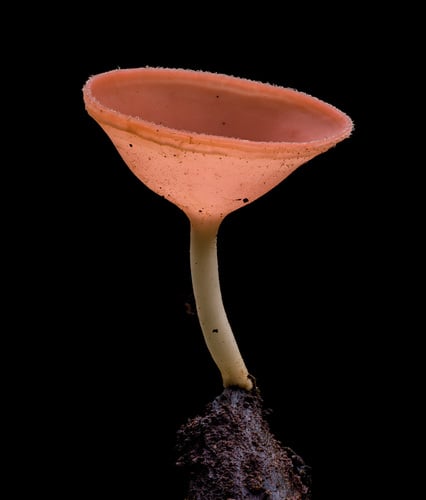
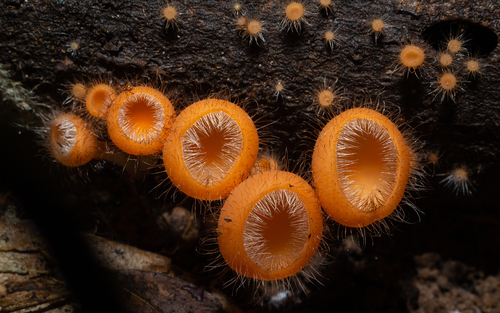
Cookeina sulcipes
(Berk.) Kuntze
iNaturalist· cc-by-nc-sa
(c) Rich Hoyer, some rights reserved (CC BY-NC-SA), uploaded by Rich Hoyer
iNaturalist· cc-by-nc
(c) Edith Belén Jiménez Díaz, some rights reserved (CC BY-NC), uploaded by Edith Belén Jiménez Díaz
Summary
Source: WikipediaCookeina sulcipes is a species of cup fungus in the family Sarcoscyphaceae. First described in 1842 by Miles Joseph Berkeley as a species of Peziza, it was transferred to the genus Cookeina by Otto Kuntze in 1891.
Description
A mushroom.
This description is brief — help expand it
Distribution
It is a tropical plant.
Where It Grows
Africa, Asia, Cameroon, Central Africa, Congo, India, Malaysia, SE Asia,
Also Known As
Kulat mangkuk, Tolong
References (5)
- Abdullah, F. & Rusea, G., 2009, Documentation of inherited knowledge on wild edible fungi from Malaysia. Blumea 54, 35-38
- Boa, E. R., 2004, Wild edible fungi and their importance to people. FAO Non Wood Forest Products Booklet 17
- See, L. S., et al, 2008, Utilization of Macrofungi by some Indigenous Communities for Food and Medicine in Peninsular Malaysia. Sustainable Forest Management and Poverty Alleviation: Roles of Traditional Forest-related Knowledge IUFRO World Series Volume 21
- Thatoi, H. & Singdevsachan, S. K., 2014, Diversity, nutritional composition and medicinal potential of Indian mushrooms: A review. African Journal of Biotechnology 13(4): 523-545
- van Dijk, H., et al, 2003, Knowledge and Utilization of Edible Mushrooms by Local Populations of the Rain Forest of South Cameroon. Ambio Vol. 32, No. 1.pp 19-23