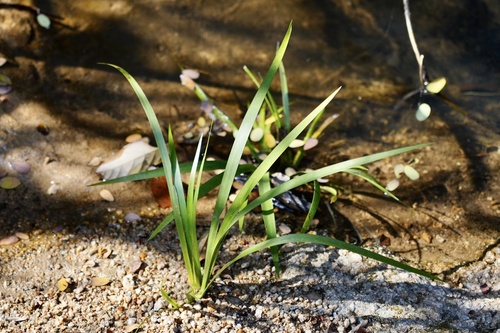
Acorus calamus
L.
Calamus, Sweet flag
iNaturalist· cc-by-nc
(c) Eduard Garin, some rights reserved (CC BY-NC), uploaded by Eduard Garin
iNaturalist· cc-by-nc
(c) Jim, some rights reserved (CC BY-NC), uploaded by Jim
iNaturalist· cc-by-nc
(c) sariai, some rights reserved (CC BY-NC), uploaded by sariai
Summary
Source: WikipediaAcorus calamus (also called sweet flag, sway or muskrat root, among many other common names) is a species of flowering plant with psychoactive chemicals. It is a tall wetland monocot of the family Acoraceae, in the genus Acorus. Although used in traditional medicine over centuries to treat digestive disorders and pain, it has no clinical evidence of safety or efficacy and may be toxic if ingested, and so has been commercially banned for use in food in the United States.
Description
A shrub or small tree. It grows 5 m tall. There are prickles along the stem. The leaves are twice divided and there are 8-18 pairs of pinnae. There are up to 50 pairs of pinnules on each pinnae. The flowers are yellow. They are in large clusters at the ends of branches. The pods are flattened.
Edible Uses
The rhizome can be candied into a sweetmeat, peeled and washed to reduce bitterness and eaten raw like a fruit, roasted as a vegetable, or used as a flavouring. It is rich in starch and contains about 1% essential oil used in food flavouring, as well as a bitter glycoside. The dried, powdered rhizome has a spicy flavour and substitutes for ginger, cinnamon, and nutmeg; a pinch can flavour tea. Young leaves are cooked and can also flavour custards in the same way as vanilla pods — the fresh leaves contain 0.078% oxalic acid. The inner portion of young stems is eaten raw and makes a palatable salad. The young, tender inflorescence is often eaten by children for its sweetness. Some caution is advised regarding toxicity.
Traditional Uses
The underground stems are ground and used to flavour food. They can be eaten raw. They have a gingery peppery taste. It should probably only be eaten sparingly with caution. They contain a bitter glucoside called acorin. The forms of Acorus in Asia contain a chemical called asarone which causes cancer. The centre of the above ground section can be eaten. The underground stem can be washed, peeled, chopped into 1 cm long pieces and cooked for 20 minutes with several changes of water then simmered for 20 minutes in sugar syrup to produce candy.
Medicinal Uses
Sweet flag has a long history of medicinal use across many traditions and is widely used today as an aromatic stimulant and mild tonic. In Ayurveda it is valued as a brain and nervous system rejuvenator and a remedy for digestive disorders, though some forms may be carcinogenic — see toxicity notes. The root is anodyne, aphrodisiac, aromatic, carminative, diaphoretic, emmenagogue, expectorant, febrifuge, hallucinogenic, hypotensive, sedative, stimulant, stomachic, mildly tonic, and vermifuge. Internally it treats digestive complaints, bronchitis, and sinusitis, and is said to stimulate and normalize appetite. In small doses it reduces stomach acidity; larger doses increase stomach secretions, making it useful in treating anorexia nervosa — though excessive doses cause nausea and vomiting. Externally it treats skin eruptions, rheumatic pains, and neuralgia. An infusion of the root can induce abortion, and chewing the root relieves toothache and is said to kill the taste for tobacco. It is a folk remedy for arthritis, cancer, convulsions, diarrhoea, dyspepsia, and epilepsy. Roots 2–3 years old are preferred, as older roots become tough and hollow. They are harvested in late autumn or early spring and dried for later use — the dry root loses 70% of its weight but gains in smell and taste, though it deteriorates with prolonged storage. Caution is advised, especially with the distilled essential oil, as large doses can cause mild hallucinations. A homeopathic remedy made from the roots treats flatulence, dyspepsia, anorexia, and gall bladder disorders. Bath oils containing calamus have caused erythema and dermatitis, particularly in hypersensitive individuals.
Known Hazards
A. calamus and products derived from A. calamus (such as its oil) were banned from use as human food or as a food additive in 1968 by the United States Food and Drug Administration. Although limits on consumption in food or alcoholic beverages (115 micrograms per day) were recommended in a 2001 ruling by the European Commission, the degree of safe exposure remained undefined. Although calamus has been used for its fragrance and ingested, it has not been studied by rigorous clinical research. Individual medical reports of toxicity mention severe nausea and prolonged vomiting over many hours following oral uses. Laboratory studies of its extracts indicate other forms of toxicity, due mainly to the emetic compound β-asarone. Allegedly, the plant is psychoactive (hallucinogenic), but for example all experiments with American calamus have been completely unsuccessful, even those involving very high dosages (up to 300 g of rhizomes).
Distribution
Its natural range is the warm temperate regions of Iran and India. They are found throughout the Philippines both cultivated and wild, growing in swamps. In Papua New Guinea it grows from sea level to 2600 m altitude. It can tolerate frost but cannot tolerate drought. It normally occurs in ditches, swamps, and on the edges of lakes and streams. It grows in wetland. It grows best in water no deeper than 22 cm. Often the plant grows in dense pure stands. It is mostly in places with a temperature below 20°C. It suits hardiness zones 3-10.
Where It Grows
Afghanistan, Armenia, Asia, Australia, Austria, Balkans, Bangladesh, Belarus, Bhutan, Bosnia, Brazil, Britain, Canada, Caucasus, China, Czech Republic, Denmark, Egypt, Estonia, Europe, France, Germany, Himalayas, Hungary, India, Indochina, Indonesia, Iran, Ireland, Italy, Japan, Korea, Laos, Latvia, Lithuania, Luxembourg, Macedonia, Malaysia, Maldives, Mediterranean, Middle East, Mongolia, Myanmar, Nepal, Netherlands, New Zealand, North Africa, North America, Northeastern India, Pacific, Pakistan, Papua New Guinea, PNG, Philippines, Philippines, Poland, Russia, Scandinavia, SE Asia, Serbia, Siberia, Sikkim, Slovenia, South America, Spain, Sri Lanka, Sweden, Thailand, Turkey, Türkiye, Ukraine, USA, Vietnam, Yugoslavia,
Cultivation
Prefers growing in shallow water or in a very moist loamy soil. Requires a sunny position. Prefers a pH in the range 5.5 to 7.5. Plants are hardy to about -25°c. The sweet flag has a long history of use as a medicinal and culinary plant. It has been cultivated for this purpose but was more commonly allowed to naturalize and was then harvested from the wild. The plant seldom flowers or sets seed in Britain and never does so unless it is growing in water. It can spread quite freely at the roots however and soon becomes established. The rhizomes are typically harvested when the plant matures in late summer to autumn. Sweet Flag flowers from late spring to early summer. Sweet Flag is a moderate grower, establishing quickly in suitable moist environments and forming dense stands over time.
Propagation
Seed is best sown in a cold frame as soon as it is ripe, with the pot stood in about 3cm of water. Pot up seedlings as soon as they are large enough to handle, keep them wet by standing pots in shallow water, and overwinter in a greenhouse or cold frame during the first year. Seed is rarely produced in Britain. Division in spring just before growth begins is very easy and can be carried out successfully at any time during the growing season, planting directly into permanent positions.
Other Uses
The leaves are used in basket making, woven into mats, and have been used as roof thatch. The plant is used in wetland restoration and as a natural water filter in aquatic systems, where its dense growth provides wildlife habitat and improves soil stability. An essential oil from the rhizome is used in perfumery and food flavouring; it is concentrated mainly in the outer skin of the root and has a fragrance reminiscent of patchouli oil. Fresh roots yield about 1.5–3.5% essential oil; dried roots yield about 0.8%, while some Japanese plants have yielded 5%. The essential oil also acts as an insect repellent and insecticide, effective against houseflies. When added to rice in granaries it significantly reduces insect damage by sterilizing male rice weevils. An essential oil from the leaves is used in perfumery and for making aromatic vinegar. The leaves and root have a refreshing scent of cinnamon. All parts of the plant can be dried to repel insects or scent linen cupboards, burned as incense, or used as a strewing herb. The growing plant is said to repel mosquitoes. The dense foliage provides shelter for invertebrates and overwintering sites for beneficial insects. The aromatic rhizomes may help mask the scent of other plants and confuse some pests.
Production
Tender young stalks are harvested. The young underground stem needs to be separated from the roots and pulled or dug out.
Other Information
It is sold in local markets. It is not known if it is used for food in Papua New Guinea.
Notes
1% volatile oil; a bitter glucoside - acorin; There is only one genus in the Acoraceae. There are 2-4 Acorus species. It has a long history of use for perfume and medicine.
Synonyms
Also Known As
Airi, Ajer, Ajeras, Aleras, Ayer, Bach, Baghshtak, Baje gida, Bas, Boch, Bojho, Bos, Changpu, Flagroot, Fortunate bullrush, Huvagoh, Jagier, Jaringao, Jeringau, Kalmos, Kalmus, Khnkegheg, Lepiech, Lin-lay, Lin-ne, Lubigan, Myrtle flag, Pravi kolmež, Puskvorec obecny, Sweet cane, Sweet sedge, Tatarak. Vacha, Vasa, Vasambu, Vavambu, Vayambu, Vekhand, Wan nam
References (70)
- Ambasta S.P. (Ed.), 2000, The Useful Plants of India. CSIR India. p 11
- Aryal, K. P., et al, 2018, Diversity and use of wild and non-cultivated edible plants in the Western Himalaya. Journal of Ethnobiology and Ethnomedicine (2018) 14:10
- Baro, D., Baruah, S. and Borthukar, S. K. 2015, Documentation on wild vegetables of Baksa district, BTAD (Assam). Scholars Research Library. Archives of Applied Science Research, 2015, 7 (9):19-27
- Beckstrom-Sternberg, Stephen M., and James A. Duke. "The Foodplant Database." http://probe.nalusda.gov:8300/cgi-bin/browse/foodplantdb.(ACEDB version 4.0 - data version July 1994)
- Behera, K. K. et al, 2008, Wild Edible Plants of Mayurbhanj District, Orissa, India. J. Econ. Taxon. Bot. Vol. 32 (Suppl,) pp 305-314
Show all 70 references Hide references
- Bircher, A. G. & Bircher, W. H., 2000, Encyclopedia of Fruit Trees and Edible Flowering Plants in Egypt and the Subtropics. AUC Press. p 7
- Bodkin, F., 1991, Encyclopedia Botanica. Cornstalk publishing, p 46
- Borrell, O.W., 1989, An Annotated Checklist of the Flora of Kairiru Island, New Guinea. Marcellin College, Victoria Australia. p 14, 156
- Bremness, L., 1994, Herbs. Collins Eyewitness Handbooks. Harper Collins. p 137
- Brickell, C. (Ed.), 1999, The Royal Horticultural Society A-Z Encyclopedia of Garden Plants. Convent Garden Books. p 75
- Brouk, B., 1975, Plants Consumed by Man. Academic Press, London. p 285
- Brown, D., 2002, The Royal Horticultural Society encyclopedia of Herbs and their uses. DK Books. p 101
- Brown, W.H., 1920, Wild Food Plants of the Philippines. Bureau of Forestry Bulletin No. 21 Manila. p 30
- Burkill, I.H., 1966, A Dictionary of the Economic Products of the Malay Peninsula. Ministry of Agriculture and Cooperatives, Kuala Lumpur, Malaysia. Vol 1 (A-H) p 34
- Cundall, P., (ed.), 2004, Gardening Australia: flora: the gardener's bible. ABC Books. p 95
- Deka, N. & Devi, N., 2015, Wild edible aquatic and marshland angiosperms of Baka district, BTC area, Assam, India. Asian J. Plant Sci. Res. 5(1):32-48
- Denes, A., et al, 2012, Wild plants used for food by Hungarian ethnic groups living inthe Carpathian Basin. Acta Societatis Botanicorum Poloniae 81 (4): 381-396
- Duke, J.A., 1992, Handbook of Edible Weeds. CRC Press. p 18
- Elias, T.S. & Dykeman P.A., 1990, Edible Wild Plants. A North American Field guide. Sterling, New York p 133
- Esperanca, M. J., 1988. Surviving in the wild. A glance at the wild plants and their uses. Vol. 2. p 274
- Facciola, S., 1998, Cornucopia 2: a Source Book of Edible Plants. Kampong Publications, p 23
- Hani Medicine of Xishuangbanna, 1999, p 367
- Hedrick, U.P., 1919, (Ed.), Sturtevant's edible plants of the world. p 24
- Hemphill, I, 2002, Spice Notes. Macmillan. p 91
- Hepper, E.N., 1993, Illustrated Encyclopedia of Bible Plants, IVP, England. p 144
- Hossain, U. & Rahman, A., 2018, Study and quantitative analysis of wild vegetable floral diversity available in Barisal district, Bangladesh. Asian J. Med. Biol. Res. 2018, 4 (4), 362-371
- Huxley, A. (Ed.), 1977, The Encyclopedia of the Plant Kingdom. Chartweil Books. p 186
- Irving, M., 2009, The Forager Handbook, A Guide to the Edible Plants of Britain. Ebury Press p 315
- Johns, R.J. & Hay, A., 1976, Monocotyledons of Papua New Guinea. Part 1 , Forestry College Bulolo, PNG p 35
- Kalle, R. & Soukand, R., 2012, Historical ethnobotanical review of wild edible plants of Estonia (1770s-1960s) Acta Societatis Botanicorum Poloniae 81(4):271-281
- Khan, M. & Hussain, S., 2014, Diversity of wild edible plants and flowering phenology of district Poonch (J & K) in the northwest Himalaya. Indian Journal of Sci, Res. 9(1): 032-038
- Kiple, K.F. & Ornelas, K.C., (eds), 2000, The Cambridge World History of Food. CUP p 432, 1862
- Kybal, J., 1980, Herbs and Spices, A Hamlyn Colour Guide. p 16
- Leach, G.J., and Osborne, P.L., 1985, Freshwater Plants of Papua New Guinea. UPNG Press, p 86
- Lembaga Biologi Nasional, 1977, Ubi-Ubian, Balai Pustaka, Jakarta. p 22
- Lim, T. K., 2015, Edible Medicinal and Non Medicinal Plants. Volume 9, Modified Stems, Roots, Bulbs. Springer p 3
- Łukasz Łuczaj and Wojciech M Szymański, 2007, Wild vascular plants gathered for consumption in the Polish countryside: a review. J Ethnobiol Ethnomedicine. 3: 17
- Łuczaj, L., et al, 2013, Wild edible plants of Belarus: from Rostafiński’s questionnaire of 1883 to the present. Journal of Ethnobiology and Ethnomedicine 2013, 9:21
- Lukasz, L., 2016, Wild Edible Plants Traditionally Used in Poland.
- Manandhar, N.P., 2002, Plants and People of Nepal. Timber Press. Portland, Oregon. p 70
- Monsalud, M.R., Tongacan, A.L., Lopez, F.R., & Lagrimas, M.Q., 1966, Edible Wild Plants in Philippine Forests. Philippine Journal of Science. p 443
- Nanagulyan, S., et al, 2020, Wild plants and fungi sold in the markets of Yerevan (Armenia). Journal of Ethnobiology and Ethnomedicine 16:26
- Pagag, K. & Borthakur, S. K., 2012, Wild edible wetland plants from Lakhimpur district of Assam, India. Pleione 6(2): 322 - 327
- Peekel, P.G., 1984, (Translation E.E.Henty), Flora of the Bismarck Archipelago for Naturalists, Division of Botany, Lae, PNG. p 75, 74
- Peter, K. V. (Ed.), 2004, Handbook of Herbs and Spices Vol. 2 Woodhead Publishing and CRC Press. p
- Pieroni, A. & Soukand, R., 2018, Forest as Stronghold of Local Ecological Practice: Currently Used Wild Food Plants in Polesia, Northern Ukraine. Economic Botany, XX(X) pp. 1-21
- Plants for a Future database, The Field, Penpol, Lostwithiel, Cornwall, PL22 0NG, UK. http://www.scs.leeds.ac.uk/pfaf/
- Prakofjewa, J., et al, 2023, Boundaries Are Blurred: Wild Food Plant Knowledge Circulation across the Polish-Lithuanian-Belarusian Borderland. Biology 2023, 12, 571.
- PROSEA handbook Volume 13 Spices. p 273
- Pruse, B., et al, 2021, Active Wild Food Practices among Culturally Diverse Groups in the 21st Century across Latgale, Latvia. Biology 2021, 10, 551.
- Purseglove, J.W., 1972, Tropical Crops. Monocotyledons. Longmans p 60
- READ,
- Redzic, S. J., 2006, Wild Edible Plants and their Traditional Use in the Human Nutrition in Bosnia-Herzegovina. Ecology of Food and Nutrition, 45:189-232
- Romanowski, N., 2007, Edible Water Gardens. Hyland House. p 47
- Samy, J., Sugumaran, M., Lee, K. L. W., 2009, Herbs of Malaysia, Marshall Cavendish. p 32
- Samydurai, P., et al, 2012, Wild habits of Kolli Hills being staple food of inhabitant tribes of eastern Ghats, Tamil Nadu, India. Indian Journal of Natural Products and Resources. 3(3) September 2012 pp 432-437
- Seidemann J., 2005, World Spice Plants. Economic Usage, Botany, Taxonomy. Springer. p 5
- Shikov, A. N. et al, 2017, Traditional and Current Food Use of Wild Plants Listed in the Russian Pharmacopoeia. Frontiers in Pharmacology. Vol. 8 Article 841
- Simkova, K. et al, 2014, Ethnobotanical review of wild edible plants used in the Czech Republic. Journal of Applied Botany and Food Quality 88, 49-67
- Slocum, P.D. & Robinson, P., 1999, Water Gardening. Water Lilies and Lotuses. Timber Press. p 90
- Soukand, R., et al, 2017, Multi-functionality of the few: current and past uses of wild plants for food and healing in Liubań region, Belarus. Journal of Ethnobiology and Ethnomedicine (2017) 13:10
- Sp. pl. 1:324. 1753
- Swapna, M. M. et al, 2011, A review on the medicinal and edible aspects of aquatic and wetland plants of India. J. Med. Plants Res. 5 (33) pp. 7163-7176
- Tyagi, R. K., et al, 2004, Conservation of Spices Germplasm in India. Indian J. Plant Genet. Resour. 17(3): 163-174
- UPHOF
- Urgamal, M., et al, 2014, Conspectus of the Vascular Plants of Mongolia. Mongolia Academy of Sciences Insitute of Botany and National University of Mongolia Department of Biology. p 37
- Valder, P., 1999, The Garden Plants of China. Florilegium. p 228
- Vermeulen, N, 1998, The Complete Encyclopedia of Herbs. Rebo Publishers. p 23
- World Checklist of Useful Plant Species 2020. Royal Botanic Gardens, Kew
- Zhang, Y., et al, 2014, Diversity of wetland plants used traditionally in China: a literature review. Journal of Ethnobiology and Ethnomedicine 2014, 10:72