Cassytha filiformis
L.
Dodder laurel
iNaturalist· cc0
no rights reserved, uploaded by 葉子
iNaturalist· cc-by-nc
(c) dakoda, some rights reserved (CC BY-NC)
iNaturalist· cc-by-nc
(c) dakoda, some rights reserved (CC BY-NC)
Summary
Source: WikipediaCassytha filiformis or love-vine is an orangish, wiry, parasitic vine in the family Lauraceae. It is found in coastal forests of warm tropical regions worldwide including the Americas, Indomalaya, Australasia, Polynesia and tropical Africa. It is an obligate parasite, meaning it cannot complete its life-cycle without another host plant. Research in Florida (in southeast United States) has found that love-vine inhibits gall wasps by attacking the galls (small growths on plants) that the wasps create for their young.
Description
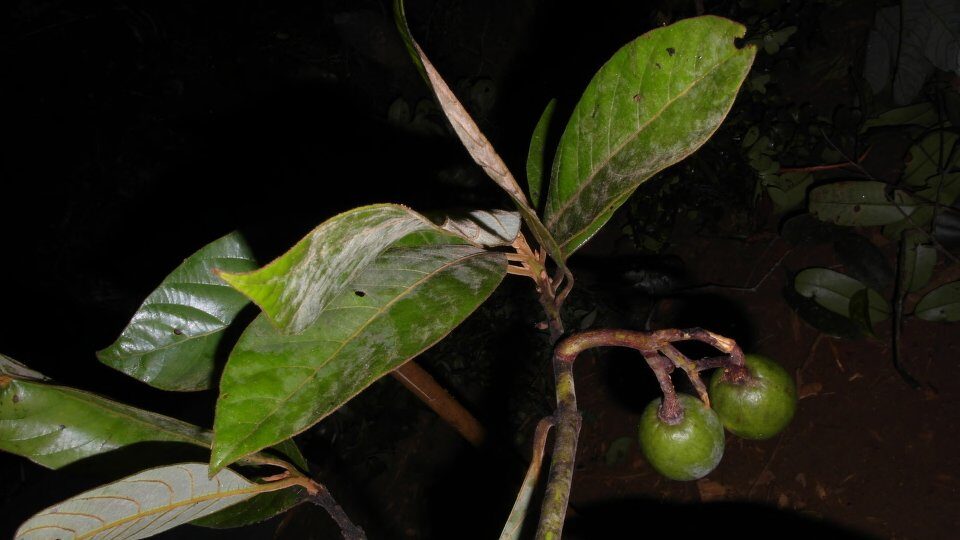
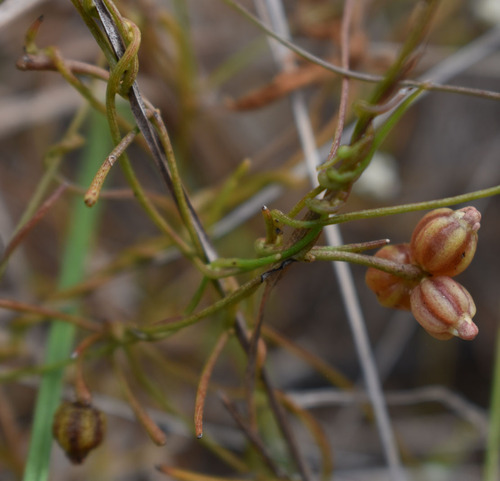
A fine straggling leafless creeper or vine that climbs over plants and gets at least some if its food from the other plants. The leaves are very small and like scales, and clasp the stem. The stem is orange to yellow and twines around plants, attaching by small suckers. The flower is small and the sepals are like bracts. The petals are white and fleshy. The flowers are 0.1-0.2 cm long. It has very small, berry-like fruit (4-5 mm across) which are green when young and turn white when ripe. The flesh is clear and the black seed can be seen from the outside.
Edible Uses
The ripe fruit is eaten, though there is only a small amount of edible flesh around the central seed. The fruit are especially enjoyed by children.
Traditional Uses
The ripe fruit is eaten. There is only a small amount of edible flesh around the central seed. CAUTION: Some Cassytha have an alkaloid that can cause abortion and should not therefore be eaten by pregnant women.
Medicinal Uses
The plant is astringent, diuretic, emmenagogue and tonic. It has a long history of use in traditional medicine, being used in many areas to treat a wide range of complaints. The whole plant, but especially the stem, contains a series of alkaloids, tannins, saponins and leucanthocyanins. Several of the alkaloids show pharmacological activities when tested in isolation. Methanolic and aqueous extracts of the whole stems have shown marked uterotonic effects which could be compared to that of oxytocin. An ethanol extract exhibited molluscicidal activity at a dose of 100 ppm, and a methanol extract exhibited antimicrobial activity against the microscopic parasite Trypanosoma vivax. An infusion of the stems is used in the treatment of digestive problems such as indigestion, biliousness and diarrhoea; feverish conditions including malaria; urinary system problems, including nephritis and oedema; headache, hepatitis, piles, sinusitis and spermatorrhoea. It is also often used by women to stimulate menstruation, hasten parturition and to suppress lactation after a stillbirth. The pounded stems are given as a vermifuge and for other intestinal troubles. A decoction of the stems is drunk to relieve itch and eczema. Externally, the stems are widely used to treat a range of skin complaints, including itchy conditions, eczema, ulcers and parasitic conditions of both skin and scalp. It is also used, in an infusion, as an eyewash. The whole plant is often used for treating venereal discharges, urethritis, gonorrhoea and syphilis. The stems are normally used fresh, but can also be dried for later use.
Known Hazards
Some Cassytha species contain an alkaloid that can cause abortion and should not be eaten by pregnant women.
Distribution
A tropical plant. It grows in lowland mangrove swamp areas and in scattered forest. It suits sandy and infertile areas and is often on coastal dunes. It occurs throughout the tropics. In Yunnan.
Where It Grows
Africa, American Samoa, Andaman Is.,Asia, Australia, Bahamas, Bangladesh, Belize, Benin, Botswana, Brazil, British Indian Ocean Terr., BIOT, Burkina Faso, Burundi, Cambodia, Cameroon, Caroline Islands, Central Africa, Central African Republic, CAR, Chad, China, Chuuk, Colombia, Comoros, Congo R, Cook Is., Costa Rica, Cuba, Dominican Republic, East Africa, East Timor, Eswatini, Ethiopia, Fiji, FSM, French Guiana, Gabon, Gambia, Ghana, Guam, Guatemala, Guiana, Guianas, Guinea, Guinée, Guinea-Bissau, Guyana, Haiti, Hawaii, Honduras, India, Indochina, Indonesia, Ivory Coast, Jamaica, Japan, Kenya, Kiribati, Laos, Liberia, Madagascar, Malawi, Malaysia, Maldives, Mali, Mariana Islands, Marshall Islands, Mauritius, Micronesia, Middle East, Mozambique, Myanmar, Nambia, Nauru, New Caledonia, Niue, North America, Pacific, Palau, Papua New Guinea, PNG, Puerto Rico, Reunion, Rotuma, Rwanda, Samoa, Saudi Arabia, SE Asia, Senegal, Seychelles, Sierra Leone, Solomon Islands, Somalia, South Africa, Southern Africa, South America, Sri Lanka, Suriname, Swaziland, Taiwan, Tanzania, Tasmania, Thailand, Timor-Leste, Togo, Tokelau, Tonga, Torres Strait, Trinidad-Tobago, Turks & Caicos, Tuvalu, Uganda, USA, Vanuatu, Venezuela, Vietnam, Wallis and Futuna, West Africa, West Indies, Yemen, Zambia, Zimbabwe,
Cultivation
It grows wild. Seeds germinate in the soil, but the plants attach to another plant getting support and food from the host plant.
Propagation
Seed - has an inbuilt dormancy and only germinates after it has been softened by microbial action.
Other Uses
The whole plant is used by local people as a paste for paper-making. The stems, mashed in water, are the source of a brown dye. The stems are dried, powdered and mixed with sesame oil to make a mucilaginous hair tonic, but this use may be attributed to the luxuriant hair-like appearance of the stems.
Other Information
The fruit are enjoyed especially by children.
Notes
There are 15-20 Cassytha species. Sometimes they are in the family Cassythaceae.
Nutrition
| Part | Moisture | kJ | kcal | Protein | Vit A | Vit C | Iron | Zinc |
|---|---|---|---|---|---|---|---|---|
| Fruit | 86.9 | — | — | — | — | 5 | — | — |
Synonyms
Also Known As
Agasi, Akar pengalasan, Akasa balli, Akasbel, Akashavalli, Amarbeli, Amarvela, Ariwurrini, Beluballi, Burrun burrun, Chemar batu, Cossagos, Dacacdufe, Devil's guts, Djirawan, Erumaikkottan, Famahotrakanga, Fetai, Feteinoa, Gau laululu'i, Hitubelagi, Kalku, Koh Samet, Lu'on ravaka, Lwandao, Nulu, Panabanab, Phak mai, Rayong, Redea-de-santcho, Saksinji, Sangazingi, Sangga langit, Shwe-nwe, Tali puteri, Tega, Te ntanini, Tjelknganiny, Tjirrkinin, Toxanh, Udamba, Umbulivella, Velanbuli, Wolle dialla, Wu gen teng, Yarrngiyarrngi, Yugulu, Zangazanga
References (63)
- Achigan-Dako, E, et al (Eds), 2009, Catalogue of Traditional Vegetables in Benin. International Foundation for Science.
- Ambasta S.P. (Ed.), 2000, The Useful Plants of India. CSIR India. p 110
- Bindon, P., 1996, Useful Bush Plants. Western Australian Museum. p 78
- Borrell, O.W., 1989, An Annotated Checklist of the Flora of Kairiru Island, New Guinea. Marcellin College, Victoria Australia. p 87
- Bourret, D., 1981, Bonnes-Plantes de Nouvelle-Caledonie et des Loyaute. ORSTOM. p 78
Show all 63 references Hide references
- Brock, J., 1993, Native Plants of Northern Australia, Reed. p 117
- Burkill, I.H., 1966, A Dictionary of the Economic Products of the Malay Peninsula. Ministry of Agriculture and Cooperatives, Kuala Lumpur, Malaysia. Vol 1 (A-H) p 491
- Cancilla, D., 2018, Ethnobotanical and Ethnozoological Values Desktop Assessment - Eliwana Project. p 10
- Cherikoff V. & Isaacs, J., The Bush Food Handbook. How to gather, grow, process and cook Australian Wild Foods. Ti Tree Press, Australia p 189. 198
- Cooper, W. and Cooper, W., 2004, Fruits of the Australian Tropical Rainforest. Nokomis Editions, Victoria, Australia. p 245
- Cowie, I, 2006, A Survey of Flora and vegetation of the proposed Jaco-Tutuala-Lore National Park. Timor-Lests (East Timor) www.territorystories.nt/gov.au p 49
- Cruz-Garcia, G. S., & Price, L. L., 2011, Ethnobotanical investigation of 'wild' food plants used by rice farmers in Kalasin, Northeast Thailand. Journal of Ethnobiology and Ethnomedicine 7:33
- Fell, D.G. & Stanton, D.J., 2015: The vegetation and flora of Mabuyag, Torres Strait, Queensland. Memoirs of the Queensland Museum – Culture 8(1):1-33. Brisbane. ISSN 1440-4788.
- Flora of Solomon Islands
- Fowler, D. G., 2007, Zambian Plants: Their Vernacular Names and Uses. Kew. p 44
- Franklin, J., Keppel, G., & Whistler, W., 2008, The vegetation and flora of Lakeba, Nayau and Aiwa Islands, Central Lau Group, Fiji. Micronesica 40(1/2): 169–225, 2008
- French, B.R., 1986, Food Plants of Papua New Guinea, A Compendium. Asia Pacific Science Foundation p 326
- Habitat Management Profile – Saibai Island. Appendix C. Preliminary List of Useful Plants for Saibai Island. p 118
- Hardwick, G., 2001, Economically Useful Plants for Northern Australia: Master Species List. Crusader eBooks.
- Hedrick, U.P., 1919, (Ed.), Sturtevant's edible plants of the world. p 174
- Henty, E.E., & Pritchard, G.S., 1973, Weeds of New Guinea and their control. Botany Bulletin No 7, Division of Botany, Lae, PNG. p 112
- Henty, E.E., 1980, Harmful Plants in Papua New Guinea. Botany Bulletin No 12. Division Botany, Lae, Papua New Guinea. p 76, 77
- Heywood, V.H., Brummitt, R.K., Culham, A., and Seberg, O. 2007, Flowering Plant Families of the World. Royal Botanical Gardens, Kew. p 182
- Hiddins, L., 1999, Explore Wild Australia with the Bush Tucker Man. Penguin Books/ABC Books. p 138
- Jackes, B.R., 2001, Plants of the Tropics. Rainforest to Heath. An Identification Guide. James Cook University. p 58
- Kenneally, K.E., Edinger, D. C., and Willing T., 1996, Broome and Beyond, Plants and People of the Dampier Peninsula, Kimberley, Western Australia. Department of Conservation and Land Management. p 113
- Kew Plants of the World Online
- Khumgratok, S., Edible Plants in Cultural Forests of Northeastern Thailand. Mahasarakham University Thailand.
- Lands, M., 1987, Mayi: Some Bush fruits of Dampierland. Magabala Books, Broome West Australia. p 31
- Lazarides, M. & Hince, B., 1993, Handbook of Economic Plants of Australia, CSIRO. p 51
- Levitt, D., 1981, Plants and people. Aboriginal uses of plants on Groote Eylandt. Australian Institute of Aboriginal Studies, Canberra. p 97
- Li Xi-wen, Li Jie, Huang Puhua, van der Werff, H., Lauraceae. Flora of China.
- Low, T., 1991, Wild Food Plants of Australia. Australian Nature FieldGuide, Angus & Robertson. p 125
- McMakin, P.D., 2000, Flowering Plants of Thailand. A Field Guide. White Lotus. p 76
- Paczkowska, G. & Chapman, A.R., 2000, The Western Australian Flora. A Descriptive Catalogue. Western Australian Herbarium. p 277
- Parham, B. E. V., 1971, The Vegetation of the Tokelau Islands with special reference to the Plants of Nukunonu Atoll. New Zealand Journal of Botany. 9:4, 576-609
- Pasha, M. K. & Uddin, S. B., 2019, Minor Edible Fruits of Bangladesh. Bangladesh J. Plant Taxon. 26(2): 299–313
- Peekel, P.G., 1984, (Translation E.E.Henty), Flora of the Bismarck Archipelago for Naturalists, Division of Botany, Lae, PNG. p 191, 193
- Pham-Hoang Ho, 1999, An Illustrated Flora of Vietnam. Nha Xuat Ban Tre. p 402
- Plants of Haiti Smithsonian Institute http://botany.si.edu/antilles/West Indies
- Smith, A.C., 1981, Flora Vitiensis Nova, Lawaii, Kuai, Hawaii, Volume 2 p 142
- Smith, M & Kalotas, A. C., 1985, Bardi Plants: An Annotated List of Plants and Their Use by the Bardi Aborigines of Dampierland, in North-western Australia. Rec. West Aust. Mus. 1985, 12(3): 317-359
- Smith, N and Wightman, G.M., 1990, Ethnobotanical Notes from Belyuen Northern Territory Australia. Northern Territory Botanical Bulletin No 10. Parks and Wildlife Commission of the Northern Territory. p 7, 9
- Smith, N. M., 1991, Ethnobotanical Field Notes from the Northern Territory, Australia, J. Adelaide Bot. Gard. 14(1): 1-65
- Sp. pl. 1:35. 1753
- Sujanapal, P., & Sankaran, K. V., 2016, Common Plants of Maldives. FAO & Kerala FRI, p 73
- Swaziland's Flora Database http://www.sntc.org.sz/flora
- Thaman, R. R., 1987, Plants of Kiribati: A listing and analysis of vernacular names. Atoll Research Bulletin No. 296
- Thaman, R. R, 2016, The flora of Tuvalu. Atoll Research Bulletin No. 611. Smithsonian Institute p 95
- Tiwi Plants and Animals. 2001, Aboriginal flora and fauna knowledge from Bathurst and Melville Islands, northern Australia. Northern Territory Botanical Bulletin; No. 24 p 35
- Topp, J. M. W., 1988, An Annotated Check List of the Flora of Diego Garcia, British Ocean Territory. Atoll Research Bulletin No. 313
- Vigilante, T., et al, 2013, Island country: Aboriginal connections, values and knowledge of the Western Kimberley islands in the context of an island biological survey. Records of the Western Australian Museum Supplement 81: 145-182
- Wheeler, J.R.(ed.), 1992, Flora of the Kimberley Region. CALM, Western Australian Herbarium, p 62
- Whistler, W. A., 1988, Ethnobotany of Tokelau: The Plants, Their Tokelau Names, and Their Uses. Economic Botany 42(2): 155-176
- Wightman, Glenn et al. 1991.Alawa Ethnobotany: Aboriginal Plant Use from Minyerri, Northern Australia. Northern Territory Botanical Bulletin No 11. Parks and Wildlife Commission of the Northern Territory. p 9, 10
- Wightman, G. & Andrews, M., 1991, Bush Tucker Identikit. Common Native Food Plants of Australia’s top end. Conservation Commission Northern Territory. p 46
- Wightman, Glenn et al. 1992, Mangarrayi Ethnobotany: Aboriginal Plant Use from the Elsey Area Northern Australia. Northern Territory Botanical Bulletin No 15. Parks and Wildlife Commission of the Northern Territory. p 14, 15
- Wightman, Glenn et al. 1994, Gurindji Ethnobotany: Aboriginal Plant Use from Daguragu Northern Australia. Northern Territory Botanical Bulletin No 18. Parks and Wildlife Commission of the Northern Territory. p 14, 15
- Williams, K.A.W., 1999, Native Plants of Queensland Volume 4. Keith A.W. Williams North Ipswich, Australia. p 102
- Williamson, J., 2005, Useful Plants of Malawi. 3rd. Edition. Mdadzi Book Trust. p 59
- World Checklist of Useful Plant Species 2020. Royal Botanic Gardens, Kew
- Yuncker, T.G., 1959, Plants of Tonga, Bernice P. Bishop Museum, Hawaii, Bulletin 220. p 119
- Yunupinu Banjgul, Laklak Yunupinu-Marika, et al. 1995, Rirratjinu Ethnobotany: Aboriginal Plant Use from Yirrkala, Arnhem Land, Australia. Northern Territory Botanical Bulletin No 21. Parks and Wildlife Commission of the Northern Territory. p 26, 27