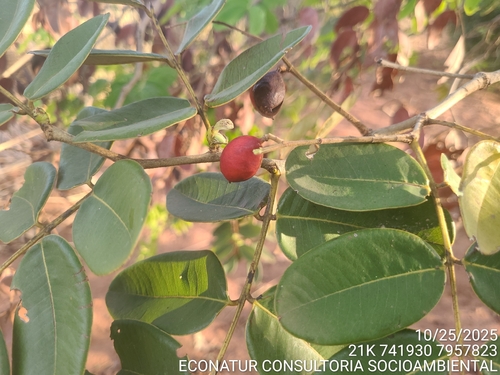
Senna surattensis
(Burm.f.) Irwin & Barneby
Singapore Shower, Golden senna
iNaturalist· cc-by-nc
(c) keeperofthegarden, some rights reserved (CC BY-NC), uploaded by keeperofthegarden
iNaturalist· cc-by-nc
(c) Stargazer, some rights reserved (CC BY-NC)
iNaturalist· cc-by-nc
(c) wadesworld19, some rights reserved (CC BY-NC)
Summary
Source: WikipediaSenna surattensis, also called glossy shower, scrambled egg tree, glossy shower, golden Senna, glaucous Cassia, sunshine tree and bushy Cassia, is a plant species of the legume family (Fabaceae) in the subfamily Caesalpinioideae that is native to southeast Asia, and possibly northern and eastern Australia. S. surattensis is named after Surat district, situated near Bombay, India.
Description
A shrub or small tree. It grows 2-7 m tall. It spreads to 4 m across. The branches can have hairs or be smooth. The leaflets are in 4-7 pairs. They are 3-10 cm long by 1.5-5 cm wide. The leaf axis has glands between the lower 2-4 pairs of leaflets. The flower cluster is 5-13 cm long with 10-20 flowers. The petals are yellow and 2-3 cm long. The fruit are flat and thin. They are 15-20 cm long and 1.2-1.8 cm wide. They can be straight or curved. The pods are divided by partitions. The seeds are blackish and 9-10 mm long by 3.5-4 mm wide. They are shiny. The seed scar is one sided and nearly at the end of the seed.
Edible Uses
The tender young leaves are cooked and eaten with rice.
Traditional Uses
The tender young leaves are cooked and eaten with rice.
This uses section is brief — help expand it
Medicinal Uses
In Southeast Asia, its juvenile leaves are cooked and eaten as a vegetable. In the Philippines, it is used in teak plantations as a shade tree and hedge plant. The roots have been used to treat gonorrhoea, its leaves for dysentery, and flowers as a laxative.
Distribution
A tropical plant. In Papua New Guinea it occurs between 15 and 50 m altitude. It can be up to 300 m above sea level. It requires rich, moist, well drained soil. It does best in a sunny position. It is drought and frost tender. In XTBG Yunnan.
Where It Grows
Africa, Asia, Australia, China, Hawaii, India*, Indochina, Indonesia, Malaysia, Maldives, Marquesas, Nigeria, Pacific, Pakistan, Papua New Guinea, PNG, SE Asia, Taiwan, Thailand, USA, Vietnam, West Africa,
Cultivation
Plants are grown from seed. The seed need to have the hard seed coat broken before planting. It can also be grown by air-layering.
Propagation
Seed - it has a hard seedcoat and may benefit from scarification before sowing in order to speed up and improve germination. This can usually be done by pouring a small amount of nearly boiling water on the seeds (being careful not to cook them!) and then soaking them for 12 - 24 hours in warm water. By this time they should have imbibed moisture and swollen - if they have not, then carefully make a nick in the seedcoat (being careful not to damage the embryo) and soak for a further 12 hours before sowing.
Other Uses
Often interplanted in young teak plantations and used as a shade tree in the Philippines.
Notes
It is not known if they are used for food in Papua New Guinea. There are 100 Cassia species. This group has been revised to a smaller more consistent group. Also as Caesalpinaceae.
Synonyms
Also Known As
Gelenggang, Glaucous cassia, Kii lec waan, Kolomona, Muong bien, Pohon kasia emas, Ranuwia, Scrambled egg bush, Song-baa-daan
References (19)
- Bodkin, F., 1991, Encyclopedia Botanica. Cornstalk publishing, p 222 (As Cassia surattensis)
- Burkill, H. M., 1985, The useful plants of west tropical Africa, Vol. 1. Kew.
- Burkill, I.H., 1966, A Dictionary of the Economic Products of the Malay Peninsula. Ministry of Agriculture and Cooperatives, Kuala Lumpur, Malaysia. Vol 1 (A-H) p 487 (As Cassia surattensis)
- Engel, D.H., & Phummai, S., 2000, A Field Guide to Tropical Plants of Asia. Timber Press. p 158 (As Cassia surattensis)
- Fl. indica 97. 1768 (As Cassia surattensis)
Show all 19 references Hide references
- Gardner, S., et al, 2000, A Field Guide to Forest Trees of Northern Thailand, Kobfai Publishing Project. p 172 (As Cassia surattensis)
- Grubben, G. J. H. and Denton, O. A. (eds), 2004, Plant Resources of Tropical Africa 2. Vegetables. PROTA, Wageningen, Netherlands. p 564 (As Cassia surattensis)
- Krishen P., 2006, Trees of Delhi, A Field Guide. DK Books. p 232
- Lamoureux, C.H., 1976, Trailside Plants of Hawaii's National Parks. Hawaii Natural History Association. p 35 (As Cassia surattensis)
- Lazarides, M. & Hince, B., 1993, Handbook of Economic Plants of Australia, CSIRO. p 51 (As Cassia surattensis)
- Liu, Yi-tao, & Long, Chun-Lin, 2002, Studies on Edible Flowers Consumed by Ethnic Groups in Yunnan. Acta Botanica Yunnanica. 24(1):41-56 (As Cassia surattensis)
- Martin, F.W. & Ruberte, R.M., 1979, Edible Leaves of the Tropics. Antillian College Press, Mayaguez, Puerto Rico. p 198 (As Cassia surattensis)
- Peekel, P.G., 1984, (Translation E.E.Henty), Flora of the Bismarck Archipelago for Naturalists, Division of Botany, Lae, PNG. p 219, 222 (As Cassia surattensis)
- Pham-Hoang Ho, 1999, An Illustrated Flora of Vietnam. Nha Xuat Ban Tre. p 852 (As Cassia surattensis)
- Selvam, V., 2007, Trees and shrubs of the Maldives. RAP Publication No. 2007/12 p 60
- Somnasang, P., Moreno, G and Chusil K., 1998, Indigenous knowledge of wild hunting and gathering in north-east Thailand. Food and Nutrition Bulletin 19(4) p 359f (As Cassia surattensis)
- Sukarya, D. G., (Ed.) 2013, 3,500 Plant Species of the Botanic Gardens of Indonesia. LIPI p 505
- Verdcourt, B., 1979, Manual of New Guinea Legumes. Botany Bulletin No 11, Division of Botany, Lae, Papua New Guinea. p 55 (As Cassia surattensis)
- World Checklist of Useful Plant Species 2020. Royal Botanic Gardens, Kew