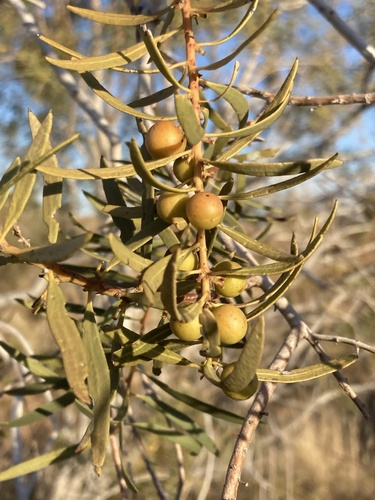
Diospyros lycioides subsp. guerkei
(Kuntze) De Winter
Quilted bluebush
iNaturalist· cc-by-nc
(c) Campbell Scott, some rights reserved (CC BY-NC), uploaded by Campbell Scott
Summary
Source: WikipediaDiospyros lycioides, commonly called the bushveld bluebush, is a species of African Diospyros, trees and shrubs in the family Ebenaceae. It is native to central and southern Africa, except the winter-rainfall area. It grows in Australia and is known as a weed there. Many parts of the plant are used: the wood, the roots and stems for toothbrushes, the fruits for alcoholic drinks, and the roots and bark in traditional medicine. It can form thickets, and it usually grows up to three meters high, though at its tallest it can be eight meters. It is one of twenty species of Diospyros in South Africa. It has 3-4 subspecies, including D. l. subsp. lycioides, D. l. subsp. guerkei, D. l. subsp. nitens, and D. l. subsp. sericea.
Description
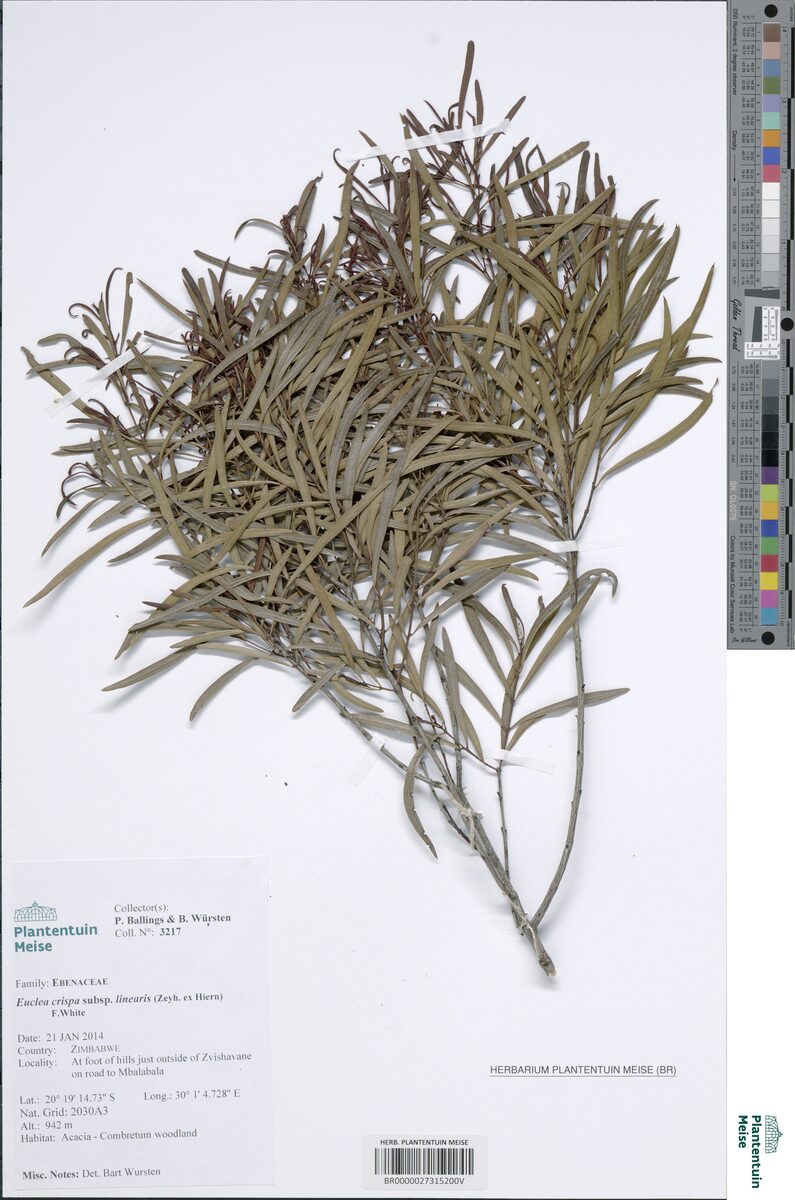
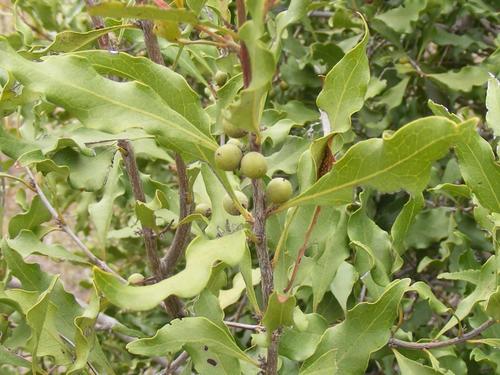
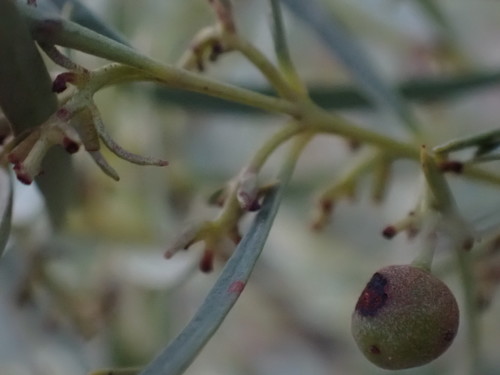
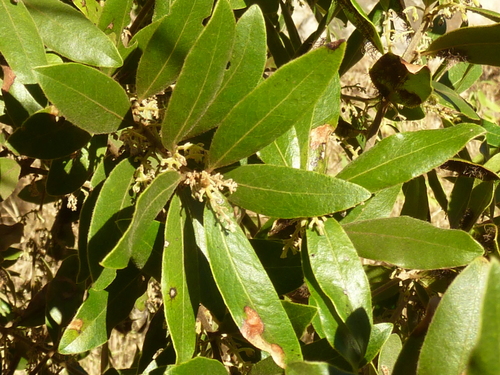
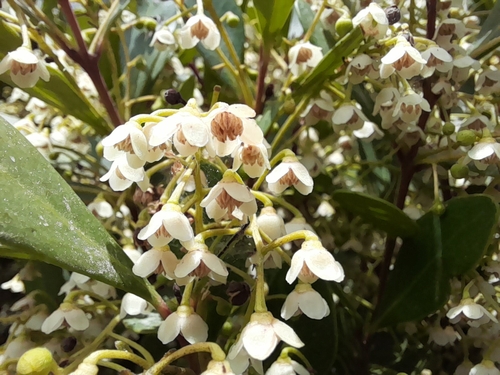
A shrub or small tree. It grows 1-4 m tall. It can have several stems. These have many branches. The branches are grey. The young twigs have soft hairs. The leaves are alternate and crowded at the ends of branches. They are broadly sword shaped. They are 3-9 cm long by 1-3 cm wide. They are olive green above and more pale underneath. The veins are sunken above and raised under the leaf. Male and female flowers are on separate trees. The flowers are in clusters in the axils of the leaves and hang down. The fruit are round and 2 cm across. They contain 1 to 6 seeds.
Edible Uses
Its root and stem are used as toothbrushes, and its wood is used for spoons, toys, construction, and furniture. In South Africa, its fruits are used to make beer and other alcoholic drinks, and its seeds are used as a coffee substitute. It also has many medicinal uses, including treating cold and coughs by chewing the roots, and using the powdered bark of the root as an abortifacient. Its leaves are food for the Mooi River opal butterfly (Chrysoritis lycegenes) and its flowers are attractive to many animals, namely bees and a few African birds.
Traditional Uses
Caution: Reports vary as to how edible the fruit are.
This uses section is brief — help expand it
Distribution
It is a subtropical plant. It grows in the understorey on the edges of forests and along river valleys. It can tolerate drought but grows better with moisture. It is cold hardy.
Where It Grows
Africa, Botswana, Eswatini, South Africa, Southern Africa, Swaziland,
Production
It is reasonably fast growing.
Synonyms
Also Known As
Bosveldbloubos, Bushveld bluebush, Lethajwa, Motloumana, Muthala, Umchafutane, Umnqandane
References (1)
- Schmidt, E., Lotter, M., & McCleland, W., 2007, Trees and shrubs of Mpumalanga and Kruger National Park. Jacana Media p 514