Caryota urens
L.
Wine Palm, Fishtail Palm, Toddy Palm
iNaturalist· cc-by-nc
(c) Nick Belliveau, some rights reserved (CC BY-NC), uploaded by Nick Belliveau
iNaturalist· cc0
no rights reserved
iNaturalist· cc-by
(c) Oleg Kosterin, some rights reserved (CC BY)
Summary
Source: WikipediaCaryota urens is a species of flowering plant in the palm family, native to Sri Lanka, India, Myanmar and Malaysia (perhaps elsewhere in Indo-Malayan region), where they grow in fields and rainforest clearings, it is regarded as introduced in Cambodia. The epithet urens is Latin for "stinging" alluding to the chemicals in the fruit. Common names in English include solitary fishtail palm, kithul palm, toddy palm, wine palm, sago palm and jaggery palm. Its leaf is used as fishing rod after trimming the branches of the leaf and drying. According to Monier-Williams, it is called moha-karin ("delusion maker") in Sanskrit. It is one of the sugar palms.
Description
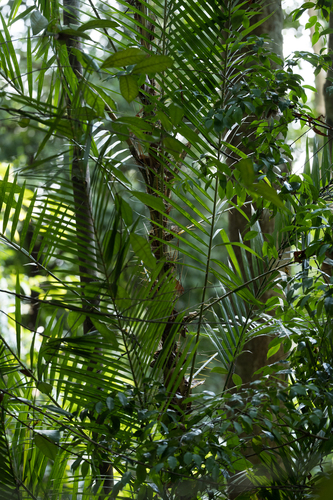
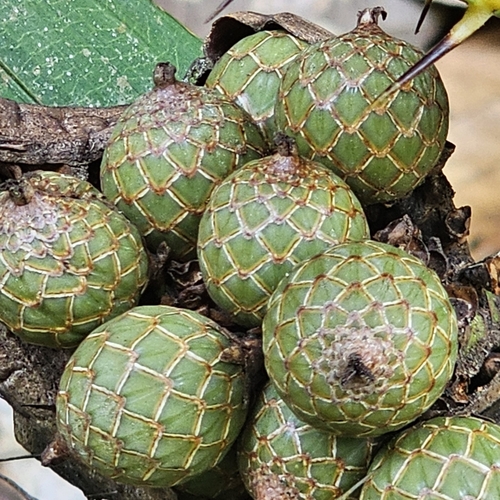
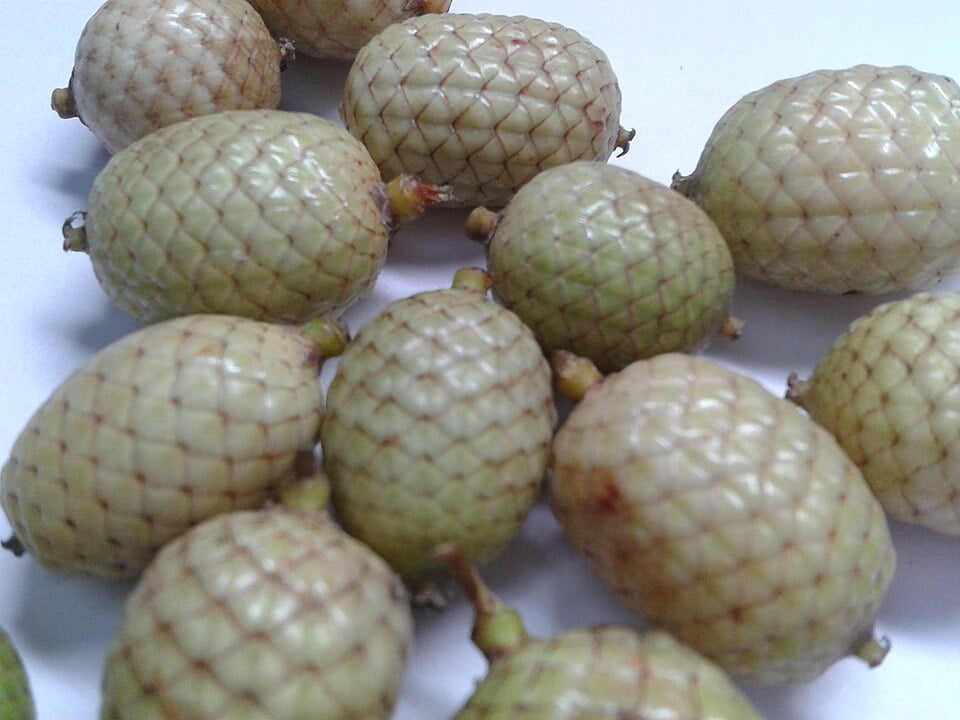
A single stemmed palm up to 10-15 m tall. It can be 20 m high. It has a large, thick, ringed, grey trunk. The leaves are very large. They can be 5-6 m long and 40 cm wide. The fronds arch over. They are twice divided. The leaflets are like a fishtail or fin and with teeth at the tip. Trees flower after 10-15 years. It only fruits once then dies. The flowers are borne on large bunches of heavy, hanging spikes. They are 3-7 m long. They bear both male and female flowers. The fruit is round and about 2 cm across. They are reddish. There are 1-2 seeds. They look like a betel nut split in half.
Edible Uses
Caryota urens produces several edible products. Sap extracted from the inflorescence is used to make a sugar substitute known as kitul honey or jaggery — concentrated in wide-mouthed vessels over an open fire to produce a viscous golden syrup with a delicious flavour. Further concentration yields kitul jaggery (candy). Inflorescence sap is also fermented with a crude mixed yeast inoculum to produce toddy, which can be distilled into a more concentrated spirit, similar to coconut toddy. Starch from the stems is processed into sago. The very young unfolding leaves and leaf bud are cooked as a vegetable, though harvesting the terminal bud kills the tree as it cannot produce side shoots or new growth. The stem pith is boiled, mixed with rice and cooked. The palm heart is also edible.
Traditional Uses
An edible starch can be extracted from the stem. The stem pith is boiled, mixed with rice and cooked. The palm heart is edible. The very young unfolded leaves are edible. They are boiled. The sap from the flower stalk is used for sugar or wine. For wine it is fermented and for sugar or jaggery it is boiled down. The seeds are used as a masticatory. They are chewed with betel leaf. The shoots are used to increase the taste of meat. CAUTION: The fruit contain stinging crystals.
Medicinal Uses
A porridge made from seed flour is prescribed by local physicians to treat gastric ulcers, migraine headaches, snake-bite poisoning and rheumatic swellings. The root is used for treating tooth ailments. The bark and seed are used to treat boils. The tender flowers are used for promoting hair growth.
Known Hazards
The fruit is capable of irritating the skin and causing a burning sensation.
Distribution
A tropical plant. It grows in tropical and warm temperate regions. It likes a deep, rich soil. It grows in open, cleared areas of rainforest. It suits humid locations. The soil needs to be well drained. It Sri Lanka it grows up to 1,000 m above sea level. In XTBG Yunnan. It suits hardiness zones 10-12.
Where It Grows
Africa, Asia, Australia, Bangladesh, Cambodia, Central America, China, Dominican Republic, East Africa, Fiji, Grenada, Guam, Guatemala, Hawaii, Himalayas, India, Indochina, Indonesia, Laos, Madagascar, Malaysia, Maldives, Marshall Islands, Micronesia, Mozambique, Myanmar, Nauru, Nepal, North America, Northeastern India, Pacific, Pakistan, Papua New Guinea, PNG, SE Asia, Senegal, Sikkim, Slovenia, Sri Lanka, Thailand, USA, Vietnam, West Africa, West Indies, Zimbabwe,
Cultivation
Plants are found in moist tropical climates where temperatures never fall below 10°c, the average annual rainfall is 1,500mm or more and the driest month has 25mm or more rain. They can also succeed in warm temperate zones and in drier areas with an annual rainfall as low as 250mm and one month or more where rainfall is below 25mm. Mature plants can be killed by temperatures of 5°c or lower. Plants grow well in full sun, even when small. Prefers a moist, shady situation. Prefers a pH in the range 6 - 7.5, tolerating 5.5 - 8. A slow-growing plant. A monocarpic species, living for several years without flowering, but then dying once it has flowered. It attains full size in about 10 - 15 years, and flowers when 15 - 30 years old. It flowers from the top down, and once the last fruit on the bottom inflorescence matures, the plant dies.. The daily yield per tree of sap for wine and sugar is 20 - 27 litres. When flowering begins, the inflorescence is stimulated to produce juice; the inflorescence is then bound into a 'candle' form and tapped for its sweet juice by repeatedly slicing off the end of the candle. A tapping period may last for 10 - 15 years before the tree dies. Harvest for sago and other purposes is mainly from wild and semi-wild populations. The trunk yields 100 - 150 kilos of starch. Usually harvests for timber occurs when the tapping period has ended. Suitable for growing indoors as a house plant. Resistant to deer.
Propagation
At room temperature, seeds remain viable for 30–90 days depending on storage conditions. An experiment in Sri Lanka found a germination rate of 99% for seeds sown after 30 days of storage in a dark room. Seeds germinate in 2–4 months. Seedlings can tolerate sun while quite small.
Other Uses
A strong, fine, soft and durable fibre obtained from the leaf bases is used to make brooms, brushes, ropes and baskets, and for stuffing cushions. A woolly scurf scraped from the leaf stalks is used for caulking boats, and in machine brushes for polishing linen and cotton yarns, cleaning scutched flax fibre, and brushing velvets. The leaves are used for thatching. The stem yields timber used for planking, flooring, rafters, roofing, partitioning and fencing, and for making spears. Stems halved lengthways and hollowed are used as gutters, drains and water conduits. Polished stems are used as monoliths in modern houses. The tree is suitable for growing indoors and has applications in carbon farming and food forest systems.
Production
It is fast growing. From the cut flower clusters 20 litres of sap per day can be collected. A mature tree yields 30-40 kg of starch from the trunk. In Sikkim fruit are available in January.
Other Information
It is a cultivated food plant. Children chew the seeds.
Notes
There are 12 Caryota species. They are tropical.
Nutrition
| Part | Moisture | kJ | kcal | Protein | Vit A | Vit C | Iron | Zinc |
|---|---|---|---|---|---|---|---|---|
| Stem starch | 13.1 | 1417 | 339 | 2.4 | — | — | 20 | — |
| Sap | — | — | — | — | — | — | — | — |
| Palm heart | — | — | — | — | — | — | — | — |
| Seeds | — | — | — | — | — | — | — | — |
Also Known As
Anapana, Ardhashishi, Bagani, Baganimara, Bankhajur, Baraflawar, Berli, Berlimad, Bherawa, Bon supari, Cariota, Chaal gua, Cha guwa, Chao tamol, Chewa gach, Chhau, Dirgha, Dokechu, Dok kechu, Dong zong, Gol sago, Guobang, Ha da a bo, Jaggery palm, Jilugujattu, Kitul, Kittul, Koondalpanai, Koonthalpanai, Kundapana, Kwai-cha, Lamgi kwa, Mada, Mari, Maype, Minbaw, Moahi, Nyod tao, Palma ribjega repa, Panamchapu, Panasoppu, Ramgua, Rangbhang, Rungbong, Sagu, Salapa, Salopa, Shankarjata, Shivajata, Somong kung, Sowat goch, Surmadi, Taminbaw, Thippili panai, Tippili, Tippilipana, Tum, Tunsae, Tuum, Vazapana, Yiaobu
References (91)
- Ambasta S.P. (Ed.), 2000, The Useful Plants of India. CSIR India. p 108
- Arinathan, V., et al, 2007, Wild edibles used by Palliyars of the western Ghats, Tamil Nadu. Indian Journal of Traditional Knowledge. 6(1) pp 163-168
- Arora, R. K., 2014, Diversity in Underutilized Plant Species - An Asia-Pacific Perspective. Bioversity International. p 101
- Aryal, K., Moe, A.T., Hein, P.P., Bay, Y.H.S., Htay, T., Aung, H.W., Shakya, B., Xuefei, Y., Shaoliang, Y. , 2020, Wild and non- cultivated edible plants and their contribution to local livelihoods in Putao, Myanmar. ICIMOD.
- Ashton, M. S., et al 1997, A Field Guide to the Common Trees and Shrubs of Sri Lanka. WHT Publications Ltd. p 79
Show all 91 references Hide references
- Azam, F. M. S., et al, 2014, Are Famine Food Plants Also Ethnomedicinal Plants? An Ethnomedicinal Appraisal of Famine Food Plants of Two Districts of Bangladesh. Evidence-Based Complementary and Alternative Medicine Volume 2014, Article ID 741712, 28 pages
- Balick, M.J. and Beck, H.T., (Ed.), 1990, Useful palms of the World. A Synoptic Bibliography. Colombia p 105, 121, 160, 619,
- Balkrishna, A., et al, 2022, Indigenous Uses of Plants among Forest-dependent Communities of Seijosa, Arunachal Pradesh. International Journal of Economic Plants 2022, 9(1):064-080
- Bandyopadhyay, S. et al, 2009, Wild edible plants of Koch Bihar district, West Bengal. Natural Products Radiance 8(1) 64-72
- Bandyopadhyay, S., et al, 2012, A Census of Wild Edible Plants from Howrah District, West Bengal, India. Proceedings of UGC sponsored National Seminar 2012
- Bircher, A. G. & Bircher, W. H., 2000, Encyclopedia of Fruit Trees and Edible Flowering Plants in Egypt and the Subtropics. AUC Press. p 88
- Blomberry, A. & Rodd, T., 1982, Palms. An informative practical guide. Angus & Robertson. p 74
- Bodkin, F., 1991, Encyclopedia Botanica. Cornstalk publishing, p 219
- Bole, P.V., & Yaghani, Y., 1985, Field Guide to the Common Trees of India. OUP p 43
- Brickell, C. (Ed.), 1999, The Royal Horticultural Society A-Z Encyclopedia of Garden Plants. Convent Garden Books. p 233
- Brouk, B., 1975, Plants Consumed by Man. Academic Press, London. p 250, 365
- Burkill, H. M., 1985, The useful plants of west tropical Africa, Vol. 4. Kew.
- Burkill, I.H., 1966, A Dictionary of the Economic Products of the Malay Peninsula. Ministry of Agriculture and Cooperatives, Kuala Lumpur, Malaysia. Vol 1 (A-H) p 475
- Chowdery, T., et al, 2014, Wild edible plants of Uttar Dinajpur District, West Bengal. Life Science Leaflets. 47:pp 20-36 http://lifesciencesleaflets.ning.com
- Cundall, P., (ed.), 2004, Gardening Australia: flora: the gardener's bible. ABC Books. p 336
- Dangol, D. R. et al, 2017, Wild Edible Plants in Nepal. Proceedings of 2nd National Workshop on CUAOGR, 2017.
- Das, T. & Das, A. K., 2005, Inventorying plant biodiversity in homegardens: A case study in Barak Valley, Assam, North East India. CURRENT SCIENCE, VOL. 89, NO. 1, 10 JULY 2005
- Davis, S.D., Heywood, V.H., & Hamilton, A.C. (eds), 1994, Centres of plant Diversity. WWF. Vol 1 or 2. p 109
- Dharani, N., 2002, Field Guide to common Trees & Shrubs of East Africa. Struik. p 286
- Etherington, K., & Imwold, D., (Eds), 2001, Botanica's Trees & Shrubs. The illustrated A-Z of over 8500 trees and shrubs. Random House, Australia. p 186
- Ethnobotany of Karbis. Chapter 4 in p 107
- Facciola, S., 1998, Cornucopia 2: a Source Book of Edible Plants. Kampong Publications, p 27
- Gangte, H. E., et al, 2013, Wild Edible Plants used by the Zou Tribe in Manipur, India. International Journal of Scientific and Research Publications, Volume 3, Issue 5
- Gautam, R. S., et al, 2022, Ethnobotanical Review of Wild Edible Plants of Nepal. Journal of Natural History Museum Volume 32, 2021-22 p 104
- Gibbons, M., 1993, Palms. Compact study Guide and Identifier. Sandstone. p 27
- Ghimeray, A. K., Lamsal, K., et al, 2010, Wild edible angiospermic plants of the Illam Hills (Eastern Nepal) and their mode of use by local community. Korean J. Pl. Taxon. 40(1)
- Ghosh, C. & Das A. P., 2011, Some useful and poisonous tea garden weeds from the Darjiling District of West Bengal, India. Pleione 5(1): 91 - 114
- Guite, C., 2016, A study of wild edible plants associated with the Paite tribe of Manipur, India, International Journal of Current Research. Vol. 8, Issue, 11, pp. 40927-40932
- Haynes, J., & McLaughlin, J., 2000, Edible palms and Their Uses. University of Florida Fact sheet MCDE-00-50-1 p 4
- Hedrick, U.P., 1919, (Ed.), Sturtevant's edible plants of the world. p 173
- Hibbert, M., 2002, The Aussie Plant Finder 2002, Florilegium. p 61
- Hu, Shiu-ying, 2005, Food Plants of China. The Chinese University Press. p 302
- Jeeva, S., 2009, Horticultural potential of wild edible fruits used by the Khasi tribes of Meghalaya. Journal or Horticulture and Forestry Vol. 1(9) pp. 182-192
- Johnson, D.V., 1998, Tropical palms. Non-wood Forest products 10. FAO Rome. p 42, 121,
- Jones, D.L., 1994, Palms throughout the World. Smithtonian Institution, Washington. p 51, 57, 165
- Jones, D.L., 2000, Palms of Australia 3rd edition. Reed/New Holland. p 133
- Kar, A., & Borthakur, S. K., 2008, Wild edible fruits of Karbi's of Karbi Anglong district of Assam, India, Pleione 2(2): 175-181
- Kar, A., et al, 2013, Wild Edible Plant Resources used by the Mizos of Mizoram, India. Kathmandu University Journal of Science, Engineering and Technology. Vol. 9, No. 1, July, 2013, 106-126
- Krishen P., 2006, Trees of Delhi, A Field Guide. DK Books. p 308
- Lalfakzuala, R., 2007, Ethnobotanical usages of plants in western Mizoram. Indian Journal of Traditional Knowledge. Vol 6(3) pp 480-493
- Lord, E.E., & Willis, J.H., 1999, Shrubs and Trees for Australian gardens. Lothian. p 94
- Luczaj, L., et al, 2021, Wild food plants and fungi sold in the markets of Luang Prabang, Lao PDR. Journal of Ethnobiology and Ethnomedicine (2021) 17:6
- Luo, B., et al, 2019, Wild edible plants collected by Hani from terraced rice paddy agroecosystem in Honghe Prefecture, Yunnan, China. Journal of Ethnobiology and Ethnomedicine 15:56
- Mahadkar, S., Valvi, S. & Rathod, V., 2012, Nutritional assessment of some selected wild edible plants as a good source of mineral. Asian Journal of Plant Science and Research 2(4):468-472
- Martin, M.A., 1971, Introduction L'Ethnobotanique du Cambodge. Centre National de la Recherche Scientifique. Paris.
- Meitei, L. R., et al, 2022, An ethnobotanical study on the wild edible plants used by forest dwellers in Yangoupokpi Lokchao Wildlife Sanctuary, Manipur, India. Ethnobotany Research and Application 23:15
- Misra, S., 2020, Survey of edible plants for human consumption in south Odisha, India. Journal of Emerging Technologies and Innovative Research (JETIR) Vol. 7, Issue 12 p 278
- Mozhui, R., et al, 2011, Wild edible fruits used by the tribals of Dimapur district of Nagaland, India. Pleione 5(1): 56 - 64.
- Narayanan Ratheesh, M. K. et al, 2011, Wild edible plants used by the Kattunaikka, Paniya and Kuruma tribes of Wayanad District, Kerala, India. Journal of Medicinal Plants Research Vol. 5(15), pp. 3520-3529
- Ogle, B. M., et al, 2003, Food, Feed or Medicine: The Multiple Functions of Edible Wild Plants in Vietnam. Economic Botany 57(1): 103-117
- Partha, P., 2014, Ethnobotany of the Laleng (Patra) Community in Bangladesh. Journal of Pharmacognosy and Phytochemistry. 2(6):173-184
- Patiri, B. & Borah, A., 2007, Wild Edible Plants of Assam. Geethaki Publishers. p 151
- Phon, P., 2000, Plants used in Cambodia. © Pauline Dy Phon, Phnom Penh, Cambodia. p 136
- Prashanth Kumar, G.M. and Shiddamallayya, N., 2015, Ethnobotanical Study of Less Known Wild Edible Plants of Hakki Pikki Tribes of Angadihalli, Hassan District, Karnataka. Journal or Medicinal Plants Studies 3(5):80-85
- PROSEA (Plant Resources of South East Asia) handbook, Volume 9, 1996, Non seed carbohydrates
- Purseglove, J.W., 1972, Tropical Crops. Monocotyledons. Longmans p 423
- Rajapaksha, U., 1998, Traditional Food Plants in Sri Lanka. HARTI, Sri Lanka. p 360
- Ramachandran,V. S., & Udhayavani, C., 2013, Knowledge and uses of wild edible plants by Paniyas and Kurumbas of Western Nilgiris, Tamil Nadu. Indian Journal of Natural Products and Resources. 4(4) December 2013, pp 412-418
- Rao, M. L. S., et al, 2014, Indigenous Plant Foods which are commonly consumed by the tribal communities in Dumbriguda Area of Visakhapatnam District, Andhra Pradesh, India. Biolife. Vol 2, Issue 3
- Rashid, H. E., 1977, Geography of Bangladesh. Westview. p 297
- Recher, P, 2001, Fruit Spirit Botanical Gardens Plant Index. www.nrg.com.au/~recher/ seedlist.html p 7
- Riffle, R.L. & Craft, P., 2003, An Encyclopedia of Cultivated Palms. Timber Press. p 292
- Sahni, K.C., 2000, The Book of Indian Trees. Bombay Natural History Society. Oxford. p 183
- Sarma, H., et al, 2010, Updated Estimates of Wild Edible and Threatened Plants of Assam: A Meta-analysis. International Journal of Botany 6(4): 414-423
- Savita, et al, 2006, Studies on wild edible plants of ethnic people in east Sikkim. Asian J. of Bio Sci. (2006) Vol. 1 No. 2 : 117-125
- Sawian, J. T., et al, 2007, Wild edible plants of Meghalaya, North-east India. Natural Product Radiance Vol. 6(5): p 414
- Singh, B., et al, 2012, Wild edible plants used by Garo tribes of Nokrek Biosphere Reserve in Meghalaya, India. Indian Journal of Traditional Knowledge. 11(1) pp 166-171
- Smith, A.C., 1979, Flora Vitiensis Nova: A New flora of Fiji, Hawai Botanical Gardens, USA Vol 1 p 408
- Sp. pl. 2:1189. 1753
- Staples, G.W. and Herbst, D.R., 2005, A tropical Garden Flora. Bishop Museum Press, Honolulu, Hawaii. p 619
- Sujanapal, P., & Sankaran, K. V., 2016, Common Plants of Maldives. FAO & Kerala FRI, p 70
- Suksri, S., et al, 2005, Ethnobotany in Bung Khong Long Non-Hunting Area, Northeast Thailand. Kasetsart J., (Nat. Sci) 39: 519-533
- Sundriyal, M., et al, 1998, Wild edibles and other useful plants from the Sikkim Himalaya, India. Oecologia Montana 7:43-54
- Sundriyal, M., et al, 2004, Dietary Use of Wild Plant Resources in the Sikkim Himalaya, India. Economic Botany 58(4) pp 626-638
- Swaminathan, M.S., and Kochnar, S.L., 2007, An Atlas of major Flowering Trees in India. Macmillan. p 272
- Teron, R. & Borthakur, S. K., 2016, Edible Medicines: An Exploration of Medicinal Plants in Dietary Practices of Karbi Tribal Population of Assam, Northeast India. In Mondal, N. & Sen, J.(Ed.) Nutrition and Health among tribal populations of India. p 149
- Uprety, Y., et al, 2016, Traditional use and management of NTFPs in Kangchenjunga Landscape: implications for conservation and livelihoods. Journal of Ethnobiology and Ethnomedicine (2016) 12:19
- Vander Velde, N, 2003, The Vascular Plants of Majuro Atoll, Republic of the Marshall Islands. Atoll research Bulletin. No. 503. Smithsonian Institute. p 31
- van Wyk, B., 2005, Food Plants of the World. An illustrated guide. Timber press. p 123
- WATT,
- Wiersema, J. H. & Leon, B., 2013, World Economic Plants. A Standard Reference CRC Press. 2nd Ed. p 148
- Wild edible plants of Himachal Pradesh
- Wong, M., 2006, Edible Plants for Hawai'i Landscapes. College of Tropical Agriculture and Human Resources. Univ. of Hawai'i
- World Checklist of Useful Plant Species 2020. Royal Botanic Gardens, Kew
- www.worldagroforestrycentre.org/treedb/
- Xu, You-Kai, et al, 2004, Wild Vegetable Resources and Market Survey in Xishuangbanna, Southwest China. Economic Botany. 58(4): 647-667.