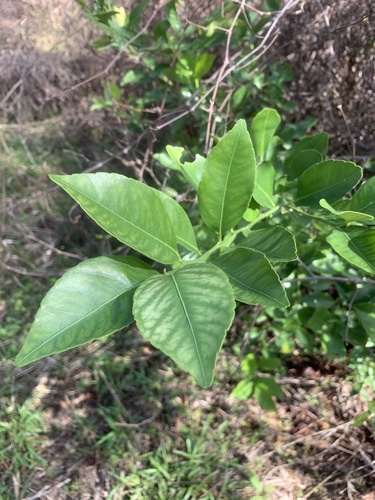
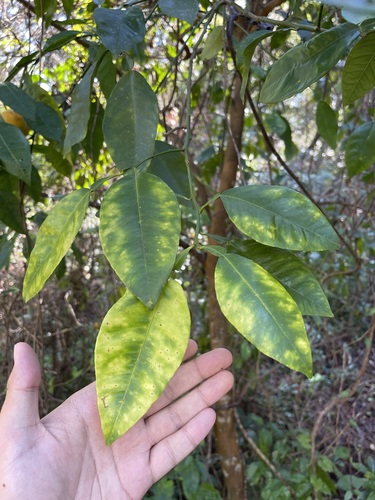
Zanthoxylum zanthoxyloides
(Lam.) Zepern. & Timler
Candle wood, Senegal prickly ash
iNaturalist· cc-by-nc-sa
(c) Marco Schmidt, some rights reserved (CC BY-NC-SA), uploaded by Marco Schmidt
iNaturalist· cc-by-nc-sa
(c) Marco Schmidt, some rights reserved (CC BY-NC-SA), uploaded by Marco Schmidt
Summary
Source: WikipediaZanthoxylum zanthoxyloides, also called Senegal prickly-ash or artar root, is a plant species in the genus Zanthoxylum. The plant contains isomeric divanilloylquinic acids (3,4-O-divanilloylquinic acid or burkinabin A, 3,5-O-divanilloylquinic acid or burkinabin B and 4,5-O-divanilloylquinic acid or burkinabin C). Burkinabin C, a type of hydrolysable tannin can be found in the root bark of F. zanthoxyloides. It also contains fagaronine, a benzophenanthridine alkaloid. A study by Williams, Soelberg and Jäger (2016) showed than ethanolic extracts of Z. zanthoxyloides have in vitro anthelmintic properties against the nematode Ascaris suum, a swine parasite that is closely related to the human parasite A. lumbricoides. The half maximal effective concentration (EC50) values were 94 μg/mL and 132 μg/mL, for roots and root bark, respectively. The authors concluded that these results encourage further investigation of the use of this plant as complementary treatment options for ascariasis.
Description
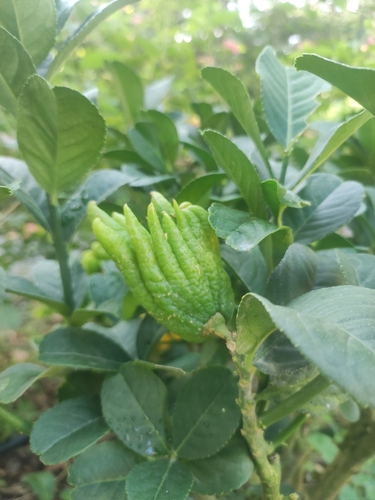
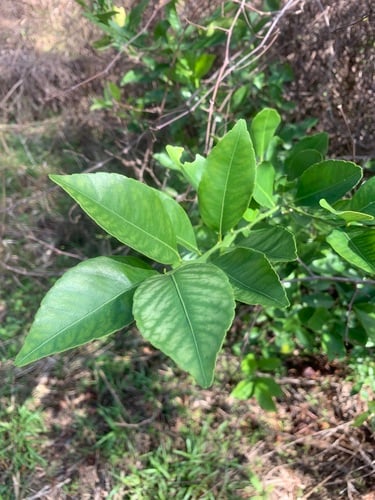
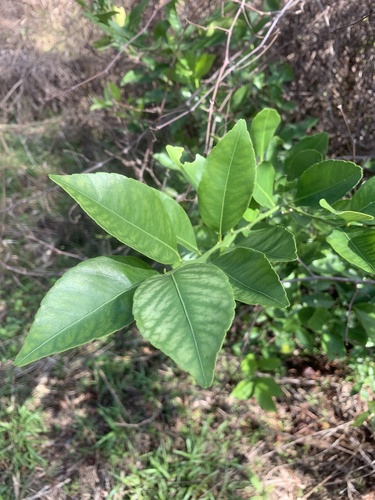
A shrub or small tree. It grows 6-8 m tall. It has spines. The trunk is straight and short. The branches are usually low down. The crown is round. The bark is grey and rough with fine cracks. The leaves are alternate and smooth. They are compound with leaflets along the stalk and one at the end. There are 5-7 pairs of opposite leaflets. The leaves are about 12 cm long. The leaflets are 5-10 cm long by 2-4 cm wide. They small of pepper and lemon when crushed. The flowers are of one sex and white or green. They are along stalks in loose groups 5-15 cm long. The fruit is an oval follicle. It is 5-6 mm across. There is one seed.
Edible Uses
The dried leaves are used as flavouring applied like pepper for meat and sauces. The fruit are eaten fresh or fermented. The bark, seeds, and roots are also edible portions.
Traditional Uses
The dried leaves are used as flavouring. They are applied like pepper for meat and sauces. The fruit are eaten fresh and also fermented.
This uses section is brief — help expand it
Medicinal Uses
The bark and leaves are used in medicine.
Known Hazards
The bark of the roots and stems is toxic.
Distribution
It is a tropical plant. It grows in woodland and savannah. It also grows in palm groves and coastal sands.
Where It Grows
Africa, Benin, Burkina Faso, Cameroon, Central Africa, Gambia, Ghana, Guinea, Guinée, Guinea-Bissau, Mali, Nigeria, Senegal, Togo, West Africa,
Cultivation
It is grown as a hedge. Trees can be cut back and will re-grow.
Other Uses
The seeds are used as beads in necklaces. Young shoots and twigs are used as chew-sticks to clean the teeth and maintain oral hygiene. The yellow wood is close-grained and extremely hard. It is durable and termite-proof.
Production
It often flowers twice a year.
Notes
It contains an alkaloid and some acids giving them an aroma. The bark and leaves are used in medicine.
Synonyms
Also Known As
Fagara jaune, Igi ata, Mubuo, Sanouyele, Senegal prickly ash, Tchanouwele, Toothache bark
References (17)
- Achigan-Dako, E, et al (Eds), 2009, Catalogue of Traditional Vegetables in Benin. International Foundation for Science.
- Avouhou, H. T., et al, 2012, Ethnobotanical Factors Influencing the Use and Management of Wild Edible Plants in Agricultural Environments in Benin. Ethnobotany Research & Applications Vol 10:571-592
- Batawila, K., et al, 2007, Diversite et gestion des legumes de cueillete au Togo. African Journal of Food, Agriculture, Nutrition and Development 7( 3& 4): 67
- Bojang, L., 1999, Non-wood Forest Products in The Gambia. EC-FAO Partnership Programme. (As Fagara xanthoxyloides)
- Bouba, A. A., et al, 2012, Proximate Composition, Mineral and Vitamin Content of Some Wild Plants Used as Spices in Cameroon. Food and Nutrition Sciences 3:423-432. (As Fagara xanthoxyloides)
Show all 17 references Hide references
- Burkill, H. M., 1985, The useful plants of west tropical Africa, Vol. 4. Kew. (As Zanthoxylum senegalense)
- Chapman, J. D. & Chapman, H. M., 2001, The Forest Flora of Taraba and Andamawa States, Nigeria. WWF & University of Canterbury. p 201
- Codjia, J. T. C., et al, 2003, Diversity and local valorisation of vegetal edible products in Benin. Cahiers Agricultures 12:1-12 (As xanthoxyloides)
- Djihounouck, Y., et al, 2018, Diversité Et Importance Socio-Economique Des Espèces Fruitières Sauvages Comestibles En Zone Kasa (Sud-Ouest Du Sénégal). European Scientific Journal December 2018 edition Vol.14, No.36 ISSN: 1857 – 7881
- Grivetti, L. E., 1980, Agricultural development: present and potential role of edible wild plants. Part 2: Sub-Saharan Africa, Report to the Department of State Agency for International Development. p 30 (As Fagara zanthoxyloides)
- INFOODSUpdatedFGU-list.xls
- Kafoutchoni, K. M., et al, 2018, Species richness, cultural importance, and prioritization of wild spices for conservation in the Sudano-Guinean zone of Benin (West Africa). Journal of Ethnobiology and Ethnomedicine. 14:67
- Le Houerou, H. N., (Ed.), 1980, Browse in Africa. The current state of knowledge. International Livestock Centre for Africa, Ethiopia. p 163 (As Fagara zanthoxyloides)
- Martin, F. W., et al, 1987, Perennial Edible Fruits of the Tropics. USDA Handbook 642 p 76 (As Fagara zanthoxyloides) p 78 (As Zanthoxylum senegalense)
- Segnon, A. C. and Achigan-Dako, E. G., 2014, Comparative analysis of diversity and utilization of edible plants in arid and semi-arid areas in Benin. Journal of Ethnobiology and Ethnomedicine. 10:80
- Seidemann J., 2005, World Spice Plants. Economic Usage, Botany, Taxonomy. Springer. p 155 (As Fagara xanthoxyloides)
- World Checklist of Useful Plant Species 2020. Royal Botanic Gardens, Kew