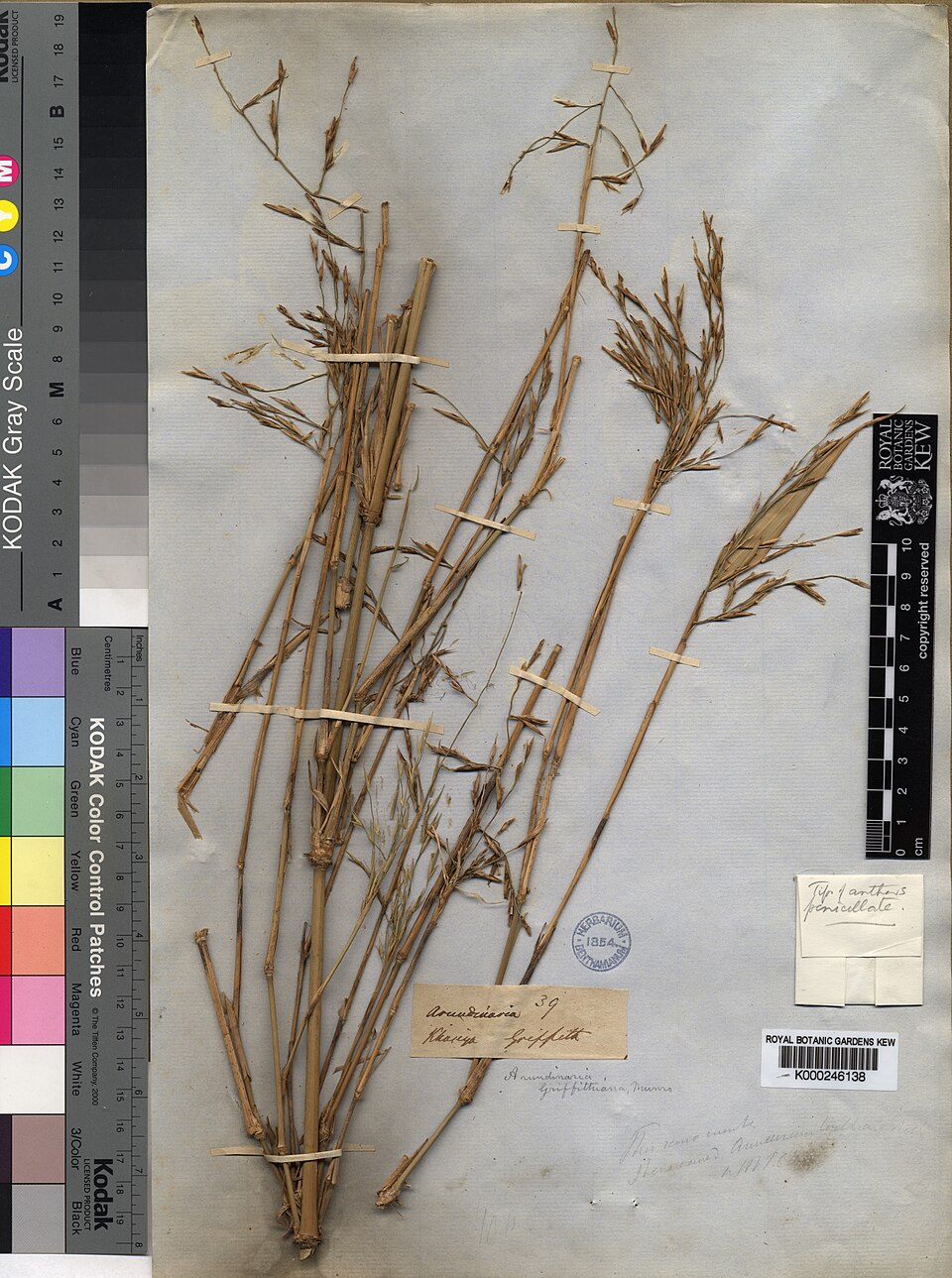
Astrebla lappacea
(Lindl.) Domin.
Curly mitchell grass
iNaturalist· cc-by
(c) Kym Nicolson, some rights reserved (CC BY), uploaded by Kym Nicolson
iNaturalist· cc-by
(c) Kym Nicolson, some rights reserved (CC BY)
Summary
Source: WikipediaAstrebla lappacea, commonly known as curly Mitchell grass, is a herb of the family Poaceae from the order Poales. It grows to 0.9 metres (3 ft) tall. Named in honour of Thomas Mitchell, the Latin specific epithet of lappacea is derived from lappa meaning with burrs. The most common of the Astrebla species, it is a widespread Australian inland plant. It is often seen on floodplains and heavy self-mulching clay soils, and flowers in response to rain or flooding. This grass is palatable to livestock, even when dry.
Description
An erect grass. It has underground stems or rhizomes. It keeps growing from year to year. It is dormant in the dry season. The ears are 15 cm long.
Edible Uses
The leaves, seeds, and whole plant serve as a cereal grain.
Distribution
It is a subtropical plant. It can grow in sandy, loamy and clay soils. It need well-drained locations. It grows in areas with an annual rainfall between 200-550 mm. It can tolerate frost. It can grow in salty and alkaline soils. It can tolerate drought. The plant is killed by flooding. It can grow in arid places.
Where It Grows
Africa, Australia, Guyana, Kenya, South America,
Cultivation
Plants can be grown from seeds. The seeds need to be stored for 12 months before planting for best germination.
Synonyms
References (3)
- Davies, C. L., Waugh, D. L. & Lefroy, E. C., 2005, Perenial Grain Crops for High Water Use. The case of Microlaena stipoides. RIRDC Publication No. 05/024
- Pascoe, B., 2018, Dark Emu. Aboriginal Australia and the birth of Agriculture. Magabala books, p 55 (As Astraleba)
- Royal Botanic Gardens, Kew (1999). Survey of Economic Plants for Arid and Semi-Arid Lands (SEPASAL) database. Published on the Internet; http://www.rbgkew.org.uk/ceb/sepasal/internet [Accessed 8th May 2011]