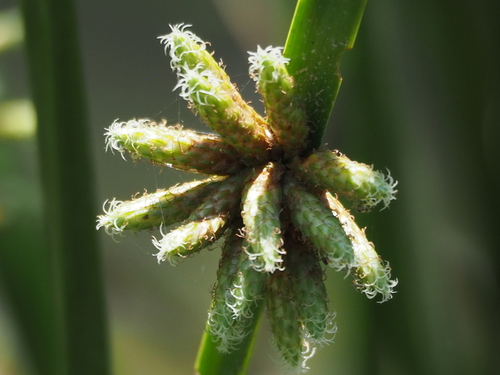
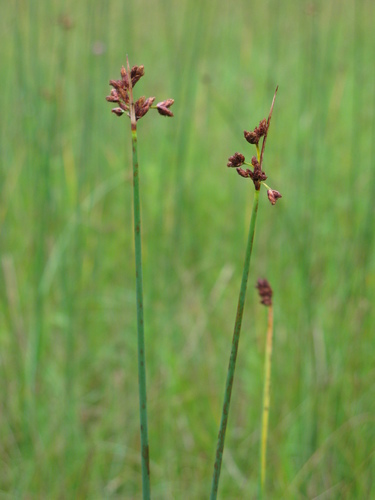
Carex kobomugi
Ohwi
Kobomugi sedge
iNaturalist· cc-by
(c) 國立臺灣博物館, some rights reserved (CC BY), uploaded by 國立臺灣博物館
iNaturalist· cc-by-nc
(c) lecanorchis, some rights reserved (CC BY-NC)
iNaturalist· cc-by
(c) 國立臺灣博物館, some rights reserved (CC BY), uploaded by 國立臺灣博物館
Summary
Source: WikipediaCarex kobomugi is a species of sedge, known as the Japanese sedge or Asiatic sand sedge, that lives in sandy coastal areas of eastern Asia, and has become an invasive species in the north-eastern United States.
Description
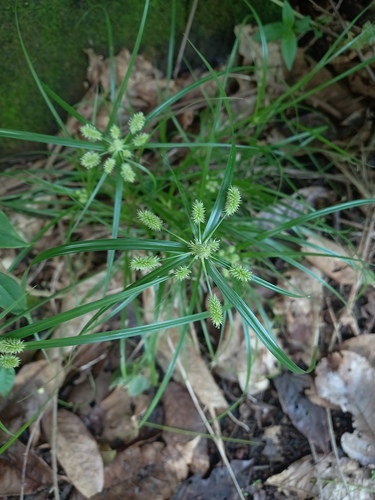
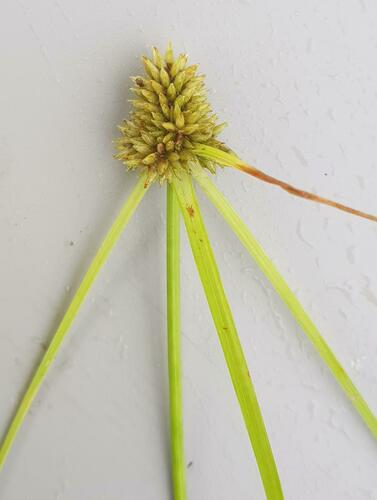
A sedge. These grow in clumps and have grass like leaves and solid stalks. It grows 10-20 cm high. The culms are 3 sided. The leaves are rough and 10-20 cm long by 4-6 mm wide. They are sharp. The spikelets are in dense heads are the top of the plant.
Edible Uses
The root can be eaten cooked. The seed is edible but is considered an emergency food, used only when nothing else is available — it is very small and particularly fiddly to use.
Traditional Uses
Starch is extracted from the seeds.
This uses section is brief — help expand it
Medicinal Uses
None known.
Distribution
It is a temperate plant. It grows on sand dunes and seashores.
Where It Grows
Asia, China, Japan, Korea, Manchuria, North America, Russia, Taiwan, USA,
Cultivation
We have very little information on this species and do not know if it will be hardy in Britain, though judging by its native range it should succeed outdoors in most parts of this country. It is likely to tolerate maritime exposure. The following notes are based on the general needs of the genus. Easily grown in a damp to wet soil in full sun or shade. Members of this genus are rarely if ever troubled by browsing deer.
Propagation
Sow seed in situ in spring in moist soil in light shade. If seed is scarce, sow in a cold frame and plant out in summer. Seed typically germinates in 2–6 weeks at 15°C. Divide in spring — larger clumps can go directly into permanent positions, but smaller clumps are best potted up and grown on in a cold frame until rooting well, then planted out in summer or the following spring.
Other Uses
This plant has potential uses in land reclamation, landscape improvement, and soil conservation, particularly for dune stabilization within its native range. However, there are considerable doubts about its effectiveness compared to native species when used outside that range.
Notes
There are about 2000 Carex species. There are 200 species in tropical America.
Synonyms
Also Known As
Japanese sedge; sea isle Japanese sedge; Asiatic sand sedge. Chinese: shai cao.
References (4)
- Hu, Shiu-ying, 2005, Food Plants of China. The Chinese University Press. p 299
- Kiple, K.F. & Ornelas, K.C., (eds), 2000, The Cambridge World History of Food. CUP p 1850
- Mem. Coll. Sci. Kyoto Imp. Univ., Ser. B, Biol. 5(3):281. 1930
- Plants for a Future database, The Field, Penpol, Lostwithiel, Cornwall, PL22 0NG, UK. http://www.scs.leeds.ac.uk/pfaf/