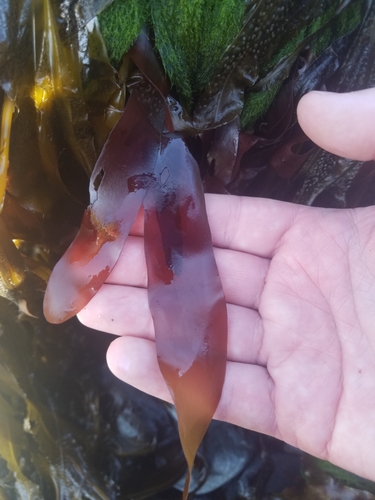
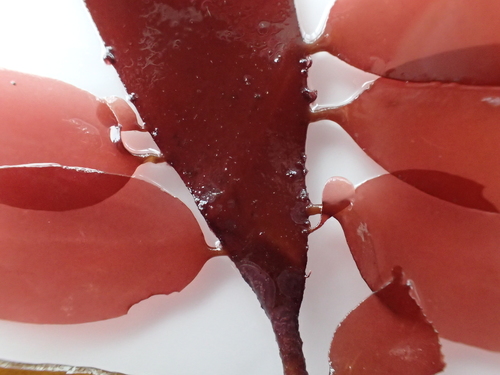
Palmaria mollis
(Setchell & N. L. Gardner) van der Meer & C. J. Bird
Ribbon seaweed
iNaturalist· cc-by-nc
(c) Michael G. Shepard, some rights reserved (CC BY-NC)
iNaturalist· cc-by-nc
(c) Paul Norwood, some rights reserved (CC BY-NC)
iNaturalist· cc-by-nc
(c) Michael G. Shepard, some rights reserved (CC BY-NC)
Description
A seaweed. It is a red seaweed. Several blades branch off a single holdfast. They can be 20-25 cm long.
This description is brief — help expand it
Edible Uses
Dulse is commonly used as food and medicine in Ireland, Iceland and Atlantic Canada. It can be found in many health food stores or fish markets and can be ordered directly from local distributors. It is also used as fodder for animals in some countries. Dulse is a good source of minerals and vitamins compared with other vegetables, contains all trace elements needed by humans, and has a high protein content. Dulse contains iodine, which prevents goitre. It is commonly found from June to September and can be picked by hand when the tide is out. When picked, small snails, shell pieces, and other small particles can be washed or shaken off the plant, which is then spread to dry. Some gatherers may turn it once and roll it into large bales to be packaged later. Fresh dulse can be eaten directly off the rocks before sun-drying. Sun-dried dulse is eaten as is or is ground to flakes or a powder. When used in cooking, dulse's properties are similar to those of a flavour-enhancer. In Iceland, the tradition is to eat it with butter.. It can be pan-fried quickly into chips, baked in the oven covered with cheese, with salsa, or simply microwaved briefly. It can be used in soups, chowders, sandwiches, and salads, or added to bread or pizza dough. Finely diced, it can be used as a flavour enhancer in meat dishes, such as chili, in place of monosodium glutamate. In Ireland dulse can be used to make "White Soda Bread". In Ballycastle, Northern Ireland, it is traditionally sold at the Ould Lammas Fair. It is particularly popular along the Causeway Coast. Although a fast-dying tradition, many gather their own dulse. Along the Ulster coastline from County Down to County Donegal, it is eaten dried and uncooked as a snack. It is commonly referred to as dillisk on the west coast of Ireland. Dillisk is usually dried and sold as a snack food from stalls in seaside towns by periwinkle sellers. Researchers at Oregon State University's Hatfield Marine Science Center have selected a fast-growing strain of Pacific dulse (P. mollis). Originally intended as a feed for abalone farming, they claim their strain of the seaweed tastes like bacon when fried.
Distribution
It is a temperate plant.
Where It Grows
Alaska, Asia, Canada, North America, Russia, USA,
Synonyms
References (2)
- http://www.seavegetables.com
- Zemke-White, W. L. & Ohno, M., 1999, World seaweed utilisation: An end-of-century summary. Journal of Applied Phycology 11: 369-376