Kappaphycus alvarezii
(Doty) Doty ex P. C. Silva
iNaturalist· cc-by
(c) Secretaria de Agricultura e Abastecimento Agriculturasp, some rights reserved (CC BY)
iNaturalist· cc-by-nc
(c) Anuschka Faucci, some rights reserved (CC BY-NC)
iNaturalist· cc-by-nc
(c) Anuschka Faucci, some rights reserved (CC BY-NC)
Summary
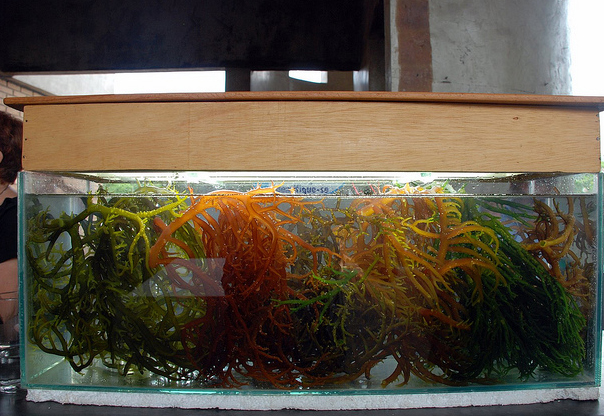
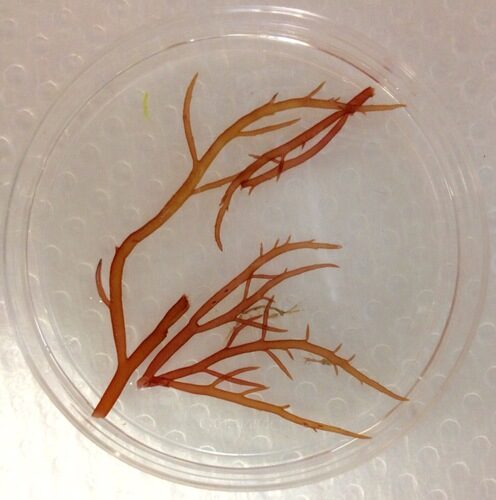
Source: WikipediaKappaphycus alvarezii, the elkhorn sea moss, is a species of red algae. The elkhorn sea moss varies in size, weight, and age. It is a dark greenish-brown hue and can sometimes be deep purple. The moss is cylindrical in shape throughout the seaweed. Its diameter averages 1.526 mm when dried. Near the base of the seaweed, its average length is from 1 mm to 17 mm and 1 mm to 2 mm in diameter. Firm algae are around 2 m tall, with axes and branches around 1–2 cm in diameter. They reproduce both sexually and asexually through vegetative propagation. Cross sections of the Elkhorn sea moss has a medulla composed of small thick-walled cells interspaced among large parenchyma cells. This moss is used for various types of foods that humans consume and can also be used to make a jelly-like dessert. Elkhorn sea moss is a good source of minerals and of high commercial interest. It is one of the most important commercial sources of carrageenans, a family of gel-forming, viscosifying polysaccharides. Farming methods affect the character of the carrageenan that can be extracted from the seaweed. It is very fast-growing, known to double its biomass in 15 days.
Description
A red seaweed in the family Solieriaceae found in tropical waters.
This description is brief — help expand it
Edible Uses
Used in salads and dried. Processed for carrageenan extraction.
Traditional Uses
It is used in salads. It is used for carrageenan. It is dried.
This uses section is brief — help expand it
Medicinal Uses
Kappaphycus is a major source of carrageenan. Carrageenan is an additive used for thickening and preserving foods and drinks. Carrageenan is used for their rheological properties such as emulsifiers, binders. It is also used for suspension or stabilization in a wide range of pharmaceutical carriers, processed food products, and cosmetics. It is used in things like toothpaste, dairy products, and jellies. Carrageenan is found within the cell wall of Kappaphycus, which contributes to the antioxidant potential and the presence of ascorbic acid, various phenolics, and vitamin A. Antioxidants defend against oxidative damage from reactive oxygen species. These species can damage cells by chain reactions. All cells contain antioxidants to reduce or prevent said damage. Different carrageenan types differ in composition and conformation, resulting in a wide range of rheological and functional properties. Carrageenans are used in a variety of commercial applications as gelling, thickening, and stabilizing agents, especially in food products such as frozen desserts, chocolate milk, cottage cheese, whipped cream, instant products, yogurt, jellies, pet foods, and sauces. Aside from these functions, carrageenans are used in pharmaceutical formulations, cosmetics, and industrial applications such as mining. Carrageenan is extracted from this seaweed in two ways. In native extraction, the seaweed is made into an aqueous solution, and the residue is filtered, leaving nearly pure carrageenan. The alkaline-modified method is less expensive and easier. The seaweed is mixed in an alkali solution, leaving a mixture of carrageenan and cellulose that can be sold as semirefined carrageenan. K. alvarezii is affected by ice-ice, a disease that severely reduces its yield.
Distribution
It grows in tropical places.
Where It Grows
Africa, Asia, Caribbean, China, Cuba, East Africa, East Timor, Fiji, FSM, Hawaii, India, Indochina, Indonesia, Kenya, Kiribati, Malaysia, Micronesia, Pacific, Philippines, SE Asia, Tanzania, Timor-Lests, Vietnam, West Indies,
Nutrition
| Part | Moisture | kJ | kcal | Protein | Vit A | Vit C | Iron | Zinc |
|---|---|---|---|---|---|---|---|---|
| Seaweed | — | — | 16.2 | — | — | — | — | — |
Synonyms
Also Known As
Budi tasi
References (5)
- Cherry, P., et al, 2019, Risks and benefits of consuming edible seaweeds. Nutrition ReviewsVR Vol. 77(5):307–329
- Fayaz, M., et al, 2005, Chemical Composition, Iron Bioavailability, and Antioxidant Activity of Kappaphycus alvarezzi (Doty). Journal of Agricultural and Food Chemistry 53: 792-797
- http://www.seavegetables.com
- Lee, B., 2008, Seaweed Potential as a marine vegetable. RIRDC Publication No. 08/009
- Zemke-White, W. L. & Ohno, M., 1999, World seaweed utilisation: An end-of-century summary. Journal of Applied Phycology 11: 369-376 (Also as Eucheuma alvarezii)