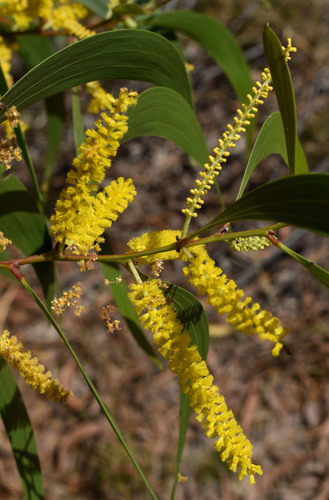
Vachellia xanthophloea
(Benth.) Banfi & Galasso
African thorn acacia, Fever tree
iNaturalist· cc-by-nc
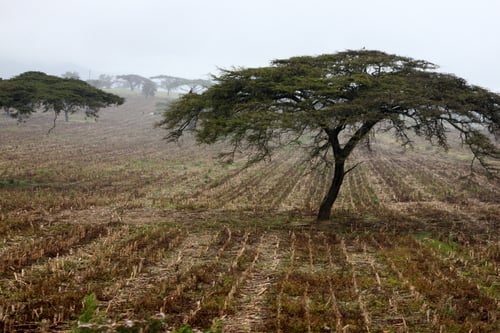
(c) William Maliepaard, some rights reserved (CC BY-NC), uploaded by William Maliepaard
iNaturalist· cc-by-nc
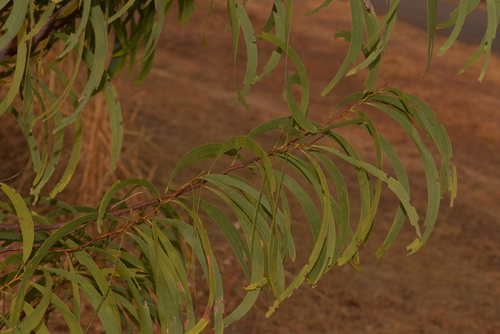
(c) ASSEDE Eméline S.P., some rights reserved (CC BY-NC), uploaded by ASSEDE Eméline S.P.
iNaturalist· cc-by-nc
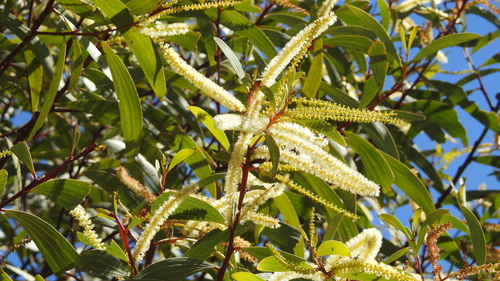
(c) James Kuria NDUNG’U, some rights reserved (CC BY-NC), uploaded by James Kuria NDUNG’U
Summary
Source: WikipediaVachellia xanthophloea (previously Acacia xanthophloea) is a tree in the family Fabaceae, commonly known in English as the fever tree. This species of Vachellia is native to eastern and southern Africa (Botswana, Kenya, Malawi, Mozambique, Somalia, South Africa, Eswatini, Tanzania, Zambia, Zimbabwe). It has also become a landscape tree in other warm climates, outside of its natural range.
Description
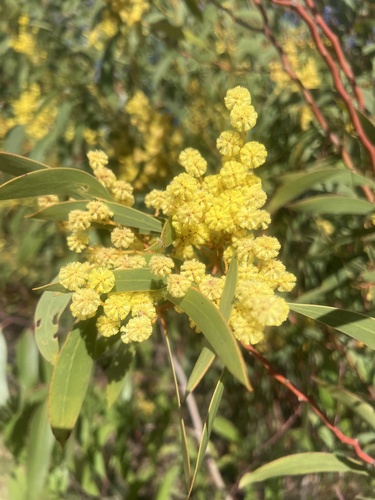
A tree. It grows 25 m tall. The trunk can be 60 cm across. The bark is smooth and powdery. The throns are straight and white in pairs and 10 cm long. The leaves have spines. The flowers are yellow and in round heads. The fruit are yellow brown pods. They are 13 cm long and flat. They are slightly constricted between the seeds and break into segments.
Edible Uses
A gum occurs in large quantities on the trunk. It is said to be edible, and is eaten by monkeys. The gum is water soluble and contains galactose, arabinose, rhamnose, glucuronic acid and 4-O-methyl-α- D-glucuronic acid.
Medicinal Uses
A decoction of the bark is used to treat indigestion and sickle cell anaemia. The powdered bark is used as an emetic to treat malaria, and also against eye complaints. In trials, bark extracts have shown weak in-vitro antimalarial activity and considerable antimicrobial activity. Leaf extracts have shown antibacterial activity against Staphylococcus aureus and Escherichia coli.
Known Hazards
Especially in times of drought, many Acacia species can concentrate high levels of the toxin Hydrogen cyanide in their foliage, making them dangerous for herbivores to eat.
Distribution
It is a tropical plant. It grows between 40-2,100 m above sea level. It can grow in arid places.
Where It Grows
Africa, Botswana, Djibouti, East Africa, Eswatini, Kenya, Malawi, Mozambique, Somalia, South Africa, Southern Africa, Swaziland, Tanzania, Zambia, Zimbabwe,
Cultivation
Plants can be grown from seeds. They have a reasonable germination rate. Seed that have been stored should be soaked in water for 24 hours.
Propagation
Seed - it has a hard seedcoat and may benefit from scarification before sowing to speed up germination. This can usually be done by pouring a small amount of nearly boiling water on the seeds (being careful not to cook them!) and then soaking them for 12 - 24 hours in warm water. By this time they should have imbibed moisture and swollen - if they have not, then carefully make a nick in the seedcoat (being careful not to damage the embryo) and soak for a further 12 hours before sowing. Germination of treated seed is generally fair, reaching about 70% after 2 weeks. When seedlings have reached the 2-leaf stage, 6 - 8 weeks after sowing, they should be transplanted from seedling trays into nursery bags. Care should be taken not to damage the long taproot. Cuttings.
Other Uses
The bark contains tannin in considerable quantity, but it does not produce good leather. The heartwood is pale brown with a reddish tinge; it is distinctly demarcated from the wide layer of paler-coloured sapwood. The wood is moderately hard, fairly heavy; it should be dried with care because it is prone to splitting and cracking; it finishes smoothly; but is susceptible to borer attack. A general-purpose timber, which is used in construction and for carpentry, boat building, boxwood, furniture, mortars, domestic utensils, troughs and fence poles. The wood is used as firewood, although the gum leaves a black tar-like deposit when burnt. It makes good quality charcoal. A popular garden tree, it has been grown in hedges. The dappled shade produced underneath the open canopy is ideal for smaller plants which require protection from the full brunt of the suns rays but still require sufficient light.
Production
It grows quickly.
Notes
There are about 1,350 Acacia species. Over 1,000 occur in Australia. Also as Mimosaceae.
Synonyms
Also Known As
Aari, Fever tree, Fever-tree thorn, Honywam, Jelenga, Kimwea, Koorsboom, Murera, Mussucatchuma, Narmo, Olerai
References (6)
- Fowler, D. G., 2007, Zambian Plants: Their Vernacular Names and Uses. Kew. p 33 (As Acacia xanthophloea)
- Lemmens, R.H.M.J., 2006. Acacia xanthophloea Benth. [Internet] Record from Protabase. Louppe, D., Oteng-Amoako, A.A. & Brink, M. (Editors). PROTA (Plant Resources of Tropical Africa / Ressources végétales de l’Afrique tropicale), Wageningen, Netherlands. (As Acacia xanthophloea)
- Maundu, P. et al, 1999, Traditional Food Plants of Kenya. National Museum of Kenya. p 48 (As Acacia xanthophloea)
- Mutie, F. M., et al, 2023, Important Medicinal and Food Taxa (Orders and Families) in Kenya, Based on Three Quantitative Approaches. Plants 2023, 12, 1145
- Royal Botanic Gardens, Kew (1999). Survey of Economic Plants for Arid and Semi-Arid Lands (SEPASAL) database. Published on the Internet; http://www.rbgkew.org.uk/ceb/sepasal/internet [Accessed 27th April 2011] (As Acacia xanthophloea)
Show all 6 references Hide references
- World Checklist of Useful Plant Species 2020. Royal Botanic Gardens, Kew