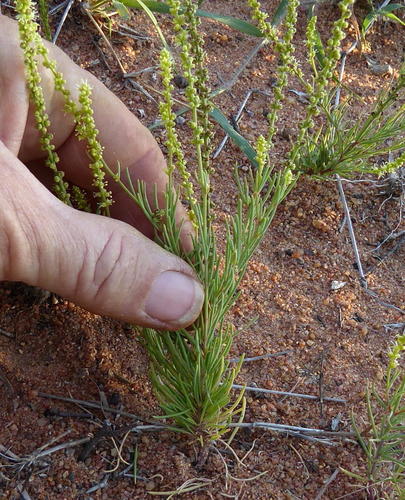
Corbichonia decumbens
(Forssk.) Exell
iNaturalist· cc-by-nc
(c) Morten Ross, some rights reserved (CC BY-NC), uploaded by Morten Ross
iNaturalist· cc-by-sa
(c) M Kriek, some rights reserved (CC BY-SA)
Description
A herb. The branches are rigid. It can be erect or lie along the ground. It can grow from seeds each year or grow for a few years. The leaves are narrowly oval and narrowed. They are 2-4 cm long by 1-2.6 cm wide. They are fleshy and have a short sharp tip at the end. The flowers are in groups about 10 cm long and the flowers are 5 mm across. The fruit is a papery capsule 5-6 mm across. It opens by 5 valves. The seeds are 1.1 mm long and black and shiny.
Edible Uses
The leaves are eaten as a vegetable.
Traditional Uses
The leaves are eaten as a vegetable.
This uses section is brief — help expand it
Distribution
It grows in tropical and subtropical places. In Pakistan it grows in rocky and sandy places and hot dry areas up to 1,000 m above sea level. It can grow in arid places.
Where It Grows
Africa, Asia, Botswana, Central Africa, Chad, East Africa, Egypt, Eswatini, Ethiopia, India, Kenya, Malawi, Mauritania, Middle East, Mozambique, Niger, North Africa, Pakistan, Sahel, Saudi Arabia, South Africa, Southern Africa, Sudan, Swaziland, Tanzania, Uganda, West Africa, Zimbabwe,
Notes
It is also put in the family Molluginaceae and Aizoaceae. There are 2 Corbichonia species.
Synonyms
Also Known As
Golijeru, Gnomai, Inyongwane, Inbongwane, Mocholo, Nhacapande, Sharunnay keeray, Xikhavichana
References (16)
- Addis, G., Asfaw, Z & Woldu, Z., 2013, Ethnobotany of Wild and Semi-wild Edible Plants of Konso Ethnic Community, South Ethiopia. Ethnobotany Research and Applications. 11:121-141
- Ambasta, S.P. (Ed.), 2000, The Useful Plants of India. CSIR India. p 414 (As Orygia decumbens)
- Flora of Pakistan.
- Fox, F. W. & Young, M. E. N., 1982, Food from the Veld. Delta Books. p 68
- GAMMIE, (As Orygia decumbens)
Show all 16 references Hide references
- Long, C., 2005, Swaziland's Flora - siSwati names and Uses http://www.sntc.org.sz/flora/
- Lulekal, E., et al, 2011, Wild edible plants in Ethiopia: a review on their potential to combat food insecurity. Afrika Focus - Vol. 24, No 2. pp 71-121
- Matlhare, T., et al, Vegetables in Botswana. p 21 Bioversity website.
- Royal Botanic Gardens, Kew (1999). Survey of Economic Plants for Arid and Semi-Arid Lands (SEPASAL) database. Published on the Internet; http://www.rbgkew.org.uk/ceb/sepasal/internet [Accessed 4th May 2011]
- Ruiters-Welcome, A. K., 2019, Food plants of southern Africa. Ph.D. thesis. Univ. of Johannesburg p 47
- Shackleton, S. E., et al, 1998, Use and Trading of Wild Edible Herbs in the Central Lowveld Savanna Region, South Africa. Economic Botany, Vol. 52, No. 3, pp. 251-259
- SHORTT, (As Glinus trianthemoides)
- Singh, H.B., Arora R.K.,1978, Wild edible Plants of India. Indian Council of Agricultural Research, New Delhi. p 39 (As Orygia decumbens)
- WATT, (As Orygia decumbens)
- Welcome, A. K. & Van Wyk, B.-E., 2019, An inventory and analysis of the food plants of southern Africa. South African Journal of Botany 122 (2019) 136–179
- World Checklist of Useful Plant Species 2020. Royal Botanic Gardens, Kew