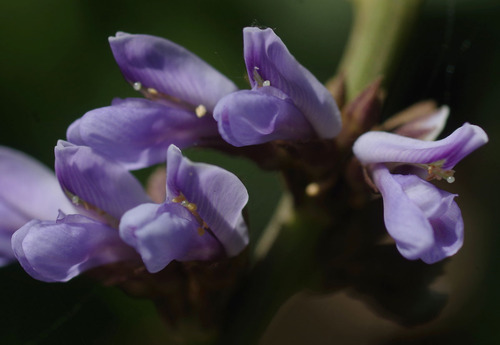
Neonotonia wightii
(Wight & Arn.) Lackey
Robust pioneer creeper, Kudzu vine, Perennial soybean
iNaturalist· cc-by-nc
(c) melodieoll, some rights reserved (CC BY-NC)
iNaturalist· cc0
no rights reserved, uploaded by 葉子
Summary
Source: WikipediaNeonotonia wightii, the perennial soybean, is a species of flowering plant in the family Fabaceae, native to sub‑Saharan Africa, Yemen, India, and Sri Lanka, and widely introduced as a forage in Brazil, Bolivia, Paraguay, northern Argentina, the Mascarene Islands, Peninsular Malaysia, Java, New Guinea, Queensland and New South Wales in Australia, and Fiji. It is shade tolerant.
Description
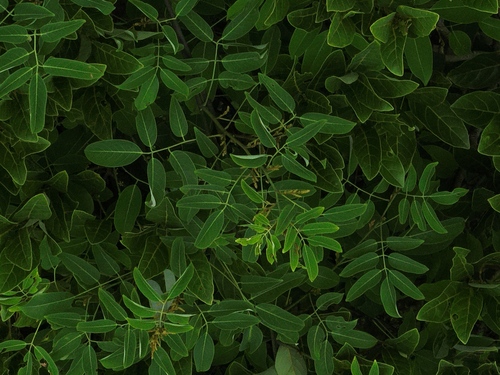
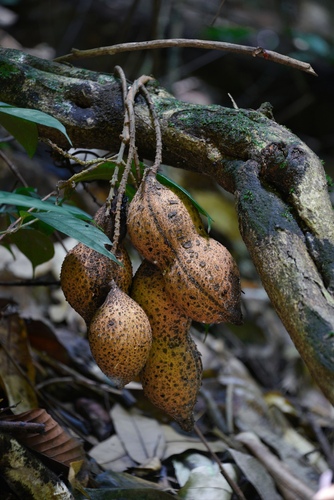
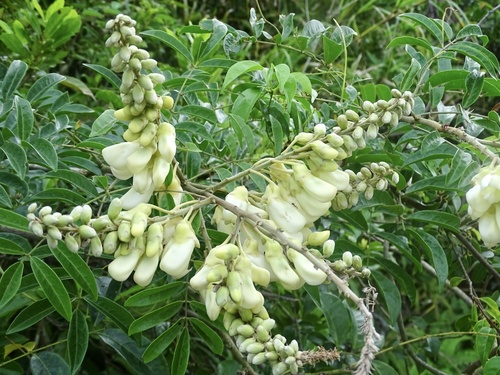
A climbing or trailing bean plant. It is a herb that keeps growing from year to year. The stems are woody at the base. Plants can be 4.5 m long. The stems can be covered with rusty hairs. The leaves have 3 leaflets. The leaflets are oval and 2-15 cm long by 1-13 cm wide. They are oval and rounded at the base. They are hairy on both surfaces. The leaf stalks are 2-12 cm long. The flower cluster can have 20 to 150 flowers. The flower standard is reddish blue and can have white patches. The fruit are oblong pods 2-4 cm long and 2-5 mm wide. They can have rusty coloured hairs. The pods are somewhat restricted between the seeds. The seeds are reddish brown and oblong. They are 2-4 mm long and 1.5-2.8 mm wide. They have a finely rough surface.
Edible Uses
The leaves are cooked and eaten as a vegetable. The tubers and roots are also edible portions. The leaves are particularly widely used in Malawi.
Traditional Uses
The leaves are cooked and eaten.
This uses section is brief — help expand it
Medicinal Uses
No medicinal uses specified in available data.
Distribution
It is a tropical plant. In Papua New Guinea it grows between 1500-1650 m altitude. It needs are annual rainfall of 750-1525 mm. It needs good quality soils. In Argentina it grows below 500 m above sea level.
Where It Grows
Africa, Angola, Argentina, Asia, Australia, Botswana, Brazil, Burundi, Cameroon, Central Africa, Chad, Congo, East Africa, Ethiopia, Fiji, Gabon, Ghana, Guinea, Guinée, India, Indonesia, Hawaii, Kenya, Liberia, Malawi, Malaysia, Mauritius, Middle East, Mozambique, Nigeria, Pacific, Papua New Guinea, PNG, Paraguay, Reunion, Rwanda, Sao Tome and Principe, Saudi Arabia, SE Asia, Sierra Leone, South Africa, Southern Africa, South America, Sri Lanka, Sudan, Tanzania, Togo, West Africa, Yemen, Zambia, Zimbabwe,
Cultivation
Perennial soybean is a native of tropical Africa, where it is found at elevations from sea level up to 2,450 metres. It grows best in areas where annual daytime temperatures are within the range 20 - 30°c, but can tolerate 13 - 32°c. Mature plants can be killed by temperatures of -10°c or lower, but young growth will be severely damaged at -2°c. A survival rate of 50% of the plants has been recorded where temperatures went down to -10°c. Normally the plant has limited frost tolerance and leaf damage at 0°c occurs in all cultivars. It prefers a mean annual rainfall in the range 800 - 1,800mm, but tolerates 550 - 4,000mm. It is best adapted to summer rainfall areas. In Kenya, at the equator, it can be grown in the lowlands and up to 2,450 metres in elevation, in Colombia it can be found from sea level to 1,800 metres in elevation. Performs best in deep, freely drained latosolic soils derived from basic igneous rocks, on self-mulching black soils and fertile alluvial soils. It is not suited to acid podzolic soil or solodic soils. It prefers free-draining loams to clays of basaltic or alluvial origin. It is somewhat tolerant of saline soils. Prefers a pH in the range 6.5 - 7, tolerating 5.7 - 7.5. Established plants are drought tolerant. Perennial soybean is a vigorous, perennial, twining, leguminous vine that can smother grasses and other low-lying vegetation. It has escaped from cultivation and become a weed in areas outside its native range, and is classified as 'Invasive' in some Pacific Islands.. Dry matter production may be 3.8-4.5 t/ha. This species has a symbiotic relationship with certain soil bacteria, these bacteria form nodules on the roots and fix atmospheric nitrogen. Some of this nitrogen is utilized by the growing plant but some can also be used by other plants growing nearby.
Propagation
Seed - it has a hard seedcoat and may benefit from scarification before sowing to speed up germination. This can usually be done by pouring a small amount of nearly boiling water on the seeds (being careful not to cook them!) and then soaking them for 12 - 24 hours in warm water. By this time they should have imbibed moisture and swollen - if they have not, then carefully make a nick in the seedcoat (being careful not to damage the embryo) and soak for a further 12 hours before sowing.
Other Uses
The plant can be used for soil restoration; as a fallow crop in abandoned gardens and as a cover crop and for woody weed control in overgrazed pastures.
Other Information
The leaves are widely used in Malawi.
Notes
It is being used as a tropical pasture legume.
Synonyms
Also Known As
Kattumochai, Yembe
References (12)
- Arinathan, V., et al, 2007, Wild edibles used by Palliyars of the western Ghats, Tamil Nadu. Indian Journal of Traditional Knowledge. 6(1) pp 163-168 (As Neonotonia wightii var. coimbatorensis)
- Burkill, H. M., 1985, The useful plants of west tropical Africa, Vol. 3. Kew. (As Glycine wightii)
- Flora Zambesiaca. http://apps.kew.org/efloras
- Grubben, G. J. H. and Denton, O. A. (eds), 2004, Plant Resources of Tropical Africa 2. Vegetables. PROTA, Wageningen, Netherlands. p 563
- Hymowitz, T., 1979, Soybeans, in Simmonds N.W.,(ed), Crop Plant Evolution. Longmans. London. p 159 (As Glycine wightii)
Show all 12 references Hide references
- ILDIS Legumes of the World http:www:ildis.org/Legume/Web
- Jardin, C., 1970, List of Foods Used In Africa, FAO Nutrition Information Document Series No 2.p 79 (As Glycine wightii)
- Long, C., 2005, Swaziland's Flora - siSwati names and Uses http://www.sntc.org.sz/flora/
- Taxon 15:35. 1966 (As Glycine wightii)
- Verdcourt, B., 1979, Manual of New Guinea Legumes. Botany Bulletin No 11, Division of Botany, Lae, Papua New Guinea. p 493 (As Glycine wightii)
- Williamson, J., 2005, Useful Plants of Malawi. 3rd. Edition. Mdadzi Book Trust. p 122 (As Glycine wightii)
- World Checklist of Useful Plant Species 2020. Royal Botanic Gardens, Kew p 321