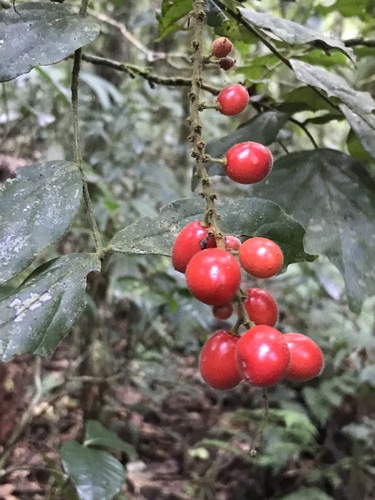
Picramnia pentandra
Sw.
iNaturalist· cc-by-nc
(c) Jenny Evans, some rights reserved (CC BY-NC)
iNaturalist· cc-by-sa
(c) Douglas Goldman, some rights reserved (CC BY-SA)
Description
A tropical to subtropical tree in the Picramniaceae family, native to warm regions.
This description is brief — help expand it
Edible Uses
The plant produces honey.
Medicinal Uses
A bitter tonic is made from the leaves and bark. It is used to treat fevers, anorexia, and stomach problems and as an enema to treat for worms. Qualitative tests indicated the presence of antioxidants, phenols, terpenoids, and alkaloids in ethanol extracts of tissues.
Distribution
It is a tropical and subtropical plant.
Where It Grows
Bahamas, Caribbean, Colombia, Cuba, Dominican Republic, Haiti, North America, Puerto Rico, South America, Trinidad, USA, Venezuela, West Indies,
Cultivation
A plant of the subtropics to tropics, where it can be found at elevations up to 600 metres. It is found in areas where the mean annual rainfall can range from 750 - 2,400mm. Plants are moderately intolerant to shade, being able to grow under the canopy of low basal-area forests as well as in openings. Seedlings are apparently more tolerant of shade than adults, and are able to progress from the understorey into the canopy of low forests. They succeed in a wide variety of well-drained soils derived from most parent materials. They are usually not found on the most fertile sites (where competition is severe) or on the worst, such as eroded, rocky ridge tops. The plant has a slow to moderate rate of growth and usually lives from 30 - 60 years. Flowering can commence when plants are 150 - 200cm tall providing sufficient light is available. The plant can flower and produce fruit all year round in moist tropical climates. A dioecious species, both male and female forms need to be grown if fruit and seed are required.
Propagation
Seed - sow in containers or in a nursery seedbed. When sown fresh, without pre-treatment, there was a 100% germination rate, starting 14 days after sowing. Prick the seedlings out when they are large enough to handle, and plant out into permanent positions when 15 - 30cm tall.
Other Uses
The light-coloured wood is hard and heavy. It is little used, other than for fuel. A natural pioneer species, it invades logged land, old pasture and abandoned fields during the scrubby stage. It can be used in planting schemes for restoring native forests.
Notes
Also as Simaroubaceae.
Synonyms
References (2)
- Grandtner, M. M., 2008, World Dictionary of Trees. Wood and Forest Science Department. Laval University, Quebec, Qc Canada. (Internet database http://www.wdt.qc.ca)
- Plants of Haiti Smithsonian Institute http://botany.si.edu/antilles/West Indies