Acanthophoenix rubra
(Bory) H. Wendl.
Barbel palm
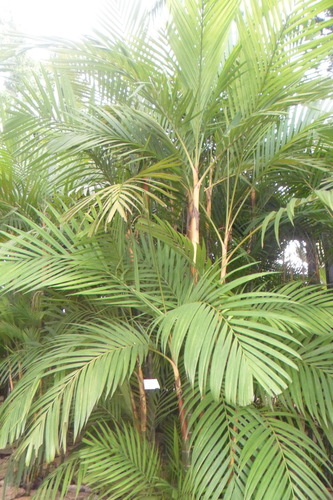
iNaturalist· cc-by-nc
(c) Sylvain Piry, some rights reserved (CC BY-NC), uploaded by Sylvain Piry
iNaturalist· cc-by-nc
(c) CORDENOS Thierry, some rights reserved (CC BY-NC), uploaded by CORDENOS Thierry
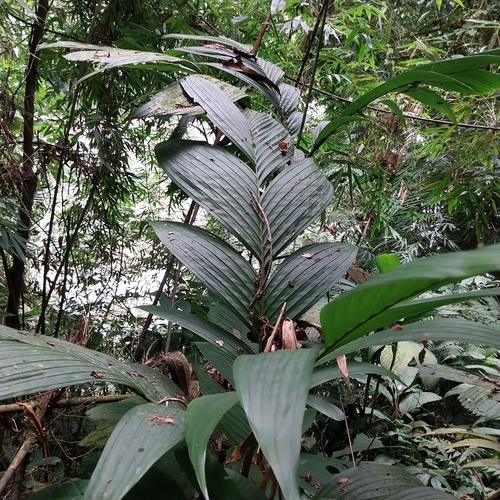
iNaturalist· cc-by-nc
(c) Jean-Philippe BASUYAUX, some rights reserved (CC BY-NC), uploaded by Jean-Philippe BASUYAUX
Summary
Source: WikipediaAcanthophoenix rubra, the barbel palm, is a critically endangered palm endemic to Mauritius, Rodrigues, and La Reunion that is prized for its edible palm hearts.
Description
A shrub or small tree. It grows 5 m tall. There are prickles along the stem. The leaves are twice divided and there are 8-18 pairs of pinnae. There are up to 50 pairs of pinnules on each pinnae. The flowers are yellow. They are in large clusters at the ends of branches. The pods are flattened.
Edible Uses
The leaves, cabbage (palm heart), and vegetable portions are edible and widely consumed, particularly in Mauritius where it is cultivated commercially.
Medicinal Uses
A decoction of the roots is used as a diuretic.
Distribution
It grows in tropical and subtropical regions. It needs to be in a frost free place. It needs well drained soil. In Mauritius it grows above 500 m above sea level. In Reunion it grows between 500-1,500 m above sea level. It suits hardiness zones 10-12.
Where It Grows
Africa, Australia, Mascarene Islands, Mauritius, Reunion,
Cultivation
Plants can be grown from seed. Seed germinate readily. Germination takes 2-4 months. Seeds grow better if soaked before planting. Young plants are best in light shade.
Production
The palm hearts turn brown quickly.
Other Information
It is cultivated in Mauritius for palm hearts.
Notes
There is only one Acanthophoenix species. It is an at risk plant. It contains catecholases.
Synonyms
Also Known As
Mascarene Islands cabbage palm, Palmiste palm, Red barbel palm
References (16)
- Balick, M.J. and Beck, H.T., (Ed.), 1990, Useful palms of the World. A Synoptic Bibliography. Colombia p 121 (As Acanthophoenix crinita and rubia)
- Bircher, A. G. & Bircher, W. H., 2000, Encyclopedia of Fruit Trees and Edible Flowering Plants in Egypt and the Subtropics. AUC Press. p 5
- Brickell, C. (Ed.), 1999, The Royal Horticultural Society A-Z Encyclopedia of Garden Plants. Convent Garden Books. p 62
- Davis, S.D., Heywood, V.H., & Hamilton, A.C. (eds), 1994, Centres of plant Diversity. WWF. Vol 1. p 285
- Etherington, K., & Imwold, D., (Eds), 2001, Botanica's Trees & Shrubs. The illustrated A-Z of over 8500 trees and shrubs. Random House, Australia. p 58
Show all 16 references Hide references
- Fl. Serres Jard. Eur. 16:181. 1867
- Grubben, G. J. H. and Denton, O. A. (eds), 2004, Plant Resources of Tropical Africa 2. Vegetables. PROTA, Wageningen, Netherlands. p 29
- Haynes, J., & McLaughlin, J., 2000, Edible palms and Their Uses. University of Florida Fact sheet MCDE-00-50-1 p 2
- Jones, D.L., 1994, Palms throughout the World. Smithtonian Institution, Washington. p 57, 116
- Jones, D.L., 2000, Palms of Australia 3rd edition. Reed/New Holland. p 111
- Martin, F.W. & Ruberte, R.M., 1979, Edible Leaves of the Tropics. Antillian College Press, Mayaguez, Puerto Rico. p 209
- Martin, F.W. & Ruberte, R.M., 1979, Edible Leaves of the Tropics. Antillian College Press, Mayaguez, Puerto Rico. p 209 (As Acanthophoenix crinita)
- Riffle, R.L. & Craft, P., 2003, An Encyclopedia of Cultivated Palms. Timber Press. p 21, 241
- van der Burg, W.J., 2004. Acanthophoenix rubra (Bory) H.Wendl. [Internet] Record from Protabase. Grubben, G.J.H. & Denton, O.A. (Editors). PROTA (Plant Resources of Tropical Africa / Ressources végétales de l’Afrique tropicale), Wageningen, Netherlands. < http://database.prota.org/search.htm>. Accessed 13 October 2009.
- Wiersema, J. H. & Leon, B., 2013, World Economic Plants. A Standard Reference CRC Press. 2nd Ed. p 8
- World Checklist of Useful Plant Species 2020. Royal Botanic Gardens, Kew