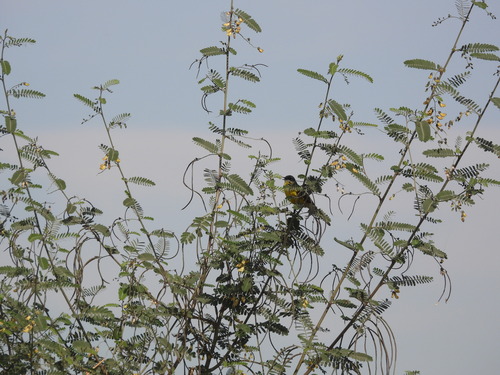
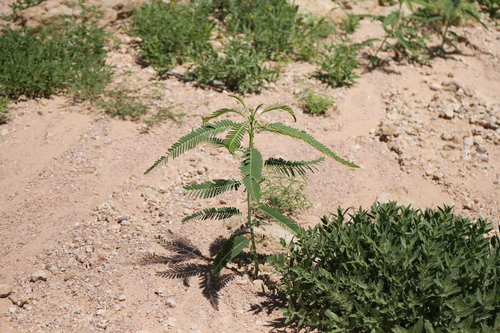
Crotalaria lanceolata
E. Mey.
Twin-leaved rattle bush
iNaturalist· cc-by-nc-sa
(c) Mauricio Mercadante, some rights reserved (CC BY-NC-SA)
iNaturalist· cc-by-nc
(c) Luís A. Funez, some rights reserved (CC BY-NC)
Description
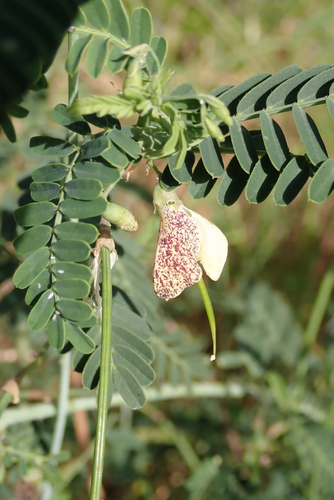
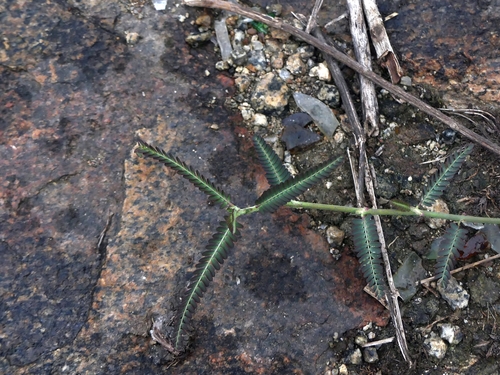
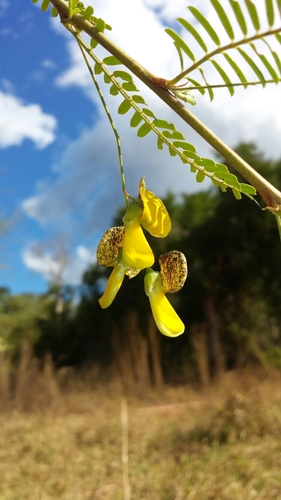
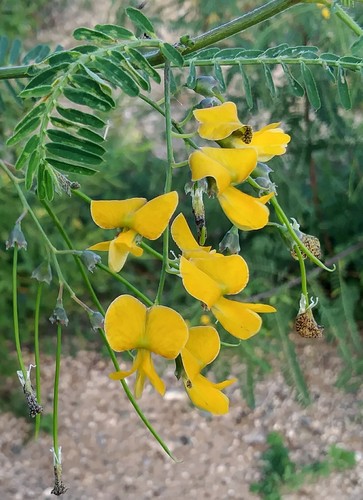
A stiffly erect bush. It has few branches. It has a few soft hairs. The leaf stalk is slender and almost straight. It is 4 cm long. The leaflets are 8 cm long by 1 cm broad. The flowers are on stalks on the top of the plant. The small flowers are well spaced along a 20 cm long stalk. The flowers are yellow. They are 1 cm long. The fruit is a pod. It is dark and hangs down. It is 3 cm long by 5 mm wide.
Edible Uses
The seeds and leaves are eaten as vegetables.
Known Hazards
No specific mention of toxicity has been seen for this species, but many members of this genus are known to contain pyrrolizidine alkaloids, the most potent of which in this genus are monocrotaline, retrorsine and retronecine. These alkaloids have a cumulative effect upon the body and, unless concentrations in a plant are high, occasional consumption is generally completely safe. Pyrrolizidine alkaloids are derived from amino acids including ornithine. Many of these alkaloids have pronounced hepatic toxicity, but the lungs and other organs may be affected as well. Mutagenic and carcinogenic activities of pyrrolizidine alkaloids have also been reported.
Distribution
It is a tropical plant. It is rare in Swaziland. In Yunnan.
Where It Grows
Africa, Asia, Australia, China, East Africa, Eswatini, Indochina, Kenya, Madagascar, Malawi, Marquesas, Mozambique, Pacific, SE Asia, South Africa, Southern Africa, Swaziland, Taiwan, Tanzania, Vietnam, Zimbabwe,
Cultivation
Crotalaria lanceolata is a plant of the moist tropics, where it is found at elevations up to 2,150 metres. It grows best in areas where annual daytime temperatures are within the range 20 - 28°c, but can tolerate 9 - 32°c. When dormant, the plant can survive temperatures down to about -2°c, but young growth is more tender and can be severely damaged at -1°c. It prefers a mean annual rainfall in the range 1,100 - 1,600mm, but tolerates 850 - 2,800mm. Grows best in a sunny position but tolerant of light shade. It succeeds in most dry to moist, well-drained soils, growing best in fertile soils but also succeeding where the fertility is low. Prefers a pH in the range 5.5 - 6.5, tolerating 5 - 7.1. Introduced to Hawaii as a green manure crop, the plant has escaped from cultivation and become naturalized as a roadside weed. It is recorded as being invasive. This species has a symbiotic relationship with certain soil bacteria; these bacteria form nodules on the roots and fix atmospheric nitrogen. Some of this nitrogen is utilized by the growing plant but some can also be used by other plants growing nearby.
Propagation
Seed - sow in situ. Pre-soaking the seed for 12 hours in warm water can help to reduce germination time.
Other Uses
A fast-growing plant that fixes atmospheric nitrogen, it is grown as a green manure and to stabilize the soil. It is an excellent source of organic matter - its fresh foliage usually contains between 0.5 - 1% nitrogen, which when incorporated into the soil improves fertility and nutrient retention, while providing structure to the soil by enriching it of humus and retarding erosion.
Also Known As
Sucsac thon
References (4)
- East African Herbarium records, 1981,
- Mutie, F. M., et al, 2023, Important Medicinal and Food Taxa (Orders and Families) in Kenya, Based on Three Quantitative Approaches. Plants 2023, 12, 1145
- Peters, C. R., O'Brien, E. M., and Drummond, R.B., 1992, Edible Wild plants of Sub-saharan Africa. Kew. p 132
- Swaziland's Flora Database http://www.sntc.org.sz/flora