Brahea armata
S. Watson
Blue Hesper palm
iNaturalist· cc-by-nc
(c) jrebman, some rights reserved (CC BY-NC), uploaded by jrebman
iNaturalist· cc-by-nc
(c) subhashc, some rights reserved (CC BY-NC)
iNaturalist· cc-by
(c) Adam J. Searcy, some rights reserved (CC BY), uploaded by Adam J. Searcy
Summary
Source: WikipediaBrahea armata, commonly known as the blue fan palm, blue hesper palm or Mexican blue palm, is a flowering plant in the family Arecaceae, native to Baja California, Mexico. Outside its natural range, it is often planted as an ornamental, valued for its striking grey-blue fronds.
Description
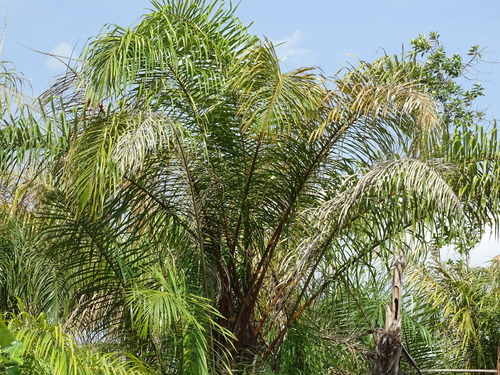
A medium sized palm. It grows to 12-15 m tall. The trunk is single and thick and grey. It can be 40-50 cm across. It can have the dead leaves hanging on the trunk or the trunk can be smooth but covered with old leaf scars. The leaf stalks are lined with thorns. The leaves are stiff and spread out like fingers on a hand. They are fan shaped. The leaves are covered with a pale blue bloom. The flowering stalk comes from amongst the leaves. It arches out further than the leaves. This flowering stalk can be 4-6 m long. The fruit are 12 mm across and yellow-brown when ripe. The seed is round.
Edible Uses
Although we have seen no reports of edibility, the fruit is almost certainly edible either raw or cooked. It is about 2cm in diameter.
Traditional Uses
The fruit is eaten.
This uses section is brief — help expand it
Medicinal Uses
None known
Distribution
It will grow from subtropical to temperate climates. It needs well drained soil and full sunlight. It can tolerate some frost. In Mexico it grows in dry rocky soils. It is often on poor alkaline soils. In Mexico it grows from sea level to 1400 m altitude. In Brisbane Botanical Gardens. It suits hardiness zones 9-11.
Where It Grows
Australia, Central America, Mexico, North America, Slovenia, USA,
Cultivation
Succeeds in most fertile moist but well-drained soils in a sheltered sunny position. Tolerant of poor dry soils. Plants are drought and heat tolerant. This species is not very cold-hardy, though it tolerates several degrees of frost if it is growing in a dry sunny climate and could be tried out of doors in the mildest areas of Britain. Palms usually have deep penetrating root systems and generally establish best when planted out at a young stage. However, older plants are substantially more cold tolerant than juvenile plants. In areas at the limit of their cold tolerance, therefore, it is prudent to grow the plants in containers for some years, giving them winter protection, and only planting them into their permanent positions when sheer size dictates. Palms can also often be transplanted even when very large. Although the thick fleshy roots are easily damaged and/or desiccated, new roots are generally freely produced. It is important to stake the plant very firmly to prevent rock, and also to give it plenty of water until re-established - removing many of the leaves can also help.
Propagation
Seed - best sown as soon as it is ripe in a warm greenhouse at not less than 24°c. Germination of fresh seed usually takes place in 3 - 4 months at 25°c. Stored seed is very slow to germinate. Pre-soaking the seed for 24 hours in warm water prior to sowing may shorten the germination time. Plants form a long tap-root some time before forming a shoot so it is best to sow 2 - 3 seeds per deep pot. Grow the seedlings on in the greenhouse for at least their first three winters. Plant them out into their permanent positions in late spring or early summer, after the last expected frosts.
Other Uses
None known Special Uses
Production
It is slow growing when young.
Notes
There are about 12-16 Brahea species. They all grow in Mexico.
Synonyms
Also Known As
Guadalupa, Mexican Blue palm, Palma azul
References (21)
- Balick, M.J. and Beck, H.T., (Ed.), 1990, Useful palms of the World. A Synoptic Bibliography. Colombia p 160
- Beckstrom-Sternberg, Stephen M., and James A. Duke. "The Foodplant Database." http://probe.nalusda.gov:8300/cgi-bin/browse/foodplantdb.(ACEDB version 4.0 - data version July 1994) (As Glaucothea armata)
- Blomberry, A. & Rodd, T., 1982, Palms. An informative practical guide. Angus & Robertson. p 64
- Bodkin, F., 1991, Encyclopedia Botanica. Cornstalk publishing, p 167
- Burkill, I.H., 1966, A Dictionary of the Economic Products of the Malay Peninsula. Ministry of Agriculture and Cooperatives, Kuala Lumpur, Malaysia. Vol 1 (A-H) p 960 (As Erythea armata)
Show all 21 references Hide references
- Cundall, P., (ed.), 2004, Gardening Australia: flora: the gardener's bible. ABC Books. p 253
- Etherington, K., & Imwold, D., (Eds), 2001, Botanica's Trees & Shrubs. The illustrated A-Z of over 8500 trees and shrubs. Random House, Australia. p 141
- Facciola, S., 1998, Cornucopia 2: a Source Book of Edible Plants. Kampong Publications, p 28 (As Erythea armata)
- Felger, R.S., Ancient Crops for the Twenty first century, in Rickie, G.A., (ed), 1979, New Agricultural Crops, AAAS Selected Symposium 38. Westview Press, Colarado. p 10
- Gibbons, M., 1993, Palms. Compact study Guide and Identifier. Sandstone. p 23
- Gibbons, M., 2003, A pocket guide to Palms. Chartwell Books. p 53
- Henderson, A., Galeano, G and Bernal, R., 1995, Field Guide to the Palms of the Americas. Princeton. p 55
- Jones, D.L., 1994, Palms throughout the World. Smithtonian Institution, Washington. p 146
- Jones, D.L., 2000, Palms of Australia 3rd edition. Reed/New Holland. p 125
- Kermath, B. M., et al, 2014, Food Plants in the Americas: A survey of the domesticated, cultivated and wild plants used for Human food in North, Central and South America and the Caribbean. On line draft. p 138
- Llamas, K.A., 2003, Tropical Flowering Plants. Timber Press. p 95
- Proc. Amer. Acad. Arts 11:146. 1876
- Riffle, R.L. & Craft, P., 2003, An Encyclopedia of Cultivated Palms. Timber Press. p 277
- Segura, S. et al, 2018, The edible fruit species in Mexico. Genet Resour Crop Evol (2018) 65:1767–1793
- World Checklist of Useful Plant Species 2020. Royal Botanic Gardens, Kew
- www.desert-tropicals.com