Thonningia sanguinea
Vahl
Ground pineapple
iNaturalist· cc-by-nc-nd
(c) Joachim Louis, some rights reserved (CC BY-NC-ND), uploaded by Joachim Louis
iNaturalist· cc-by
(c) mmmavocado, some rights reserved (CC BY)
iNaturalist· cc-by-nc
(c) David Bygott, some rights reserved (CC BY-NC), uploaded by David Bygott
Description
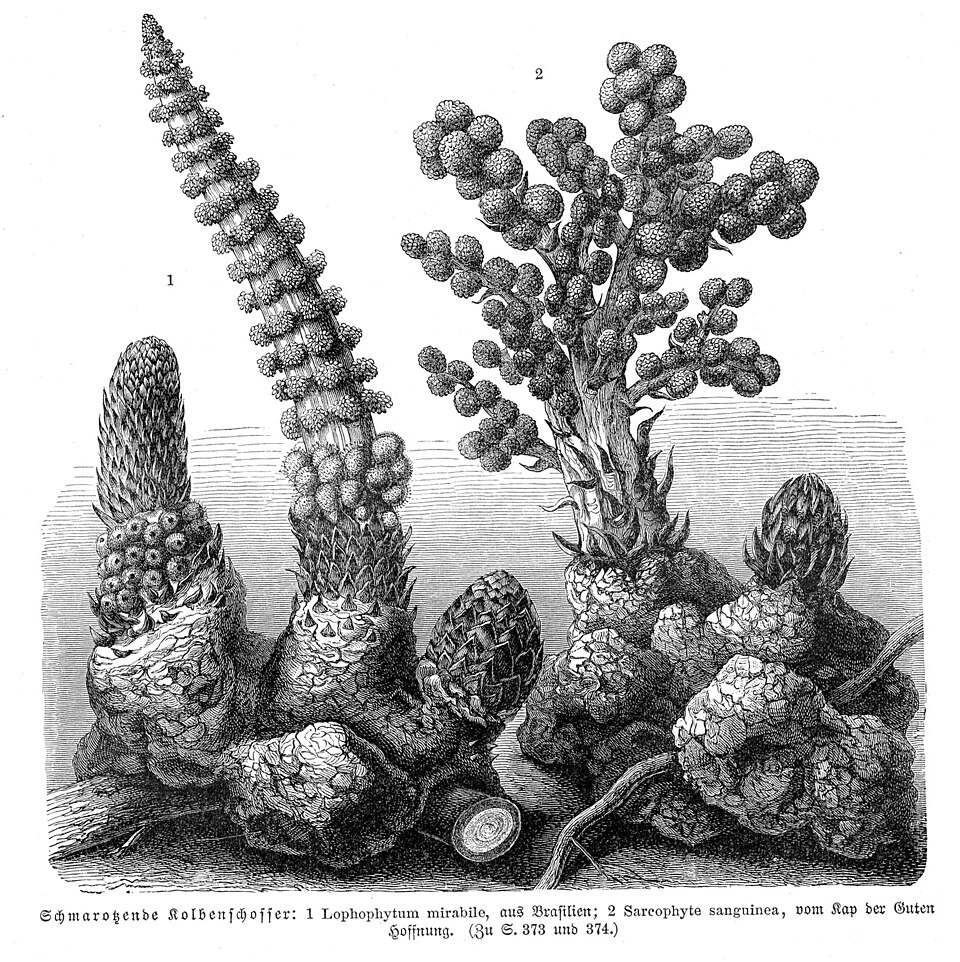
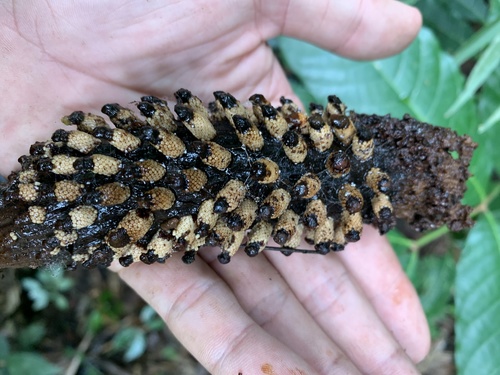
A plant that grows attached to other trees for food. It has a stout rhizome or underground stem. There are tubers where the rhizome attaches to the host plant. The scaly flower heads only appear above the ground. They are 7 cm high
Edible Uses
The rhizome is used as a flavoring ingredient in sauces and other dishes, and is sold fresh in local food markets.
Traditional Uses
The rhizome is used to flavour sauces and other dishes.
This uses section is brief — help expand it
Medicinal Uses
A decoction of the flowers is used to treat sore throats and laryngitis. The flower-heads, combined with other medicines, are used as a vermifuge. The red-coloured flowers are crushed with a pimento into a paste for use as an enema in the treatment of haemorrhoids. The paste is also rubbed onto stiff necks. Combined with other plants, the inflorescence is used in the treatment of leprosy, cutaneous infections, and paralysis. Ash from the burnt flowers is applied to the soles of the feet to treat ulceration (? Yaws). Sap expressed from the flower-heads is used as an eye-instillation for rachitic children and premature babies. The roots are vermifuge. A decoction of the root is used in the treatment of rheumatism. The whole plant, pounded up, is used as an aphrodisiac and astringent. It is used in the treatment of dysentery and blennorrhoea. An ointment is prepared for treating swellings on the neck and around the ears. The whole plant is prepared as a plaster to maturate abscesses, and crushed and diluted in water is used as a mouth-wash for dental caries, gingivitis and mouth-infections. The rhizome and flowers, without the red bracts, are made into an ointment for application to skin-diseases. The sap is given to a suckling infant with fever in the form of an embrocation which is applied to the infant’s body after the tummy has been pricked with the flower-head scales.
Known Hazards
The plant is used as a traditional remedy in many African cultures. This includes in those with sexually transmitted diseases in Ghana. In those with diarrhea in the Congo. A portion of the leaves is used in those with worms. Mixed with Capsicum, it is used topically on hemorrhoids and torticollis. It is used for leprosy, skin infections and abscesses, dental caries, gingivitis, and heart disease. In Zaire, it is said to prevent incontinence and bedwetting. The other uses for the plant include as an ingredient in the poison applied to hunting arrows by peoples of Côte d'Ivoire. It is also known as a flavoring for soup. In some areas, the flower heads are considered to be an aphrodisiac. In Ghana and Côte d'Ivoire, the spiky flower heads are tied to the ankles of toddlers to encourage them to learn to walk; the spikes keep them from sitting down. All parts of the plant are used. The plant is considered a weed in some places, such as rubber plantations, where it can become abundant.
Distribution
It is a tropical plant. It grows in woodland and in forests along rivers. In Nigeria it has been recorded at 230 m above sea level.
Where It Grows
Africa, Angola, Benin, Burkina Faso, Cameroon, Central Africa, Central African Republic, CAR, Congo, Côte d'Ivoire, East Africa, Gabon, Ghana, Guinea, Guinée, Guinea-Bissau, Ivory Coast, Nigeria, Sierra Leone, Sudan, Togo, West Africa,
Cultivation
The plant can parasitize plantation crops such as Hevea, oil-palm and cacao. Infestation is not normally fatal, but it must cause some loss of vigour in the host. Heavy infestation, however, has been recorded on Hevea trees in the Southern Province of Sierra Leone, where trees have been killed.
Other Information
The rhizomes are sold in local food markets.
Also Known As
Langa dia mfinda, Mbengela, Pisa de maluca, Timba timba
References (8)
- Burkill, H. M., 1985, The useful plants of west tropical Africa, Vol. 1. Kew.
- Chapman, J. D. & Chapman, H. M., 2001, The Forest Flora of Taraba and Andamawa States, Nigeria. WWF & University of Canterbury. p 168
- Dalziel, J. M., 1937, The Useful plants of west tropical Africa. Crown Agents for the Colonies London.
- Grivetti, L. E., 1980, Agricultural development: present and potential role of edible wild plants. Part 2: Sub-Saharan Africa, Report to the Department of State Agency for International Development. p 24 (As Thonningia spp.)
- Kafoutchoni, K. M., et al, 2018, Species richness, cultural importance, and prioritization of wild spices for conservation in the Sudano-Guinean zone of Benin (West Africa). Journal of Ethnobiology and Ethnomedicine. 14:67
Show all 8 references Hide references
- Peters, C. R., O'Brien, E. M., and Drummond, R.B., 1992, Edible Wild plants of Sub-saharan Africa. Kew. p 68
- von Katja Rembold, 2011, Conservation status of the vascular plants in East African rain forests. Dissertation Universitat Koblenz-Landau p 183
- World Checklist of Useful Plant Species 2020. Royal Botanic Gardens, Kew