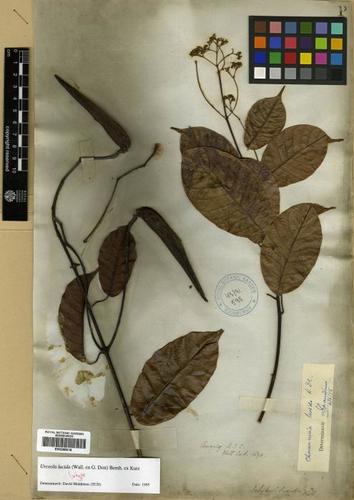
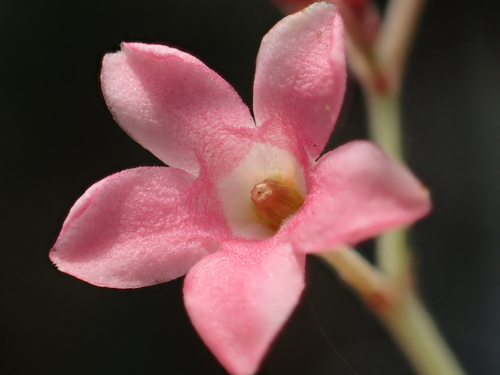
Tabernaemontana siphilitica
(L. f.) Leeuwenberg
Azucar
iNaturalist· cc-by-nc
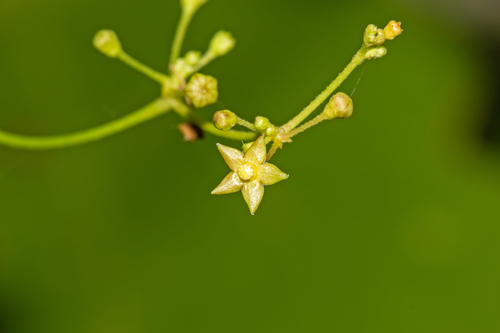
(c) Julien Piolain, some rights reserved (CC BY-NC), uploaded by Julien Piolain
iNaturalist· cc-by-nc
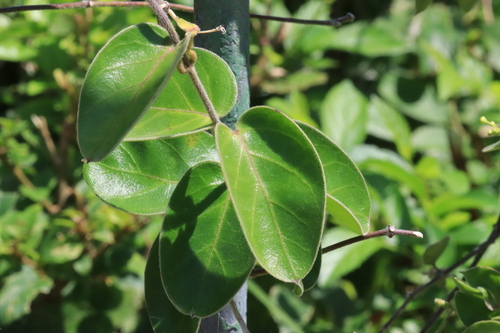
(c) humbertomendozacifuentes, some rights reserved (CC BY-NC)
Summary
Source: WikipediaTabernaemontana siphilitica is a species of plant in the family Apocynaceae. The species is a plant native to Brazil, widely distributed in the North (Acre, Amazonas, Pará, Roraima, Tocantins), Northeast (Maranhão), and Central-West (Mato Grosso do Sul, Mato Grosso) regions. Found in the Amazon and Cerrado phytogeographic domains, it occurs in various vegetation types, including riparian or gallery forests, terra firme forests, floodplains, semideciduous seasonal forests, and Amazonian savannas. Despite its presence in different habitats, it is not endemic to Brazil.
Description
A shrub or tree. It grows 6 m tall. The twigs are square shape The fruit divides into one seeded sections that stick out sideways. These are narrowly oval and 4 cm long and 2.3 cm wide and 1.6 cm thick. They are yellow to orange-brown. They are finely wrinkled and have a short beak. They have ridges along them. The pulp is thin, white and edible. There are several seeds. They can be 1 cm long by 0.3 cm wide and are brown.
Edible Uses
Fruit - raw. The thin layer of white pulp is eaten. The fruit is up to 40mm long and 23mm wide, containing several seeds up to 10mm long.
Medicinal Uses
A decoction of the leaves and stems is used in the treatment of syphilis. A decoction of the stem bark, combined with the with leaves of Bonafousia undulata, is used in the treatment of rheumatism. An infusion of the leaves is used to treat malaria. A decoction of the leaves is used as a wash to treat children who are believed to be sick because their father has hunted tapir. The plant contains alkaloids of the corynane, ibogane and aspidospermane types.
Distribution
It is a tropical plant. It grows as an understorey plant or in marsh forest.
Where It Grows
Amazon, Bolivia, Brazil, Colombia, Ecuador, French Guiana, Guianas, Guyana, Peru, South America, Suriname, Venezuela,
Synonyms
Also Known As
A do pij cha, Agua-de-galo, Azucar, Do-pistcha, General-do-campo, Grao-de-galo, Guachamaca, Guallabusay, Herva-de-lontra, Lechoso, Najudi, Radie capiaie, Rosa-cambraia
References (13)
- Alkaloids 1:339. 1983
- Barfod, A. S. & Kvist, L. P., 1996, Comparative Ethnobotanical Studies of the Amerindian Groups in Coastal Ecuador. The Danish Academy of Sciences and Letters. p 76 (As Tabernaemontana tetrastachya)
- Brako, L. & J. L. Zarucchi. 1993. Catalogue of the flowering plants and gymnosperms of Peru. Monogr. Syst. Bot. Missouri Bot. Gard. 45. (L Peru)
- Fouqué, A. 1972. Espèces fruitières d'Amérique tropicale. Institut français de recherches fruitierès outre-mer (ifac)
- Grandtner, M. M. & Chevrette, J., 2013, Dictionary of Trees, Volume 2: South America: Nomenclature, Taxonomy and Ecology. Academic Press p 650
Show all 13 references Hide references
- Kermath, B. M., et al, 2014, Food Plants in the Americas: A survey of the domesticated, cultivated and wild plants used for Human food in North, Central and South America and the Caribbean. On line draft. p 849
- Leeuwenberg, A. J. M. 1991. A revision of Tabernaemontana. I. The Old World species. II. The New World species., 1994 (Rev Tabern) 2:372.
- Lopez-Diago, D. & Garcia, N., 2021, Wild edible fruits of Colombia. Biota ColomBiana 22 (2) p 30
- Martin, F. W., et al, 1987, Perennial Edible Fruits of the Tropics. USDA Handbook 642 p 82 (As Bonfousia tetrastachya)
- Reis, S. V. and Lipp, F. L., 1982, New Plant Sources for Drugs and Foods from the New York Botanical Garden herbarium. Harvard. p 243 (As Tabernaemontana tetrastachya)
- Roa, J. A. G. & Boada, D. S. G., 2018, Fundación para el Fortalecimiento de la Fruticultura y Plantas Alimenticias no Convencionales en Colombia. (Also as Tabernaemontana tetrastachya)
- Torre, de la L., et al, 2008, Enciclopedia de las Plantas Útiles del Ecuador. Herbario QCA. Pontificia Universidad Católica del Ecuador. p 176
- van Roosmalen, M.G.M., 1985, Fruits of the Guianan Flora. Utrecht Univ. & Wageningen Univ. p 34