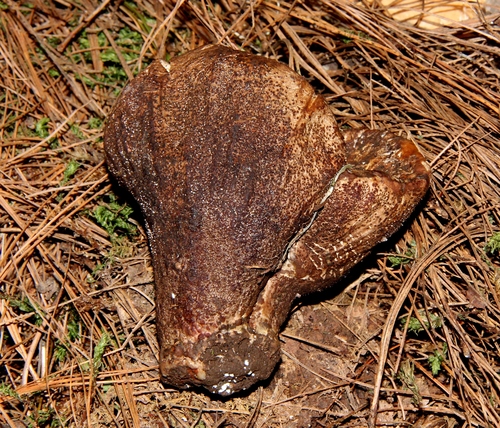
Hypomyces lactifluorum
(Schwein.) Tul. & C. Tul.
Lobster mushroom
iNaturalist· cc-by-nc
(c) tombigelow, some rights reserved (CC BY-NC), uploaded by tombigelow
iNaturalist· cc-by-nc
(c) stellar_viscera, some rights reserved (CC BY-NC)
Summary
Source: WikipediaHypomyces lactifluorum, or the lobster mushroom, is a parasitic ascomycete fungus that grows on certain species of mushrooms, turning them a reddish orange color that resembles the outer shell of a cooked lobster. The fungus is edible.
Description
A mushroom. A striking fluorescent-orange mould-like fungus. It grows on Russula and Lactarius. It develops a lumpy or pimpled layer over the surface.
Edible Uses
The fruiting bodies are eaten, including both the parasite and host mushroom. They can be sautéed or added to omelettes.
Traditional Uses
The fruiting bodies are eaten. Both the parasite and hosta re eaten. They can eb sauteed or added to omelettes.
This uses section is brief — help expand it
Known Hazards
Lobster mushrooms are widely eaten and enjoyed freshly foraged and cooked. They are commercially marketed and sometimes found in grocery stores; they have been made available at markets in Oregon. They have a seafood-like flavor and a firm, dense texture. While edible, field guides note the hypothetical possibility that H. lactifluorum could parasitize a toxic host and that individuals should avoid consuming lobster mushrooms with unknown hosts, although no instances of toxicity have been recorded. During the course of infection, the chemicals get converted into other more flavorful compounds, making lobster mushrooms more edible. Lactarius piperatus has a spicy, hot flavor but that flavor is counteracted by the parasite H. lactifluorum, making it more edible and delicious. One author notes that he has personally never experienced any trouble from consuming them and another notes that there have been no reports of poisoning in hundreds of years of consumption.
Distribution
A temperate to tropical plant.
Where It Grows
Canada, Central America, Guatemala, Mexico, North America, USA,
Other Information
It is sold in local markets.
Also Known As
Enchilado, Oreja, Xintazcal
References (13)
- Alonso-Aguilar, L. E., et al, 2014, The cultural significance of wild mushrooms in San Mateo Huexoyucan, Tlaxcala, Mexico. Journal of Ethnobiology and Ethnomedicine, 10:27
- Boa, E. R., 2004, Wild edible fungi and their importance to people. FAO Non Wood Forest Products Booklet 17
- Cortes, L.E.U., et al, 2018, Ethnomycology and mushroom selling in a market from Northwest Puebla, México. Scientia Fungorum vol. 47: 47-55
- Estrada-Martinez, E., et al, 2009, Contribucion al conocimiento etnomicologico de los Hongos Comestibles Silvestres de Mercados Regionales y Comunidades de la Sierra Nevada (Mexico). Intercienca Jan 2009 Vol. 34 No. 1
- Facciola, S., 1998, Cornucopia 2: a Source Book of Edible Plants. Kampong Publications, p 252
Show all 13 references Hide references
- Garibay-Orijel, R., et al, 2007, Understanding cultural significance, the edible mushrooms case. Journal of Ethnobiology and Ethnomedicine. 3:4
- Hall, I. R., et al, 2003, Edible and Poisonous Mushrooms of the World. Timber Press. p 178
- Perez-Moreno, J. et al, 2008, Wild Mushroom Markets in Central Mexico and a Case Study at Ozumba. Economic Botany, 62(3), 2008, pp. 425–436
- Perez-Moreno, J., et al, 2009, Social and Biotechnological Studies of Wild Edible Mushrooms in Mexico. Acta Botanica Yunnanica Suppl. XV1: 55-61
- Ponce, J. P. M., et al, 2019, Ethnomycological knowledge among Kaqchikel, indigenous Maya people of Guatemalan Highlands. Journal of Ethnobiology and Ethnomedicine (2019) 15:36
- Quinonez-Martinez, M., et al, 2014, Knowledge and use of edible mushrooms in two municipalities of the Sierra Tarahumara, Chihuahua, Mexico. Journal of Ethniobiology and Ethnomedicine 10:6
- Santiago, F, H., et al, 2016, Traditional knowledge and use of wild mushrooms by Mixtecs or Ñuu savi, the people of the rain, from Southeastern Mexico. Journal of Ethnobiology and Ethnomedicine 12:35 p 8
- Schneider, E., 2001, Vegetables from Amaranth to Zucchini: The essential reference. HarperCollins. p 361