Corymbia citriodora
(Hook.) K. D. Hill & L. A. S. Johnson
Lemon-scented gum
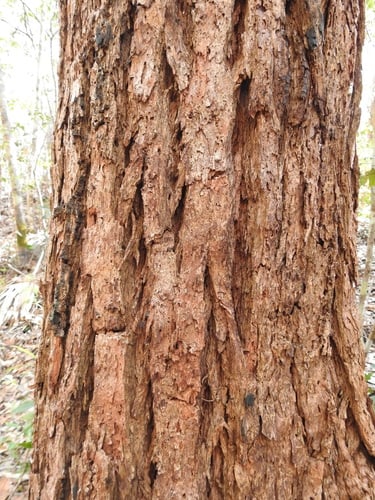
iNaturalist· cc-by-nc
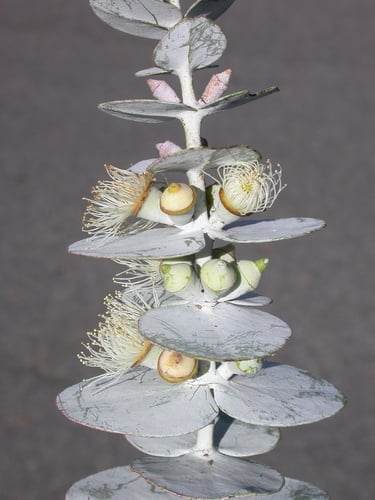
(c) Dean Nicolle, some rights reserved (CC BY-NC), uploaded by Dean Nicolle
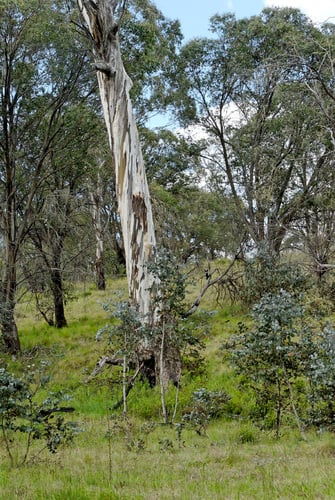
iNaturalist· cc-by-nc
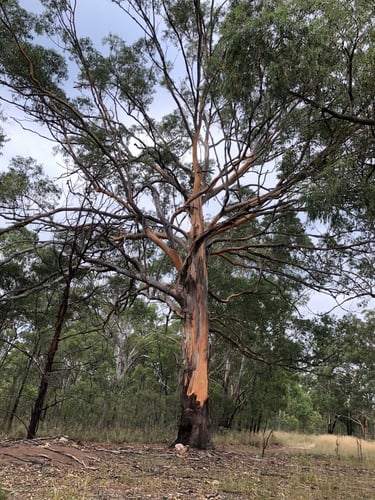
(c) Dean Nicolle, some rights reserved (CC BY-NC), uploaded by Dean Nicolle
iNaturalist· cc-by-nc
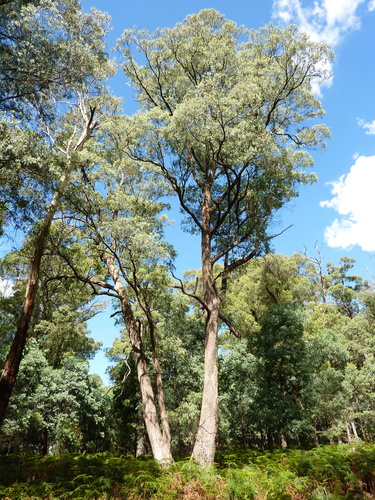
(c) Greg Rossington, some rights reserved (CC BY-NC), uploaded by Greg Rossington
Summary
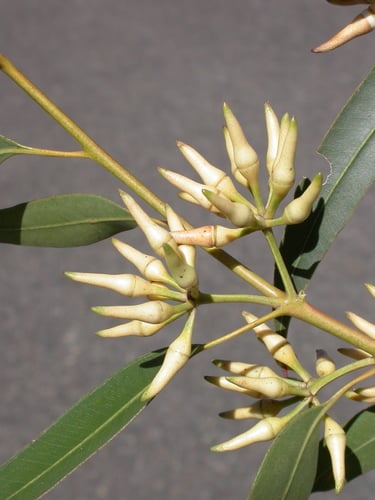
Source: WikipediaCorymbia citriodora, commonly known as lemon-scented gum and other common names, is a species of tall tree that is endemic to north-eastern Australia. It has smooth white to pink bark, narrow lance-shaped to curved adult leaves, flower buds in groups of three, white flowers and urn-shaped or barrel-shaped fruit.
Description
A slender tree. It grows 25-50 m tall and spreads 25 m wide. The bark is powdery and grey and peels off. The leaves are broadly sword shaped and rough and green. The young leaves are more broad. The leaves have a lemon scent. The flowers are in clusters and are creamy white. They are 2 cm across.
Edible Uses
The leaves produce a sweet, manna-like substance that can be scraped off and eaten. The plant is also a honey and honey-flora species, and the leaves are used as a spice and culinary herb.
Traditional Uses
A sweet manna-like gum on the leaves is eaten. Caution: Eucalyptus oil is poisonous.
This uses section is brief — help expand it
Medicinal Uses
Eucalyptus leaves are a traditional Aboriginal herbal remedy. The essential oil extracted from the leaves is a powerful antiseptic used worldwide to relieve coughs, colds, sore throats, and other infections, and is a common ingredient in over-the-counter cold remedies. The oil is antibacterial and has a strong disinfectant action, destroying lower forms of life — especially when aged, as ozone forms in it upon exposure to air. It can be applied externally to cuts and skin infections, inhaled to relieve blocked nasal passages, gargled for sore throats, or taken internally for a wide range of complaints. Like all essential oils, it can have a harmful effect on the body in larger doses. An oleo-resin exuded naturally from the tree, or obtained by making incisions in the trunk, contains tannin and is powerfully astringent. It is used internally for diarrhoea and bladder inflammation, and applied externally to cuts and wounds.
Known Hazards
None known
Distribution
A subtropical plant. It needs a temperature above 5-7°C. It grows on dry plateaus. Arboretum Tasmania.
Where It Grows
Africa, Asia, Australia*, Brazil, East Africa, India, Madagascar, Malawi, Mozambique, Pakistan, South Africa, South America, Tasmania, Zambia, Zimbabwe,
Cultivation
Corymbia citriodora is native from the tropical climate of eastern Queensland to the subtropical and warm temperate regions of northern New South Wales. It is usually found in areas where the summers are hot (it can withstand a mean monthly maximum of 29 - 35°c) and any winter is generally mild. It is not a very cold-hardy plant, but succeeds in areas where frosts are occasional and generally light. It can succeed in arid to semiarid zones, though is said to grow best where the mean annual rainfall, falling mostly in the summer, is within the range 600 - 1,300mm, with a 5 - 7 month dry season. Prefers a sunny position in a moderately fertile well-drained moisture retentive circum-neutral soil. Tolerates poor and dry soils, especially those low in mineral elements.Plants can be grown in infertile clays, laterites, poor and gravelly soils and podzols, preferably well drained. Established plants are drought tolerant. Does not succeed in frost hollows or in windy sites. The plant develops a lignotuber - this is a woody tuber that starts to develop near the base of seedlings and can become massive in the mature plants of some species. It possesses embedded vegetative buds, allowing the plant to regenerate following crown destruction, for example by fire. A very fast growing species. Flowering usually starts within 2 years after planting and seeds are produced abundantly by 5 years of age. This species is often cultivated from warm temperate areas to the tropics for its essential oil; it especially thrives in a Mediterranean climate. The leaves are strongly lemon-scented when crushed. When grown for fuel, yields of 10 - 21 cubic metres per hectare per year have been obtained. Whilst most Corymbia species, grown in small numbers outside their native range, can be an attractive and useful addition to the landscape, certain species (including this one) are more problematic. When grown in monocultures, especially outside their native range, they can become an environmental disaster. They are voracious, especially in their use of water; they are allelopathic, inhibiting the growth of the native flora; they reduce habitats for native fauna; and encourage the worst possible attitudes to land use and conservation. The trees cast a very light shade. Flower buds are formed in the summer prior to flowering and seed capsules need at least a further year in which to ripen. Plants are shallow-rooting and, especially in windy areas, should be planted out into their permanent positions when small to ensure that they do not suffer from wind-rock. They strongly resent root disturbance and should be container grown before planting out into their permanent position.
Propagation
Surface sow seed in a seedtray in a sunny position, keeping the compost moist at all times. Species from high altitudes benefit from 6–8 weeks of cold stratification at 2°C. Germination rates typically average 30–50%, with rapid, complete germination achieved under moist, warm conditions (25–30°C optimal) in the presence of light. Seeds of this species are relatively large for a eucalypt and can be sown directly into containers filled with a sterilised, freely draining loam-and-sand mixture, then covered with a light sprinkling of fine sand. Prick seedlings into individual pots as soon as the second set of true leaves develops — if left longer they may not transplant well. Seedlings are planted out in the field at about 25cm height, 10–12 weeks after sowing, ideally timed to coincide with the onset of the rainy season in tropical climates. Seed has long viability.
Other Uses
A lemon-scented essential oil obtained from the leaves is used in perfumery and medicinally. Leaf yield is 0.5–2.0% essential oil. This species is a very rich source of citronella — some batches contain up to 98%. Glabrous leaves may yield oil with 65.5% citronellal, 12.2% citronellol, and 3.6% isopulegol; hairy leaves yield more oil at 86.6–90.1% citronellal, 4.6–6.0% citronellol, and 0.7–0.8% isopulegol, along with α-pinene, β-pinene, and isovaleric aldehyde. The leaves and essential oil act as an insect repellent, and the leaves are used in potpourri. Bark may contain up to 12% tannin. The heartwood is pale grey-brown to dark brown, clearly demarcated from the white or cream sapwood, which can be up to 60mm wide. The grain is straight or interlocked, occasionally wavy, with an open, coarse texture. The wood is hard, strong, and tough — it saws and planes well but is difficult to nail and prone to checking and collapse during drying. It is susceptible to marine borer and termite attack. Uses include heavy and general construction, frame and bridge building, flooring, cladding, tool handles, and case manufacturing. The dense, heavy wood (specific gravity 0.75–1.1) burns steadily, produces good charcoal with an ash content of 1–2%, and is also used as a general fuelwood. The tree is planted for ornamental, amenity, land reclamation, revegetation, shade, and windbreak purposes.
Synonyms
Also Known As
Safeda
References (6)
- Brown, D., 2002, The Royal Horticultural Society encyclopedia of Herbs and their uses. DK Books. p 207 (As Eucalyptus citriodora)
- Facciola, S., 1998, Cornucopia 2: a Source Book of Edible Plants. Kampong Publications, p 140 (As Eucalyptus citriodora)
- T. L. Mitchell, J. exped. trop. Australia 235. 1848 (As Eucalyptus citriodora)
- Seidemann J., 2005, World Spice Plants. Economic Usage, Botany, Taxonomy. Springer. p 150 (As Eucalyptus citriodora)
- Wild edible plants of Himachal Pradesh (As Eucalyptus citriodora)
Show all 6 references Hide references
- World Checklist of Useful Plant Species 2020. Royal Botanic Gardens, Kew