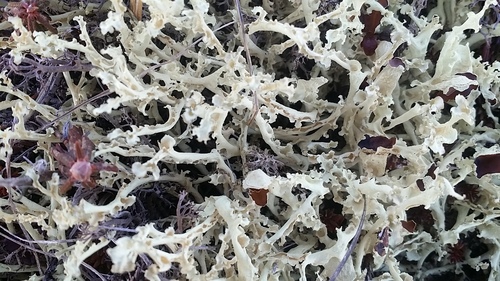
Bryoria fremontii
(Tuck.) Brodo & D. Hawksw.
Black tree lichen, Wila
iNaturalist· cc-by-sa
(c) Millifolium, some rights reserved (CC BY-SA)
iNaturalist· cc-by-nc
(c) Jordan Collins, some rights reserved (CC BY-NC)
Summary
Source: WikipediaBryoria fremontii is a dark brown horsehair lichen that grows hanging from trees in western North America, and northern Europe and Asia. It grows abundantly in some areas, and is an important traditional food for a few First Nations in North America.
Description
A lichen. It is dark brown and hair like. It grows hanging from trees. It can be 60-90 cm long. The branches can have small greenish-yellow fruiting disks. These are 2-6 mm across.
Edible Uses
Like all lichens, Bryoria fremontii stores its energy in polysaccharides which are completely indigestible to humans. Nonetheless, this lichen was, and still is, highly regarded as a food for Salish peoples, such as the Secwepemc, the Shuswap, the Nlaka'pamux, the Lillooet, and the Sinkaietk There is a report that among the Flathead of Montana, even the smallest family would harvest over 10 kg of it every July. It is theorised that these peoples may consume the lichen because when it is cooked with other foods, it may capture carbohydrates from these other foods that would otherwise be lost in the fire pit method used to cook it, increasing the carbohydrates by 23 to 122%. It often grows high in trees and can thus be difficult to harvest. The most common way to collect the lichen is by twisting the lichen around the end of a long stick (which is sometimes hooked) and then pulling the lichen down off the tree. This lichen-collecting stick is called a txipmn in the Okanagan language. The lichen can be collected at any time of year, but it is important to choose the right type of lichen. Some specimens are toxic due to vulpinic acid. There are numerous other species of Bryoria that look very similar, but are bitter and mildly toxic. The species of tree on which the lichen is growing and the general location of that tree are both thought to be important factors for determining if it is the right type of lichen to eat, but not everyone agrees on which locations and tree species are better. Many people taste the lichen first to make sure that it isn't bitter, and some people choose the lichens that are darker coloured. The collected specimen is cleaned by hand to remove twigs, dirt, other lichens, sap and other contaminants. Then it is usually soaked several hours to overnight in water, often in running water. It is sometimes worked with hands, or pounded with a paddle-shaped tool while being soaked. This process of cleaning is called kálka in the Secwepemc language, and may help to remove the vulpinic acid, which is slightly water-soluble. After being cleaned it is traditionally cooked in a pit. The pit is 1 to 3m across and 60 to 90 cm deep. A fire is lit in the pit, and numerous rocks are heated up on the fire until they are very hot. Some people sprinkle some dirt over the rocks after they have been heated up. Then a thick layer of wet vegetation (moss, fern fronds, skunk cabbage leaves, bark, grass or conifer needles) is used to cover the rocks and line the pit. The lichen is piled on top of this vegetation, almost always with layers of root vegetables or other food. The lichen is then covered with more wet vegetation. Often a barrier of large leaves, bark, reed mats, or burlap sacks is placed on top of all the vegetation to stop any detritus from falling into the food. The entire thing is then covered over with a layer of dirt. Water is usually added to the pit after it has been covered. This is accomplished by holding a large stick upright in the pit as it is being filled with the dirt, vegetation, and food. This stick is pulled out after the pit is completely covered, leaving a small hole that extends right down to the hot rocks at the bottom. Water is poured down this resulting hole, and then it is sealed with dirt. Then a fire is usually built on top of the pit, and the lichen is left to cook for anywhere from overnight to several days. When it is dug up it has formed a black, gelatinous dough about a quarter of its original volume. It is often eaten freshly cooked. Sugar is often added, and sometimes cream, berries or fish eggs. The loaves are sometimes dried into cakes and stored for future use. Sometimes berry juice is added before it is dried. These dried cakes can be stored for many years. Before being eaten, they are usually boiled in water or soup to rehydrate them. Alternately, instead of boiling the cakes, some people just soak the cakes overnight in cold water or dip them into soup like crackers. They can also be powdered and boiled in water to make a porridge. It has sometimes been prepared by simply boiling it in water. The Dakelh have been recorded to bake it into a kind of fruitcake: the lichen is mixed into the bread dough like one would do with raisins. The Okanagan sometimes roast the fresh lichen on a stick over hot coals, turning it frequently. When the lichen is crumbly it is then boiled to the consistency of molasses. This method of preparation is called spatkán in the Okanogan language. The lichen can also be prepared using more modern cooking methods such as pressure cookers, crockpots or clay bakers.
Traditional Uses
The lichen is soaked in water then cooked and eaten. It can be dried and eaten with soups.
This uses section is brief — help expand it
Known Hazards
The lichen usually does not contain any secondary lichen substances. However, some specimens are quite high in vulpinic acid. These specimens are often classified as a separate species, Bryoria tortuosa; in 1992, it was posited that they are different morphotypes of the same species, but in 2016, it was discovered that the difference is the result of the presence or absence of a basidiomycete as an additional symbiont. Vulpinic acid is both toxic and bright yellow, and, besides making the lichen poisonous, it can also give the lichen a yellowish tint. As a result, although it is usually reddish-brown to dark brown, some specimens can be yellowish-brown or even bright yellow. All yellowish specimens of this lichen should be considered to be poisonous. However, not all poisonous specimens are distinctly yellow. Often the vulpinic acid is concentrated in the interior of each branch, and is not apparent from the colour of the surface of the lichen. A more reliable characteristic to distinguish the poisonous specimens from the edible ones is that the specimens that contain vulpinic acid usually have abundant, long, yellow pseudocyphellae that twist around the main branches (these require a hand lens to see). Bryoria fremontii can be mistaken for numerous other species of Bryoria, all of which look superficially similar. Although Bryoria fremontii is edible, most other species of Bryoria are mildly toxic. Furthermore, in certain areas Bryoria fremontii can contain toxic quantities of vulpinic acid, which is one of the most potent poisons found in lichens.
Distribution
It is a temperate plant. It grows in North America between 1,200-2,300 m in conifer forests.
Where It Grows
Asia, Canada, India, North America, USA,
Production
It is gathered in late summer.
Other Information
It has been an important traditional food of First Nation people in the USA.
Notes
Also put in the family Usneaceae.
Synonyms
Also Known As
Black moss, Edible horsehair lichen
References (8)
- Ambasta S.P. (Ed.), 2000, The Useful Plants of India. CSIR India. p 26 (As Alectoria jubata)
- Beckstrom-Sternberg, Stephen M., and James A. Duke. "The Foodplant Database." http://probe.nalusda.gov:8300/cgi-bin/browse/foodplantdb.(ACEDB version 4.0 - data version July 1994) (As Alectoria jubata and as Alectoria fremontii)
- Etkin, N.L. (Ed.), 1994, Eating on the Wild Side, Univ. of Arizona. p 68
- Kuhnlein, H. V. and Turner, N. J., 1991, Traditional Plant Foods of Canadian Indigenous Peoples. Food and Nutrition in History and Anthropology Volume 8. Gordon and Breach. p 21
- Turner, N., 1997, Food Plants of Interior First Peoples. Royal BC Museum Handbook p 33
Show all 8 references Hide references
- Turner, N., et al, 2011, "Up on the Mountain": Ethnobotanical Important of Montane Sites in Pacific Coastal North America. Journal of Ethnobiology 31(1): 4-43
- www.lichen.com/usetype.html
- Yanovsky, E., 1936, Food Plants of the North American Indians. United States Department of Agriculture Miscellaneous Publication No 237. Washington, D.C. p 3 (As Alectoria jubata)