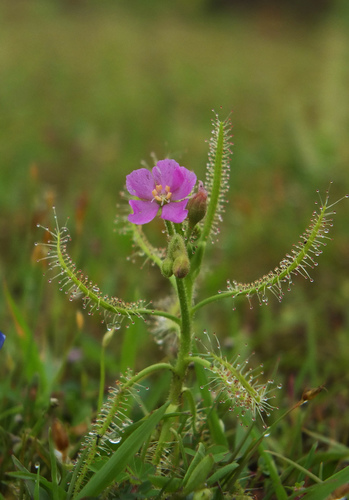
Drosera rotundifolia
Linn.
Round-leafed sundew, Dewplant
iNaturalist· cc-by-nc
(c) Vladimir Bryukhov, some rights reserved (CC BY-NC)
iNaturalist· cc-by-nc
(c) Vladimir Bryukhov, some rights reserved (CC BY-NC)
iNaturalist· cc-by-nc
(c) Vladimir Bryukhov, some rights reserved (CC BY-NC)
Summary
Source: WikipediaDrosera rotundifolia, the round-leaved sundew, roundleaf sundew, or common sundew, is a species of carnivorous flowering plant that grows in bogs, marshes and fens. One of the most widespread sundew species, it has a circumboreal distribution, being found in almost all of Europe, all of Siberia, large parts of North America, Korea and Japan but is also found as far south as eastern China, the Philippines, and into the Southern Hemisphere in New Guinea.
Description
A small herb. It forms rings or leaves. It can be an annual or keep growing from year to year. It grows 5-10 cm high and spreads 10 cm wide. The leaves are cup shaped and on fine stalks. The flowers are very small and white or pink. They have 5 petals. They are on a leafless stalk. The fruit are capsules of winged seeds.
Edible Uses
The plant's juice can be used to curdle plant milks: heat the milk and leaves together to cause curdling.
Traditional Uses
The leaves are used to distill a liquor. It is mixed with brandy, raisins and sugar and fermented. The juice from the leaves is used to curdle milk.
Medicinal Uses
Sundew has a long history of herbal use, valued for its fortifying and aphrodisiac effects. It relaxes the muscles of the respiratory tract, easing breathing and relieving wheezing, making it useful for chest complaints. The flowering plant is antibacterial, antibiotic, antispasmodic, antitussive, demulcent, expectorant, and hypoglycaemic. It is used in the treatment of whooping cough, incipient phthisis, chronic bronchitis, and asthma. An extract contains plumbagin, which is antibiotic against a wide range of pathogens. Because of their protein-digesting enzymes, the leaf juice is applied externally to treat warts and corns; the plant has also been used externally on bunions. Internal use causes a harmless colouring of the urine. The plant is harvested in summer and can be dried for later use. Use with caution. The plant has become quite rare and should not be harvested from the wild. The entire fresh plant, harvested when it is beginning to flower, is used to make a homeopathic remedy, used mainly for coughs and specifically for whooping cough.
Distribution
A temperate plant. It mostly grows on sphagnum moss. It needs wet peat in the sun. It is frost hardy. It suits hardiness zones 3-9.
Where It Grows
Asia, Australia, Canada, Caucasus, China, Europe, Finland, Greenland, Indonesia, Italy, Japan, Korea, Lebanon, Luxembourg, Mediterranean, Middle East, North America, Scandinavia, SE Asia, Siberia, Slovenia, Sweden,
Cultivation
Prefers a sandy peaty soil, succeeding in poor soils and bogs. Requires a sunny position. An insectivorous plant, it can survive in nitrogen poor soils because it gets the nutrients it needs from insects. The upper surfaces of leaves are covered with hairs that secrete a sweet sticky substance.This attracts insects, which become smeared with it and unable to escape - the plant then exudes a digestive fluid that enables it to absorb most of the insect into its system.
Propagation
Sow seed thinly, ideally as soon as it is ripe, into pots of free-draining soil with some charcoal added and a layer of finely chopped sphagnum moss on top. Surface sow and keep the compost moist. Germination usually occurs in 1–2 months at 20°C. Grow plants on in pots through their first growing season, ensuring the soil does not dry out. Divide in autumn, overwinter in a greenhouse, and plant out into permanent positions in late spring.
Other Uses
Substances in the plant are used to inhibit the growth of bacteria.
Other Information
Up to 50 million plants are harvested from the wild annually in Finland.
Notes
It is used in medicine. It contains plumbagin.
Also Known As
Lustwort, Okroglolostna rosika, Sundew
References (12)
- Bodkin, F., 1991, Encyclopedia Botanica. Cornstalk publishing, p 361
- Brown, D., 2002, The Royal Horticultural Society encyclopedia of Herbs and their uses. DK Books. p 197
- Conn, B.J., (Ed.) 1995, Handbooks of the Flora of Papua New Guinea. Vol 3. Melbourne University Press. p 54
- Cormack, R. G. H., 1967, Wild Flowers of Alberta. Commercial Printers Edmonton, Canada. p 131
- Cundall, P., (ed.), 2004, Gardening Australia: flora: the gardener's bible. ABC Books. p 514
Show all 12 references Hide references
- Facciola, S., 1998, Cornucopia 2: a Source Book of Edible Plants. Kampong Publications, p 92
- Flora of China @ efloras.org Volume 8
- Hedrick, U.P., 1919, (Ed.), Sturtevant's edible plants of the world. p 283
- Hibbert, M., 2002, The Aussie Plant Finder 2002, Florilegium. p 89
- MacKinnon, A., et al, 2009, Edible & Medicinal Plants of Canada. Lone Pine. p 216
- Marinelli, J. (Ed), 2004, Plant. DK. p 432
- Sp. pl. 1:281. 1753