Piper sylvaticum
Roxb.
Mountain long pepper
iNaturalist· cc-by-nc
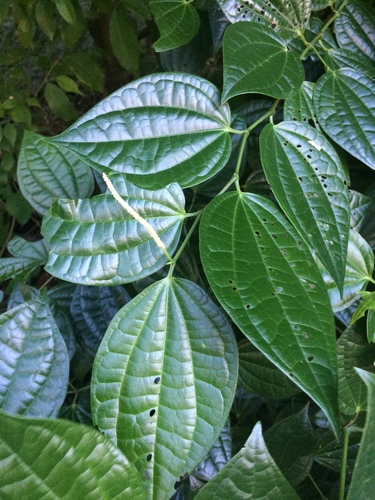
(c) Denis Wadesky, certains droits réservés (CC BY-NC), publiées par Denis Wadesky
iNaturalist· cc-by-nc
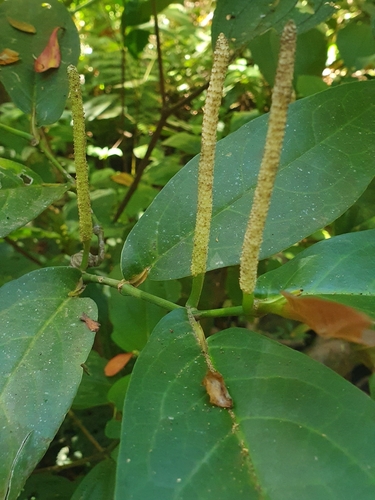
(c) Denis Wadesky, certains droits réservés (CC BY-NC), publiées par Denis Wadesky
iNaturalist· cc-by-nc
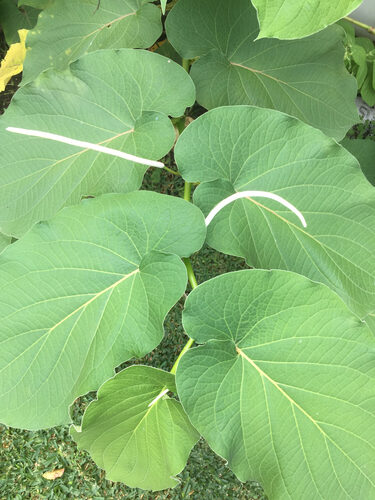
(c) Denis Wadesky, certains droits réservés (CC BY-NC), publiées par Denis Wadesky
Summary
Source: WikipediaPiper sylvaticum is a climber in the Piperaceae, or pepper, family. It is found in the northeast of the Indian subcontinent, and in China. The fruits are used in medicinal products.
Description
A climber. It has stolons or runners. The stems are ridged. They have fine hairs when young. The leaf stalks are 1-7 cm long. The leaf blade is oval and 8-11 cm long by 4-8 cm wide. The flower spikes are opposite the leaves. Male spikes are slender and 5-8 cm long. Female spikes are erect and 2-3 cm long by 3-4 mm wide. The fruit is fleshy, round and 3 mm across.
Edible Uses
The fruit is used in food preparation as a spice. The leaves are eaten as a vegetable.
Traditional Uses
The fruit are used in food preparation. The leaves are eaten as a vegetable.
This uses section is brief — help expand it
Known Hazards
In the Indian subcontinent the leaves are used as vegetables, and the roots are used in indigenous medicine as a cure for snake poison and to treat tumours. The mashed leaves are use as an anti-inflammatory by the Monpa people of Mêdog County in southeastern Tibet. Adnan et al.'s work on the bioactivity of the species cites wide traditional medicine uses in the native countries of the plant. The leaves, stems, roots, fruits, and seeds are used to treat a variety of diseases, including rheumatic pain, headaches, chronic cough, cold, asthma, piles, diarrhea, wounds in lungs, tuberculosis, indigestion, dyspepsia, hepatomegaly, and pleenomegaly. The root is specifically used as a carminative, while the aerial parts have diuretic actions. Adnan et al. found that P. sylvaticum is bioactive.
Distribution
A tropical plant. In south China it grows in wet places at about 800 m above sea level. In Yunnan.
Where It Grows
Asia, Bangladesh, China, India, Indochina, Laos, Myanmar, Northeastern India, SE Asia, Tibet,
Also Known As
Pahari pipul, Rari, Taw-kun
References (4)
- Ambasta, S.P. (Ed.), 2000, The Useful Plants of India. CSIR India. p 461
- Angami, A., et al, 2006, Status and potential of wild edible plants of Arunachal Pradesh. Indian Journal of Traditional Knowledge 5(4) October 2006, pp 541-550
- Hedrick, U.P., 1919, (Ed.), Sturtevant's edible plants of the world. p 501
- Srivastava, R. C., 2009, Traditional knowledge of Adi tribe of Arunachal Pradesh on plants. Indian Journal of Traditional Knowledge. 8(2): 146-153