Banksia spinulosa
Smith
Hairpin Banksia
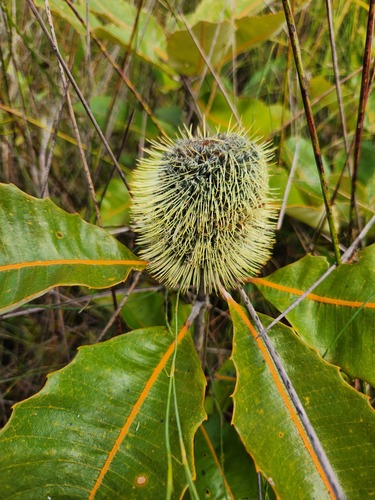
iNaturalist· cc-by-nc-sa
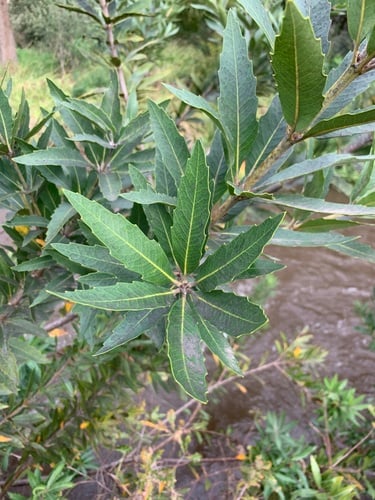
(c) Reiner Richter, some rights reserved (CC BY-NC-SA), uploaded by Reiner Richter
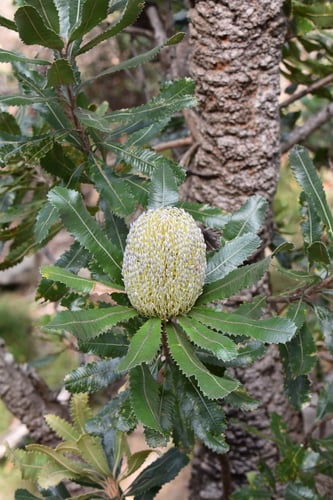
iNaturalist· cc-by-nc
(c) Vicky Heaton, some rights reserved (CC BY-NC), uploaded by Vicky Heaton
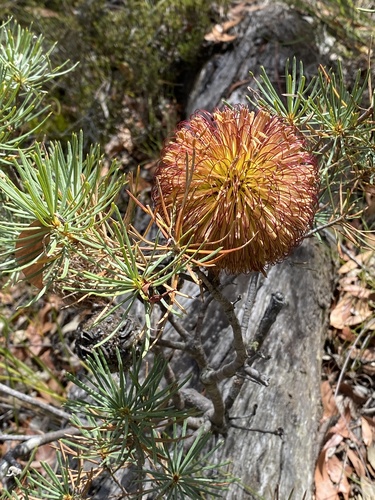
iNaturalist· cc-by-nc
(c) Jonathan M, some rights reserved (CC BY-NC), uploaded by Jonathan M
Summary
Source: WikipediaBanksia spinulosa, the hairpin banksia, is a species of woody shrub, of the genus Banksia in the family Proteaceae, native to eastern Australia. Widely distributed, it is found as an understorey plant in open dry forest or heathland from Victoria to northern Queensland, generally on sandstone though sometimes also clay soils. It generally grows as a small shrub to 2 metres (7 ft) in height, though can be a straggly tree to 6 metres (20 ft). It has long narrow leaves with inflorescences which can vary considerably in coloration; while the spikes are gold or less commonly yellowish, the emergent styles may be a wide range of colours – from black, purple, red, orange or yellow. Banksia spinulosa was named by James Edward Smith in England in 1793, after being collected by John White, most likely in 1792. He gave it the common name prickly-leaved banksia, though this has fallen out of use. With four currently recognised varieties, the species has had a complicated taxonomic history, with two varieties initially described as separate species in the early 19th century. A fourth, from the New England region, has only recently been described. However, there has been disagreement whether one, var. cunninghamii, is distinct enough to once again have specific status. The pre-eminent authority on Banksia, Alex George, concedes there is still more work to be done on the Banksia spinulosa complex. The hairpin banksia is pollinated by and provides food for a wide array of vertebrate and invertebrate animals in the autumn and winter months. Its floral display and fine foliage have made it a popular garden plant with many horticultural selections available. With the recent trend towards smaller gardens, compact dwarf forms of Banksia spinulosa have become popular; the first available, Banksia 'Birthday Candles', has achieved a great deal of commercial success and wide recognition, and has been followed by several others.
Description
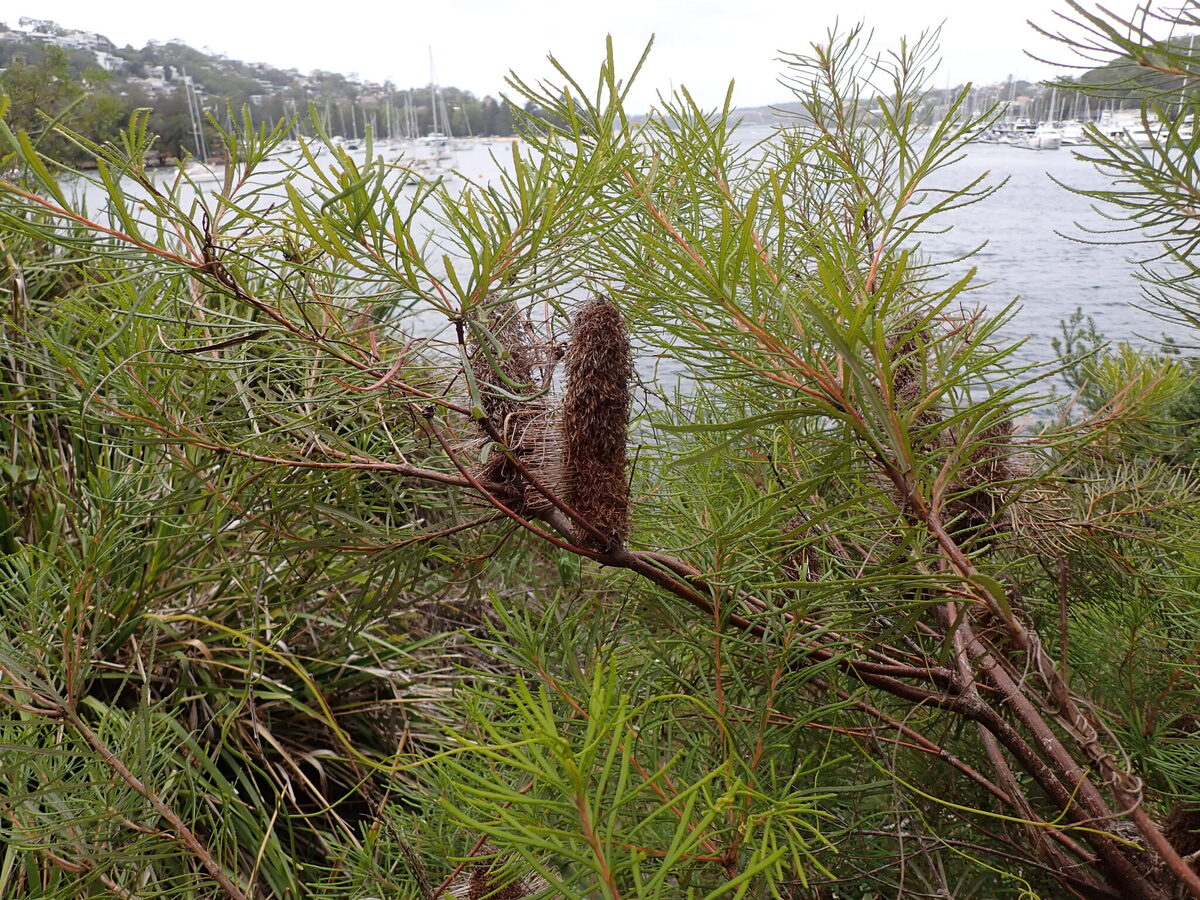
A medium spreading shrub. It grows 1-4 m tall. It can spread 1-4 m across. The leaves are narrow and the edges of the leaves are rolled under. The edges have small teeth. The leaves are green above and paler underneath. They are 2-10 cm long by 0.2-0.7 cm wide. The flowers are golden yellow. They are in flower heads up to 18 cm long. The fruit are follicles and the seed are retained after maturity.
Edible Uses
Both the nectar and seeds are edible.
Distribution
It is a warm temperate to subtropical plant. It grows in coastal areas. It does best in acid soils. It cannot tolerate high pH. It needs well drained soils. It needs full sun. It can stand heavy frosts. Hobart Botanical Gardens. It suits hardiness zones 9-11.
Where It Grows
Australia*, Tasmania,
Cultivation
It can be grown from seed or cuttings.
Notes
There are about 75 Banksia species. They are mostly in Australia.
Synonyms
References (21)
- Bodkin, F., 1991, Encyclopedia Botanica. Cornstalk publishing, p 131
- Caton, J.M. & Hardwick, R. J., 2016, Field Guide to Useful Native Plants from Temperate Australia. Harbour Publishing House. p 122
- Cronin, L., 1989, The Concise Australian Flora. Reed. p 62
- Cundall, P., (ed.), 2004, Gardening Australia: flora: the gardener's bible. ABC Books. p 219
- Edible and Useful Native Plants (off internet)
Show all 21 references Hide references
- Elliot, W.R., & Jones, D.L., 1982, Encyclopedia of Australian Plants suitable for cultivation. Vol 2. Lothian. p 304
- Etherington, K., & Imwold, D., (Eds), 2001, Botanica's Trees & Shrubs. The illustrated A-Z of over 8500 trees and shrubs. Random House, Australia. p 118
- Greig, D., 1996, Flowering Natives for Home Gardens. Angus & Robertson. p 71
- Grieg, D., 2002, A photographic guide to Wildflowers of South-eastern Australia. New Holland. p 104
- Haslam, S., 2004, Noosa's Native Plants. Noosa Integrated Catchment Assn. Inc. p 225
- Hibbert, M., 2002, The Aussie Plant Finder 2002, Florilegium. p 38
- Holliday, I., 1979, A Field Guide to Australian Native Shrubs. Rigby. p 24
- Lazarides, M. & Hince, B., 1993, Handbook of Economic Plants of Australia, CSIRO. p 31
- Llamas, K.A., 2003, Tropical Flowering Plants. Timber Press. p 321
- Lord, E.E., & Willis, J.H., 1999, Shrubs and Trees for Australian gardens. Lothian. p 151
- Melzer, R. & Plumb, J., 2011, Plants of Capricornia. Belgamba, Rockhampton. p 279
- Molyneux, B & Forrester, S., 1997, The Austraflora A-Z of Australian Plants. Reed. p 52
- N. Holl. Pl. 1: 13. T. 4. 1793
- Smith, K & I., 1999, Grow your own bushfoods. New Holland. Australia. p 106
- Townsend, K., 1994, Across the Top. Gardening with Australian Plants in the tropics. Society for Growing Australian Plants, Townsville Branch Inc. p 97
- Williams, K.A.W., 1999, Native Plants of Queensland Volume 4. Keith A.W. Williams North Ipswich, Australia. p 70