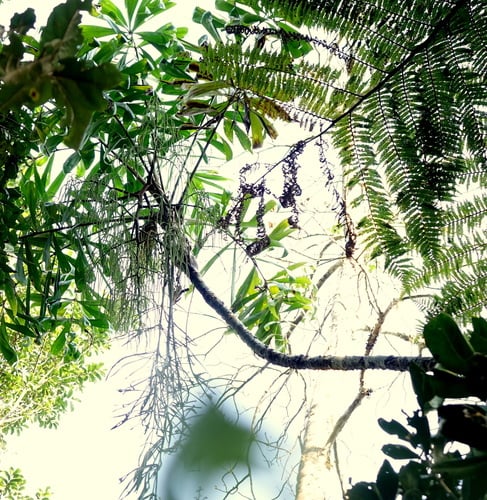
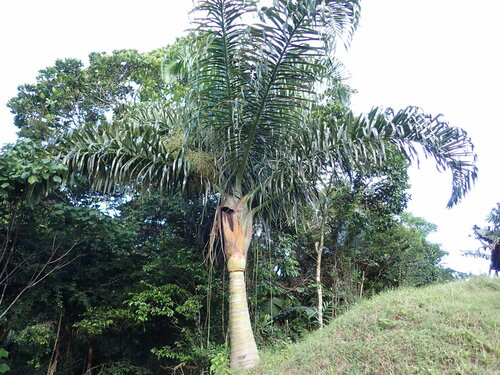
Bactris major var. infesta
(Mart.) Drude
Marajau
gbif· cc-by-nc
Pâmela Parpinelli
gbif· cc-by-nc
Pâmela Parpinelli
gbif· cc-by-nc
Pâmela Parpinelli
Summary
Source: WikipediaBactris major is a small to medium-sized (1–10 m tall) spiny palm which ranges from Mexico, through Central America into northern South America and Trinidad. The species is divided into three or four varieties, although the boundaries between varieties is not always clearly defined. The fruits are eaten or used to flavour drinks. Spanish names for the palm species include marayaú.
Description
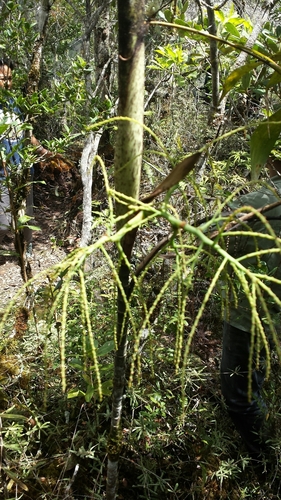
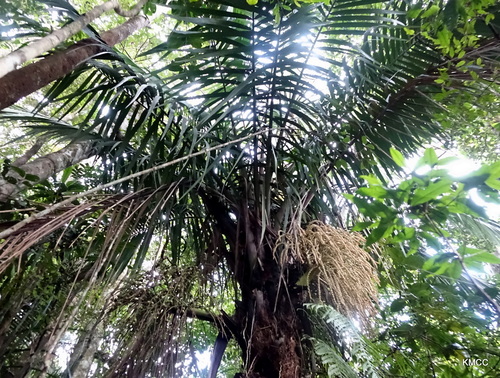
A palm with a cluster of trunks. They can be 8 m tall but only 5 cm thick. The young palms are spiny. Older trunks are smooth. They have prominent white rings. The fronds are dull green and divided along the stalk. They are 1-2 m long. The leaflets occur in groups of 2-7. They are distributed in 3 different planes. They are 30-40 cm long and 1.5-2 cm wide. The fruit occur in clusters. They are egg-shaped and purple. The flesh is juicy and edible. There are 4 slightly different varieties.
Edible Uses
The fruit flesh is edible fresh and can be made into wine. The seeds are also edible.
Traditional Uses
The flesh of the fruit is edible and can also be made into wine.
This uses section is brief — help expand it
Distribution
It is a tropical plant. In Bolivia it grows up to 700 m altitude. It will grow on many well drained soils. It can grow in light shade but does better in full sun. It cannot tolerate frost.
Where It Grows
Belize, Bolivia, Brazil, Central America, Colombia, El Salvador, Guatemala, Guianas, Honduras, India, Mexico, Nicaragua, North America, Panama, South America, Suriname, Venezuela, West Indies,
Cultivation
Plants are grown from seed. Seed need to be sown while fresh. Seed germinate readily. Young plants need shade but mature plants can grow in full sun.
Notes
There are 239 Bactris species. There are 75 species in tropical America. Most Bactris have fruit that are edible but many are not attractive.
Synonyms
Also Known As
Beach palm, Black Roseau, Cana brava, Cocorotes, Coyul, Cubarro, Hones, Huiscoyol, Ichicaqui, Jakuate, Pokenoboy, Prickly palm
References (13)
- Altschul, S.V.R., 1973, Drugs and Foods from Little-known Plants. Notes in Harvard University Herbaria. Harvard Univ. Press. Massachusetts. no. 94
- Ambasta S.P. (Ed.), 2000, The Useful Plants of India. CSIR India. p 65
- Balick, M.J. and Beck, H.T., (Ed.), 1990, Useful palms of the World. A Synoptic Bibliography. Colombia p 157 (As Pyrenoglyphis infesta), 561 (As Pyrenoglyphis infesta),
- Coe, F.G., and Anderson, G.J., 1996, Ethnobotany of the Garifuna of Eastern Nicaragua. Economic Botany 50(1) pp 71-107
- Flowerdew, B., 2000, Complete Fruit Book. Kyle Cathie Ltd., London. p 162
Show all 13 references Hide references
- Hedrick, U.P., 1919, (Ed.), Sturtevant's edible plants of the world. p 90
- Henderson, A., Galeano, G and Bernal, R., 1995, Field Guide to the Palms of the Americas. Princeton. p 192
- Johnson, D.V., 1998, Tropical palms. Non-wood Forest products 10. FAO Rome. p 91
- Jones, D.L., 1994, Palms throughout the World. Smithtonian Institution, Washington. p 52, 55, 56
- NYBG Herbarium "edible"
- Riffle, R.L. & Craft, P., 2003, An Encyclopedia of Cultivated Palms. Timber Press. p 268
- Vasquez, Roberto Ch. & Coimbra, German S., 1996, Frutas Silvestres Comestibles de Santa Cruz. p 163
- Wickens, G.E., 1995, Edible Nuts. FAO Non-wood forest products. FAO, Rome. p163