Baccaurea polyneura
Hook. f.
Jintek merah, Jintek-jintek
iNaturalist· cc-by
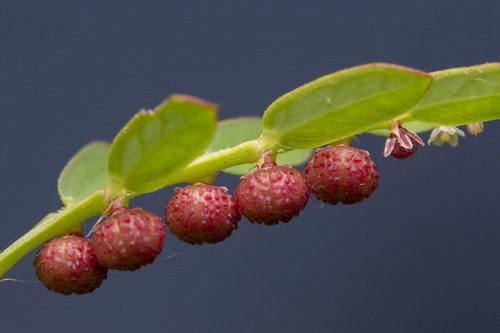
(c) adzla, some rights reserved (CC BY)
iNaturalist· cc-by-nc
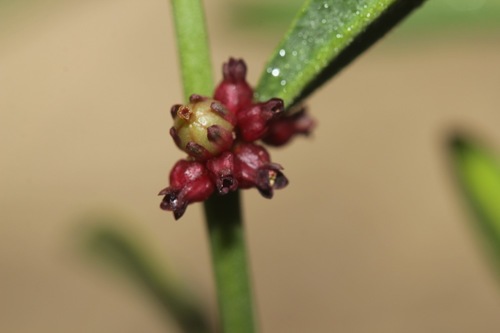
(c) Yeoh Thean Kheng, some rights reserved (CC BY-NC)
iNaturalist· cc-by-nc-sa
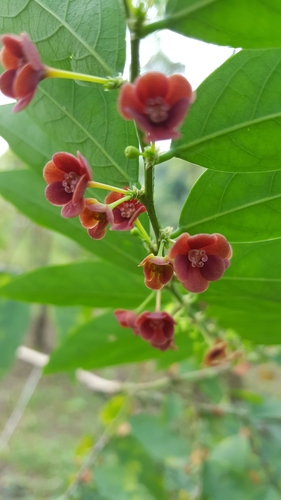
(c) Ahmad Fuad Morad, some rights reserved (CC BY-NC-SA)
Summary
Source: WikipediaBaccaurea polyneura is a species of plant in the family Phyllanthaceae. It is native to Sumatra, Borneo, Java, Peninsular Malaysia, Singapore and Peninsular Thailand. The fruit, called jentik, is edible, if sour, and is locally harvested and sold.
Description
A tree. It grows 20-25 m tall. The trunk is 90 cm across. The leaves are oblong and 15 cm long by 6 cm wide. Trees are separately male and female. The flowers are yellow to green spikes. The fruit are small and hang in clusters from the branches in strings about 20 cm long. There are about 50 fruit. The fruit are 2 cm long. They turn yellow to orange when ripe. The pulp is deep orange and sweet. The flowering stalks are on the branches. Female stalks are 30 cm long. The fruit are oval. The flesh is edible. The fruit are yellow to orange when ripe.
Edible Uses
Fruit - raw. A sweet to sour flavour. The globose fruits are up to 26mm in diameter. The fruit is borne in clusters on stems up to 24cm long. The ripe fruit splits open when pressed/pinched to show one to three reddish pulpy segments, each with one seed inside. The pulp is often swallowed whole. The taste is sour with a pinch of sweetness.
Traditional Uses
The fruit are eaten. They can be sweet or sour.
This uses section is brief — help expand it
Medicinal Uses
We have no specific information on this species, but the bark of several members of this genus is used to relieve eye inflammation.
Distribution
A tropical plant. It grows in lowland forests up to 200 m altitude above sea level. It can be in swamp forests.
Where It Grows
Asia, Brunei, Indochina, Indonesia, Malaysia, Myanmar, Sarawak, SE Asia, Thailand,
Cultivation
Plants can be grown from seed.
Propagation
Seed - when sown fresh it usually germinates in a few days.
Other Uses
We have no specific information for this species, but the bark of several members of this genus is used, along with other ingredients, as a dyestuff to colour silk yellow, red or mauve, using the dyeing process known as 'pekan' in Malay. The wood is durable and used for house-posts. Although we have no more specific information for this species, most members of this genus produce an excellent timber, which can be used to build houses and boats and to make furniture. In common with other trees that produce their flowers and fruits on the trunk of the tree, members of this genus are generally considered to be good support trees for the climbing rattan palms, which are grown to provide material for basket making, weaving into furniture, making ropes etc.
Other Information
The fruit are especially eaten by children.
Notes
There are about 80 Baccaurea species.
Synonyms
Also Known As
Enyak beruk, Jelantik, Jelentik, Jelintik, Jentik bukit, Kapul burung, Kayu masam, Peris, Pris, Rambai hutan, Simpak nyabor
References (19)
- Bircher, A. G. & Bircher, W. H., 2000, Encyclopedia of Fruit Trees and Edible Flowering Plants in Egypt and the Subtropics. AUC Press. p 51
- Burkill, I.H., 1966, A Dictionary of the Economic Products of the Malay Peninsula. Ministry of Agriculture and Cooperatives, Kuala Lumpur, Malaysia. Vol 1 (A-H) p 283
- Chai, P. P. K. (Ed), et al, 2000, A checklist of Flora, Fauna, Food and Medicinal Plants. Lanjak Entimau Wildlife Sanctuary, Sarawak. Forestry Malaysia & ITTO. p 167 (Also as Baccaurea hookeri)
- Giesen, W., 2013, Paludiculture: sustainable alternatives on degraded peat land in Indonesia (revised draft) (As Baccaurea kunstleri)
- Hanum, F. I., 1999, Plant Diversity and Conservation Value of Ayer Hitam Forest, Selangor, Peninsula Malaysia. Pertanika J. Trop. Agric. Sci. 22(2):73-83 (As Baccaurea kunstleri)
Show all 19 references Hide references
- Hoe, V. B. & Siong, K. H., 1999, The nutritional value of indigenous fruit and vegetables in Sarawak. Asia Pacific J. Clin. Nutr. 8(1):24-31
- Khoo, H. E., et al, 2008, Carotenoid Content of Underutilized Tropical Fruits. Plant Foods for Human Nutrition 63:170-175
- Milow, P., et al, 2013, Malaysian species of plants with edible fruits or seeds and their evaluation. International Journal of Fruit Science. 14:1, 1-27 (Also as Baccaurea hookeri and Baccaurea kunstleri)
- Prosea No. 2 (As Baccaurea kunstleri)
- Septiani, Y. & Sidabutar, H., (Eds.) 2015, Biodiversity Survey. In the Sub Watershed Embaloh, Betung Kerihun National Park. ITTO p 82
- Siong, K. H., 2003, Indigenous Fruits of Sarawak. ITTO & Sarawak Forest Department. p 56 (As Baccaurea hookeri)
- Slik, F., www.asianplant.net
- Sukarya, D. G., (Ed.) 2013, 3,500 Plant Species of the Botanic Gardens of Indonesia. LIPI p 146
- Suwardi, A. B., et al, 2020, Wild edible fruits generate substantial income for local people of the Gunung Leuser National Park, Aceh Tamiang Region. Ethnobotany Research & Applications 20:11
- Suwardi, A. B., et al, 2020, Ethnobotany and conservation of indigenous edible fruit plants in South Aceh, Indonesia. Biodiversitas Vol. 21, No. 5, pp 1850-1860
- Verheij, E. W. M. and Coronel, R.E., (Eds.), 1991, Plant Resources of South-East Asia. PROSEA No 2. Edible fruits and nuts. Pudoc Wageningen. p 320
- World Checklist of Useful Plant Species 2020. Royal Botanic Gardens, Kew
- www.nationalherbarium.nl/thaueuph/ Flora of Thailand.
- Zawiah, N. & Othaman, H., 2012, 99 Spesies Buah di FRIM. Institut Penyelidikan Perhutanan Malaysia. p 50 and p 48 (As Baccaurea kunstleri)