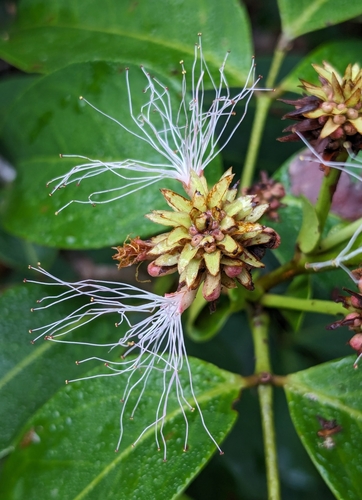
Acacia ramulosa
W. Fitzg.
Horse mulga, Narrow-leaf Mulga
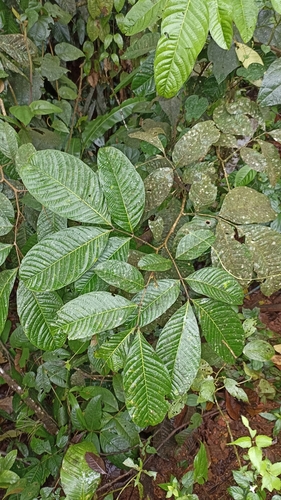
iNaturalist· cc-by-sa
(c) dr.scott.mills, some rights reserved (CC BY-SA), uploaded by dr.scott.mills
iNaturalist· cc-by-sa
(c) Mark Marathon, some rights reserved (CC BY-SA)
iNaturalist· cc-by-sa
(c) dr.scott.mills, some rights reserved (CC BY-SA), uploaded by dr.scott.mills
Summary
Source: WikipediaAcacia ramulosa, commonly known as horse mulga or bowgada wattle, is a shrub belonging to the genus Acacia and the subgenus Juliflorae endemic to arid areas of Australia.
Description
A shrub or small tree. It grows 5 m tall. There are prickles along the stem. The leaves are twice divided and there are 8-18 pairs of pinnae. There are up to 50 pairs of pinnules on each pinnae. The flowers are yellow. They are in large clusters at the ends of branches. The pods are flattened.
Edible Uses
The seeds are eaten, and galls are also consumed.
Traditional Uses
The seeds are eaten.
This uses section is brief — help expand it
Distribution
It grows in arid regions. It is drought and frost resistant. It requires a well drained soil and a sunny position. It can grow on limestone soils.
Where It Grows
Australia*,
Cultivation
It is grown from seed.
Notes
There are about 1,350 Acacia species. Over 1,000 occur in Australia. Also as Mimosaceae.
Also Known As
Pakuta, Palpa
References (9)
- Bonney, N., 1997, Economic Native Trees and Shrubs for South Australia. Greening Australia (SA) inc. Campbelltown SA 5074 p 17
- Cherikoff V. & Isaacs, J., The Bush Food Handbook. How to gather, grow, process and cook Australian Wild Foods. Ti Tree Press, Australia p 42, 188 Elliot, W.R., & Jones, D.L., 1982, Encyclopedia of Australian Plants suitable for cultivation. Vol 2. Lothian. p 105
- Hunter, J.T., 2017, Is there a relationship between contemporary high Aboriginal plant resource locations and mapped vegetation communities? Cunninghamia 17:27-34. The Royal Botanic Garden Sydney. ISSN 2200 - 405X
- J. Western Australia Nat. Hist. Soc. 2(1):15. 1904
- Lang, P. J., et al, 1986, Anangu Pitjantjatjara Lands Biological Survey. p 41, 44
Show all 9 references Hide references
- Lazarides, M. & Hince, B., 1993, Handbook of Economic Plants of Australia, CSIRO. p 6
- Lister, P.R., P. Holford, T. Haigh, and D.A. Morrison, 1996, Acacia in Australia: Ethnobotany and potential food crop. p. 228-236. In: J. Janick (ed.), Progress in new crops. ASHS Press, Alexandria, VA.
- Paczkowska, G . & Chapman, A.R., 2000, The Western Australian Flora. A Descriptive Catalogue. Western Australian Herbarium. p 320
- Pennock, A., et al, Australian Dry-zone Acacias for Human Food: Proceedings of a Workshop.