Rubus neoebudicus
Gillaumin
Chi Chi
iNaturalist· cc-by-nc
(c) Greg Lasley, some rights reserved (CC BY-NC), uploaded by Greg Lasley
gbif· cc-by
Dominik Maximilián Ramík
iNaturalist· cc-by
(c) Nigel Voaden, some rights reserved (CC BY)
gbif· cc0
President and Fellows of Harvard College
Description
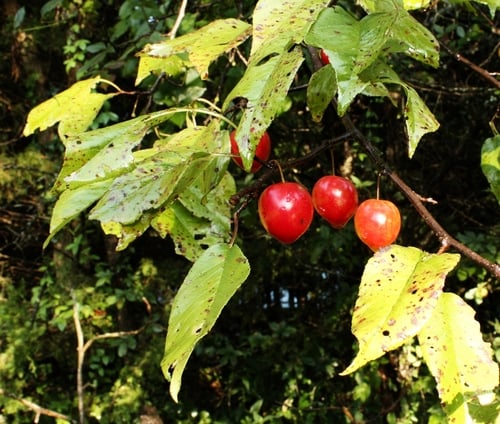
A bramble or straggling herb. It grows 4 m tall. The stems have short hairs. The leaves have 5 leaflets spread out like fingers on a hand. Sometimes the upper leaves only have 3 leaflets. The leaf stalk is 2-5 cm long. The end leaflet is 8-14 cm long by 2-4 cm wide. The flowers are on branched stalks with 8 flowers on side stalks. The fruit are red. They are oval and 1 cm across.
Edible Uses
The fruit are eaten.
Distribution
A tropical plant. In Papua New Guinea it occurs in New Britain and New Ireland. It grows between 600-1,700 m above sea level.
Where It Grows
Pacific, Papua New Guinea, PNG, Solomon Islands, Vanuatu,
Notes
There are about 250 Rubus species. Collected from San Cristobel, Makira by Brass. It is an unresolved name in The Plant List. PROSEA gives Rubus brassii as a synonym of Rubus neo-ebudicus Gillaumin.
Dangerous Lookalikes
This plant can be confused with the following toxic species. Always verify identification carefully before consuming any wild plant.
Red Baneberry
Actaea rubra
Walter Siegmund (talk)
Chi Chi
Rubus neoebudicus
(c) Greg Lasley, some rights reserved (CC BY-NC), uploaded by Greg Lasley
Red Baneberry: Short herbaceous plant (no thorns), berries on thick red stems, each berry has a single seed, compound sharply-toothed leaves.
Chi Chi: Thorny woody canes (brambles), aggregate berry made of many drupelets, berries pull easily from receptacle.
Synonyms
References (4)
- Altschul, S.V.R., 1973, Drugs and Foods from Little-known Plants. Notes in Harvard University Herbaria. Harvard Univ. Press. Massachusetts. no. 1431 (As Rubus brassii)
- Flora malesiana
- French, B.R., 2010, Food Plants of Solomon Islands. A Compendium. Food Plants International Inc. p 243 (As Rubus brassii)
- Merrill & Perry, L.M., 1940, J. Arnold Arbor. 21: 182 (As Rubus brassii)