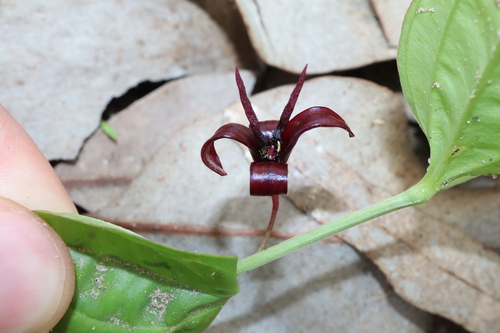
Stemona tuberosa
Lour.
Bach bo, Sessile stemona root
iNaturalist· cc0
no rights reserved, uploaded by 葉子
iNaturalist· cc-by-nc
(c) JODY HSIEH, some rights reserved (CC BY-NC)
iNaturalist· cc-by-nc
(c) Andrew Pierce, some rights reserved (CC BY-NC), uploaded by Andrew Pierce
Summary
Source: WikipediaStemona tuberosa is a species of flowering plant in the family Stemonaceae. Hornets play an important role in seed dispersal by biting off the seed with its elaiosome and then carrying the seed away for about 100 m. There they chew off the elaiosome and abandon the seed which is likely to be taken by ants into their nest.
Description
A slender herb. It is a climber. Stems can be 4 m long. The roots are 9-13 cm long by 1-2 cm wide. The stems have a woody base and are often branched. The leaves are opposite and in rings. The leaf stalk is 3-10 cm long. The leaves are oval and 6-24 cm long by 5-17 cm wide. The edges are slightly wavy. The fruit is a capsule 3-6 cm long by 1-3 cm wide. There are several seeds.
Edible Uses
The roots are traditionally treated with limewater and candied with sugar, or boiled as a vegetable. The fruit and tubers are also edible.
Traditional Uses
CAUTION: The roots contain alkaloids. The roots are treated with limewater then candied with sugar. They are also boiled as a vegetable.
This uses section is brief — help expand it
Medicinal Uses
Stemona tuberosa (Chinese: 百部; pinyin: bǎi bù) is one of the 50 fundamental herbs used in traditional Chinese medicine. It can be used as a treatment for Pediculus capitus and Phthirus pubis typically with low skin irritation.
Known Hazards
The roots contain alkaloids.
Distribution
A tropical plant. It grows in tropical Asia. It grows in forests, thickets and mountain slopes between 300-2,300 m above sea level. It grows in well-drained soils and open places and can be in light shade. In Sichuan and Yunnan.
Where It Grows
Asia, Bangladesh, Cambodia, China, India, Indochina, Indonesia, Laos, Malaysia, Myanmar, Northeastern India, Philippines, SE Asia, Taiwan, Thailand, Vietnam,
Cultivation
Plants can be grown from seeds and cuttings.
Other Uses
The roots contain stemorin. They have been recommended for use as an insecticide. They can be used against mosquito larvae, fleas and bugs. The roots are collected when the plant withers, they are well bruised and soaked in water, then the water is used for spraying on plants in order to kill any pests attacking them. The tuberous roots are 10 - 30cm long and 2 - 3cm thick.
Notes
It is used in medicine.
Synonyms
Also Known As
Barhtlum, Basel phauk, Japanese stemona root, Kaniputeega, Kaniputiga, Ijedigadda, Simi-tauk, Stemona filipina, Thagdi, Ubi kemili hutan, Ubi kelili
References (12)
- Ambasta, S.P. (Ed.), 2000, The Useful Plants of India. CSIR India. p 598
- Burkill, I.H., 1966, A Dictionary of the Economic Products of the Malay Peninsula. Ministry of Agriculture and Cooperatives, Kuala Lumpur, Malaysia. Vol 2 (I-Z) p 2111
- Fl. Cochinch. 2:404. 1790
- Hedrick, U.P., 1919, (Ed.), Sturtevant's edible plants of the world. p 634
- Lim, T. K., 2015, Edible Medicinal and Non Medicinal Plants. Volume 9, Modified Stems, Roots, Bulbs. Springer p 79
Show all 12 references Hide references
- Medhi, P. & Borthakur, S. K., 2012, Phytoresources from North Cachur Hills of Assam -3: Edible plants sold at Hflong market. Indian Journal of Natural Products and Resources. 3(1) pp 84-109
- Medhi, P., Sarma, A and Borthakur, S. K., 2014, Wild edible plants from the Dima Hasao district of Assam, India. Pleione 8(1): 133-148
- PROSEA handbook Volume 9 Plants yielding non-seed carbohydrates. p 190
- Pullaiah, T., et al, Ethnobotany of India, Volume 1: Eastern Ghats and Deccan.
- Samydurai, P., et al, 2012, Wild habits of Kolli Hills being staple food of inhabitant tribes of eastern Ghats, Tamil Nadu, India. Indian Journal of Natural Products and Resources. 3(3) September 2012 pp 432-437
- Sukarya, D. G., (Ed.) 2013, 3,500 Plant Species of the Botanic Gardens of Indonesia. LIPI p 975
- World Checklist of Useful Plant Species 2020. Royal Botanic Gardens, Kew