Laetiporus sulphureus
(Bull) Fr.
Chicken of the woods, Sulfur polypore, Sulphur shelf
iNaturalist· cc-by-nc
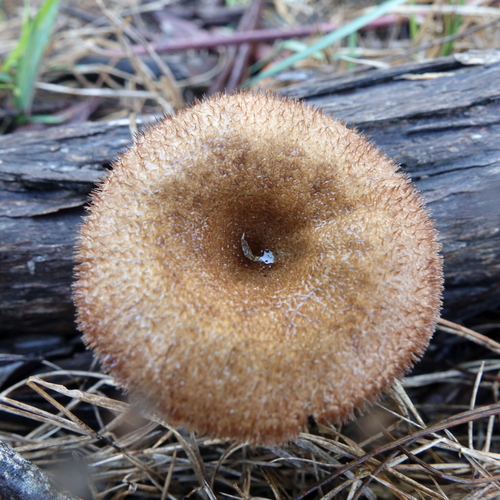
(c) Stephen John Davies, some rights reserved (CC BY-NC), uploaded by Stephen John Davies
iNaturalist· cc-by-nc-sa
(c) jonathantellerelsberg, some rights reserved (CC BY-NC-SA)
iNaturalist· cc-by
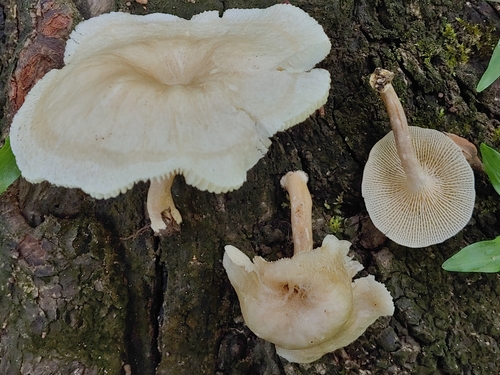
(c) Dr. Alexey Yakovlev, some rights reserved (CC BY), uploaded by Dr. Alexey Yakovlev
Summary
Source: WikipediaLaetiporus sulphureus is a species of bracket fungus (fungi that grow on trees). Its common names include sulphur polypore, sulphur shelf, and chicken-of-the-woods. Its fruit bodies grow as striking golden-yellow shelf-like structures on tree trunks and branches. Old fruitbodies fade to pale beige or pale grey. The undersurface of the fruit body is made up of tubelike pores rather than gills. Found in Europe and North America, L. sulphureus is a saprophyte and occasionally a weak parasite, causing brown cubical rot in the heartwood of trees on which it grows. Unlike many bracket fungi, it is edible when young, although adverse reactions have been reported.
Description
A mushroom. It is bright sulphur-yellow to orange.
This description is brief — help expand it
Edible Uses
Due to its taste, Laetiporus sulphureus has been called the chicken polypore and chicken-of-the-woods (not to be confused with Grifola frondosa, the so-called hen-of-the-woods). Many people think that the mushroom tastes like crab or lobster leading to the nickname lobster-of-the-woods. The authors of Mushrooms in Color said that the mushroom tastes good sauteed in butter or prepared in a cream sauce served on toast or rice. It is highly regarded in Germany and North America. Young specimens are edible if they exude large amounts of a clear to pale yellow watery liquid. Only the young outer edges of larger specimens should be collected, as older portions tend to be tough, unpalatable, and bug-infested. The mushroom should not be eaten raw.
Traditional Uses
The fruiting body is edible when still unripe. It has a spicy flavour. The trimmed edges of the young caps are used. They are cut into very thin slices and stewed for 30 minutes or more. It can be dried.
Known Hazards
Some people have experienced gastrointestinal upset after eating this mushroom, and it should not be consumed raw. Severe adverse reactions can occur, including vomiting and fever, in about 10% of the population, but this is now thought to be the result of confusion with morphologically similar species such as Laetiporus huroniensis, which grows on hemlock trees, and L. gilbertsonii, which grows on Eucalyptus.
Distribution
It grows in temperate places. It grows on trees. It grows in moist places.
Where It Grows
Africa, Alaska, Asia, Bhutan, Britain, Canada, China, Europe, France, Guyana, Himalayas, Hungary, India, Italy, Japan, Kyrgyzstan, Malaysia, Mediterranean, Mexico, Nepal, North America, Northeastern India, Pacific, Papua New Guinea, PNG, Romania, Russia, SE Asia, Sicily, Sikkim, South Africa, Southern Africa, South America, Turkey, Türkiye, Uruguay, USA,
Other Information
It is sold in local markets in Nepal.
Synonyms
Also Known As
Linhuangjun, Mirgay chaew, Rakteauu
References (34)
- Adhikari, M. K., 2014, Addition and correction to the knowledge on edibility of wild mushrooms in Nepal: a discussion. Bul. Dept. Pl. Res. N. 36, Nepal p 5
- Ambasta, S.P. (Ed.), 2000, The Useful Plants of India. CSIR India. p 482 (As Polyporus sulphureus)
- Boa, E. R., 2004, Wild edible fungi and their importance to people. FAO Non Wood Forest Products Booklet 17
- Christensen, M., et al, 2008, Collection and Use of Wild Edible Fungi in Nepal. Economic Botany, 62(1), 2008, pp. 12–23
- Ciesla, W.M., 1998, Non-wood forest products from conifers. Non-wood forest products 12, FAO, Rome, p 91 (As Polyporus sulphureus)
Show all 34 references Hide references
- Devkota, S., 2008, Distribution and Status of Highland mushrooms: A study from Dolpa, Nepal. J.Nat.Hist.Mus.Vol.23,2008, 51-59
- Dongol, et al, 1995, Edible Mushrooms in Nepal
- Facciola, S., 1998, Cornucopia 2: a Source Book of Edible Plants. Kampong Publications, p 253
- Fan, L., et al, The Use of Edible Wild Plants and Fungi in Korean-Chinese Villages. Journal of Environmental Information Science 44-5 p 71-79 (As Tyromyces sulphureus (Bull. ex Fr.) Donk.)
- Gryzenhout, M., 2010, Mushrooms of South Africa. Pocket Guide. Struik. p 83
- Guild, B., 1979, The Alaskan Mushroom Hunter's Guide. Alaska Northwest Publishing Company. p 188
- Hall, I. R., et al, 2003, Edible and Poisonous Mushrooms of the World. Timber Press. p 259
- Henkel, T. W., et al, 2004, Edible mushrooms from Guyana. Mycologist 18(3): 104-111
- Jordan, P., 2000, The Mushroom Guide and Identifier, Hermes House, p 68
- Joshi, K. and Joshi, A. R., 2008, Ethnobotanical Studies on Some Lower Plants of the Central Development Region, Nepal. Ethnobotanical Leaflets 12:832-40
- Kang, Y., et al, 2012, Wild food plants and wild edible fungi in two valleys on the Qinling Mountains (Shaanxi, central China) Journal of Ethnobiology and Ethnomedicine; 9:26
- Kaufmann, B. et al, 1999, The Great Encyclopedia of Mushrooms. Konemann. p 213
- Kaye, G.C., 1986, Wild and Exotic Mushroom Cultivation in North America
- Kiple, K.F. & Ornelas, K.C., (eds), 2000, The Cambridge World History of Food. CUP p 320
- Kiple, K.F. & Ornelas, K.C., (eds), 2000, The Cambridge World History of Food. CUP p 322 (As Polyporus sulphureus)
- Kuhnlein, H. V. and Turner, N. J., 1991, Traditional Plant Foods of Canadian Indigenous Peoples. Food and Nutrition in History and Anthropology Volume 8. Gordon and Breach. p 27 (As Polyporus sulphureus)
- Kuhnlein and Turner, 1991, (As Polyporus sulphureum)
- Lentini, F. and Venza, F., 2007, Wild food plants of popular use in Sicily. J Ethnobiol Ethnomedicine. 3: 15
- Luczaj, L., et al, 2015, Wild food plants and fungi used by Ukrainians in the western part of the Maramureş region in Romania. Acta Soc Bot Pol 84(3):339–346
- Manju, S., and Sundriyal, R. C., 2001, Wild Edible Plants of the Sikkim Himalaya: Nutritive Values of Selected Species. Economic Botany 55(3): 377-390 (As Polyporus sulphureus)
- Mukhia, P.K., et al, 2013, Wild plants as Non Wood Forest Products used by the rural community of Dagana, a southern foothill district of Bhutan, SAARC Journal, 27 pages
- Ostry, M. E., et al, 2010, Field Guide to Common Macrofungi in Eastern Forests and Their Ecosystem Functions. USDA Forest Service General Technical Report NRS-79 p 67
- Pace, G., 1998, Mushrooms of the world. Firefly books. p 194, 205 (As Boletus sulphureus)
- Schneider, E., 2001, Vegetables from Amaranth to Zucchini: The essential reference. HarperCollins. p 182
- See, L. S., et al, 2008, Utilization of Macrofungi by some Indigenous Communities for Food and Medicine in Peninsular Malaysia. Sustainable Forest Management and Poverty Alleviation: Roles of Traditional Forest-related Knowledge IUFRO World Series Volume 21
- Shaw, 1984, (As Polyporus sulphureus)
- Vetner, J., 2005, Lithium content of some common edible wild-growing mushrooms. Food Chemistry 90:31-37
- www.plantnames.unimelb.edu.au (As Polyporus sulphureus)
- Yokayama, 1975,