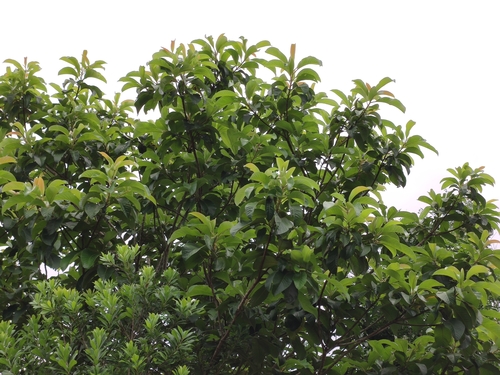
Alangium salviifolium
(L. f.) Wangerin
Sage-leaved Alangium
iNaturalist· cc-by-nc
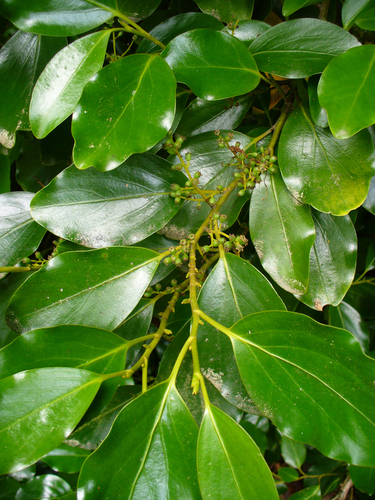
(c) Aditya Gadkari, some rights reserved (CC BY-NC), uploaded by Aditya Gadkari
iNaturalist· cc-by-nc
(c) Shiwalee Samant, some rights reserved (CC BY-NC), uploaded by Shiwalee Samant
iNaturalist· cc-by-sa
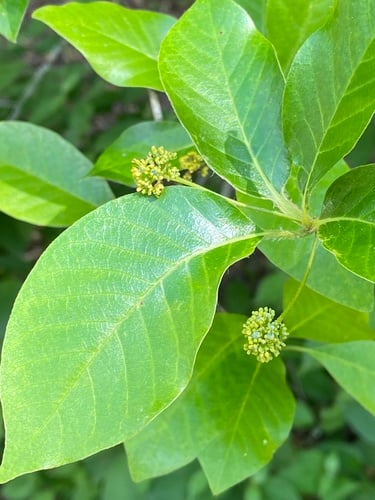
(c) Dinesh Valke, some rights reserved (CC BY-SA)
Summary
Source: WikipediaAlangium salviifolium, commonly known as sage-leaved alangium, is a flowering plant in the Cornaceae family. It is also commonly known as udugu chettu in Telugu, Ankolam in Malayalam, Ankola in Kannada, Akola or Ankol in Hindi and Alanji in Tamil. In India, Its mostly found in dry regions in plains and low hills and also found on roadsides.
Description
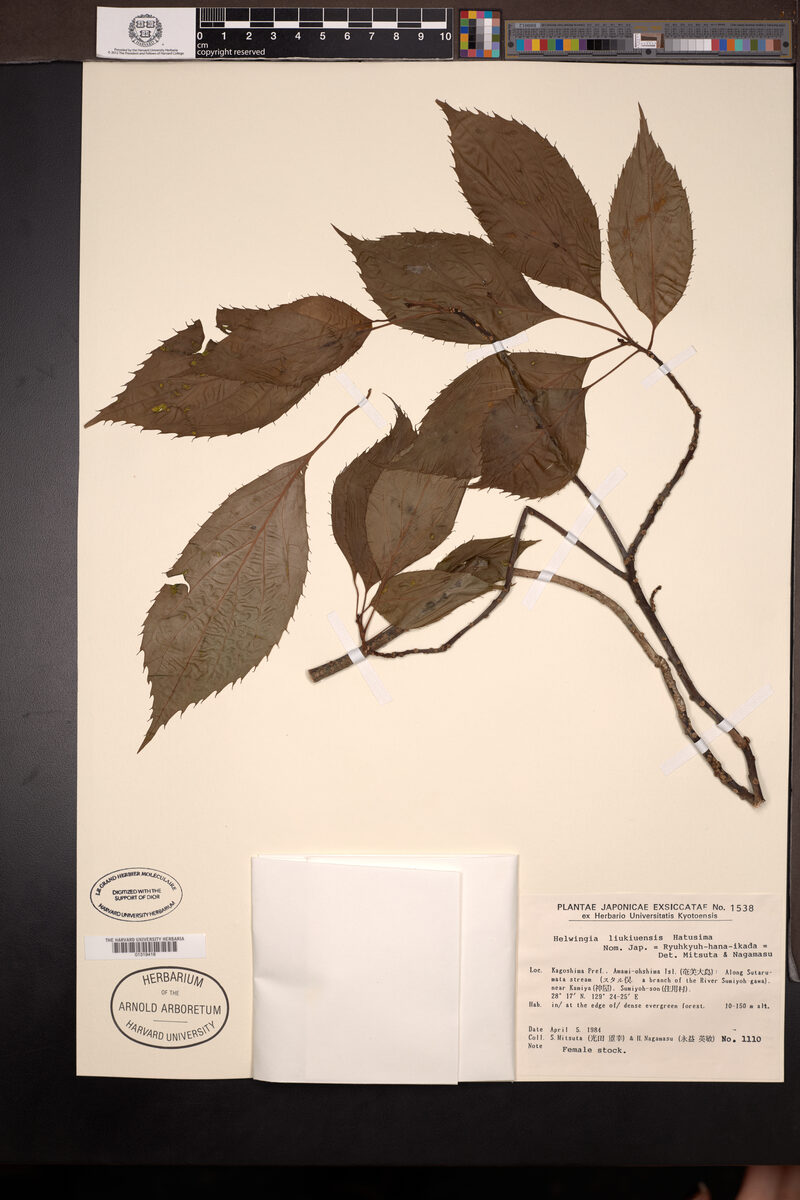
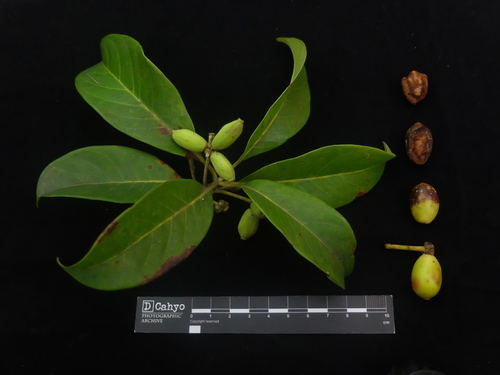
A shrub or tree. It is often straggling. The bark is thick, grey and fibrous. The branches are slender and usually have thorns. The leaves have short stalks. They are entire and vary in shape. They are 8-15 cm long. They are hairy when young. They become smooth on the top surface. The flowers have short stalks. They are small and greenish-white. They have a sweet scent. They occur singly or in clusters along the twigs. There are 5-10 petals that are narrow and hairy. The fruit is a smooth berry. It is green but turns red or black at maturity. It has a single seed. The fruit pulp is sweet but has an unpleasant taste.
Edible Uses
The ripe sweet fruit pulp is eaten raw. The kernel of the seed is also eaten.
Traditional Uses
The ripe fruit are sweet and edible. The pulp is eaten raw. The kernel of the seed is eaten.
This uses section is brief — help expand it
Medicinal Uses
In Ayurveda the roots and the fruits are used for the treatment of rheumatism and haemorrhoid. Externally, it is used for the treatment of bites by rabbits, rats, and dogs. The root-bark is also used in traditional medicine skin problems and as an antidote for snake bite. The root-bark is also used to expel parasitic worms (Platyhelminthes) and other internal parasites from the body. It is used as an emetic and purgative as well. The wood is said to be hard and close-grained because of which good finishing is possible. It is used to make ornamental work, pestles and rollers and also is good as a fuel wood. The stems because of its sharp ends are used as a spear in Kenya. The twigs are also used as toothbrush in India. It is considered to be good for making musical instruments and for making furniture as well.
Distribution
A tropical plant. It grows in the tropics. In southern China it grows in forests below 1,200 m above sea level.
Where It Grows
Africa, Andamans, Asia, Bangladesh, Cambodia, Comoros, China, Himalayas, India, Indochina, Indonesia, Laos, Malaysia, Myanmar, Nepal, Northeastern India, Pacific, Philippines, SE Asia, Sri Lanka, Thailand, Vietnam,
Cultivation
Plants can be grown from seeds.
Propagation
Seed - Cuttings of half ripe wood.
Other Uses
The twigs are used for brushing the teeth. A mixture of the mature fruits, combined with honey and the roots of sweet flag (Acorus calamus), is used as a pesticide to manage pests on agricultural crops. A non-edible oil from the seeds is used as an illuminant. The brown wood is close grained and heavy. Its density varies widely from 440 - 1,100 kg/m³ at 15% moisture. It air dries well without checking, works well, bends easily and takes a good finish. It is not durable and should not be used for exterior purposes, especially when in contact with the ground. The wood is valued for musical instruments and furniture in India; it is used in construction for beams and flooring; cabinet work, inlaying, carving, bobbins, spindles, pestles, oil mills, shuttles, rice pestles, tool handles, walking sticks, gunstocks and handicraft articles. The stems are traditionally used for making spears in Kenya.
Production
The fruit are available from April to June in India.
Other Information
The fruit are especially eaten by children.
Notes
There are 17-20 Alangium species. This one is used in medicine. Also put in the family Alangiaceae.
Synonyms
Also Known As
Aakna, Aakola, Akar-kanta, Akol, Akola, Alangi, Ankar, Ankol, Ankola, Ankolamu, Ankole, Ankoli, Ankollam, Ankora, Ankota, Ankul, Ankula, Ankulo, Ankura, Ankwal, Ansaroli, Azhingi, Bagh-ankura, Dhala dari, Dhalanga, Irinjil, Onkla, Ooduga, Wait sesatak, Wangerin
References (38)
- Ambasta S.P. (Ed.), 2000, The Useful Plants of India. CSIR India. p 25
- Bandana, P. & Debabrata, P., 2015, Wild Edible Plant Diversity and its Ethno-medicinal use by Indigenous Tribes of Koraput, Odisha, India. Research Journal of Agriculture and Forestry Sciences. Vol. 3(9), 1-10, October (2015)
- Bandyopadhyay, S., et al, 2012, A Census of Wild Edible Plants from Howrah District, West Bengal, India. Proceedings of UGC sponsored National Seminar 2012
- BARC, 2016, State of Biodiversity for Food and Agriculture in Bangladesh. Bangladesh Agricultural Research Council.
- Basha, S. K. M., Ethnobotanical Trees of Sri Lanka Malleswara Wildlife Sanctuary; Eastern Ghats, Andhra Pradesh.
Show all 38 references Hide references
- Behera, K. K. et al, 2008, Wild Edible Plants of Mayurbhanj District, Orissa, India. J. Econ. Taxon. Bot. Vol. 32 (Suppl,) pp 305-314
- Bircher, A. G. & Bircher, W. H., 2000, Encyclopedia of Fruit Trees and Edible Flowering Plants in Egypt and the Subtropics. AUC Press. p 17
- Burkill, I.H., 1966, A Dictionary of the Economic Products of the Malay Peninsula. Ministry of Agriculture and Cooperatives, Kuala Lumpur, Malaysia. Vol 1 (A-H) p 82
- Chakraborty, S. & Chaturbedi, H. P., 2014, Some Wild Edible Fruits of Tripura- A Survey. Indian Journal of Applied research. (4) 9
- Chauhan, S. H., et al, 2018, Consumption patterns of wild edibles by the Vasavas: a case study from Gujarat, India. Journal of Ethnobiology and Ethnomedicine (2018) 14:57
- Chowdery, T., et al, 2014, Wild edible plants of Uttar Dinajpur District, West Bengal. Life Science Leaflets. 47:pp 20-36 http://lifesciencesleaflets.ning.com
- CREVOST & LEMARIE, 1917, Catalogue of Prod. Indochine p 266
- Datar, M. N. & Upadhye, A. S., 2015, Forest foods of Northern Western Ghats: Mode of Consumption, Nutrition, and Availability. Asian Agri-History Vol. 19, No. 4, 2015 (293–316)
- Datar, M. N. & Upadhye, A. S., 2016, Forest foods of northern region of Western Ghats. MACS - Agharkar Research Institute, Pune. Pp 1-160. ISBN: 978-93-85735-10-3 p 19
- Ekka, N. S. & Ekka, A., 2016, Wild Edible plants Used by Tribals of North-east Chhattisgarh (Part-I), India. Research Journal of Recent Sciences. Vol. 5(ISC-2015), 127-131 (2016)
- H. G. A. Engler, Pflanzenr. IV. 220B(Heft 41):9. 1910
- Hedrick, U.P., 1919, (Ed.), Sturtevant's edible plants of the world. p 31 (As Alangium lamarckii)
- Jadhav, V. D. et al, 2011, Documentation and ethnobotanical survey of wild edible plants from Kolhapur district. Recent Research in Science and Technology. 3(12): 58-63
- Jadhav, R., et al, 2015, Forest Foods of Northern Western Ghats: Mode of Consumption, Nutrition and Availability. Asian Agri-History Vol. 19, No. 4: 293-317
- Kannan, M., et al, 2015, Ethnobotanical survey on wild edible plants of Kalrayan Hills, Salem District, Tamil Nadu, India. Global J. Res. Med Plants & Indigen. med. 4(12): 236-246
- Kiran, K. C., et al, 2019, Diversity and Seasonal Availability of Potential Wild Edible Plants from Vidarbha Region of Maharashtra State, India. Int.J.Curr.Microbiol.App.Sci (2019) 8(2): 1434-1446
- Majumdar, K., & Datta, B. K., 2009, Traditional wild edible fruits for the forest dwellers of Tripura, India. Pleione 3(2): 167 - 178.
- Milow, P., et al, 2013, Malaysian species of plants with edible fruits or seeds and their evaluation. International Journal of Fruit Science. 14:1, 1-27
- Misra S. & Misra M., 2016, Ethnobotanical and Nutritional Evaluation of Some Edible Fruit Plants of Southern Odisha, India. International Journal of Advances in Agricultural Science and Technology, Vol.3 Issue.1, March- 2016, pg. 1-30
- Misra, S., 2020, Survey of edible plants for human consumption in south Odisha, India. Journal of Emerging Technologies and Innovative Research (JETIR) Vol. 7, Issue 12 p 277
- Pasha, M. K. & Uddin, S. B., 2019, Minor Edible Fruits of Bangladesh. Bangladesh J. Plant Taxon. 26(2): 299–313
- Reddy, K. N., et al, 2006, Traditional knowledge on wild food plants in Andhra Pradesh. Indian Journal of Traditional Knowledge 6(1) pp 223-229
- Sasi, R. & Rajendran, A., 2012, Diversity of Wild Fruits in Nilgiri Hills of the Southern Western Ghats - Ethnobotanical Aspects. IJABPT, 3(1) p 82-87
- Setiya, A. V., et al, 2016, Exploration and documentation of some wild edible plants used by the aboriginals from Gadchiroli District (M.S.) India. International Advanced Research Journal in Science, Engineering and Technology. 3(7)
- Shah, G.L. et al, 1981, An account of the Ethnobotany of Saurashtra in Gujarat State (India). J. Econ. Tax. Bot. Vol 2 pp 173-182
- Singh, H.B., Arora R.K.,1978, Wild edible Plants of India. Indian Council of Agricultural Research, New Delhi. p 48
- Singh, V. and Singh, P., 1981, Edible Wild Plants of Eastern Rajasthan. J. Econ. Tax. Bot. Vol 2 pp 197-207
- Sukarya, D. G., (Ed.) 2013, 3,500 Plant Species of the Botanic Gardens of Indonesia. LIPI p 890
- Swaminathan, M.S., and Kochnar, S.L., 2007, An Atlas of major Flowering Trees in India. Macmillan. p 286
- Tamil herbs, 2007, Edible Plants of the Tropical Dry Evergreen Forest.
- WATT, 1889, Dictionary
- World Checklist of Useful Plant Species 2020. Royal Botanic Gardens, Kew
- Yesodharan, K. & Sujana, K. A., 2007, Wild edible plants traditionally used by the tribes in the Parambokulam Wildlife Sanctuary, Kerala, India. Natural Product Radiance 6(1) pp 74-80