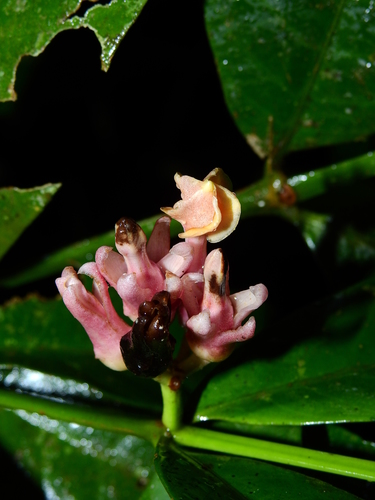
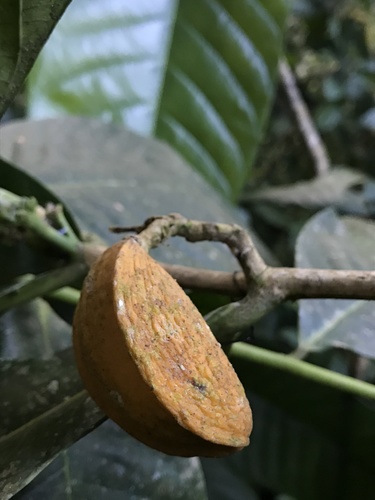
Hunteria umbellata
(K. Schum.) Hallier f.
iNaturalist· cc-by-nc
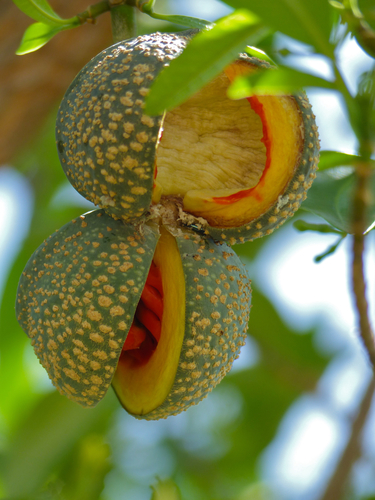
(c) Carel Jongkind, some rights reserved (CC BY-NC), uploaded by Carel Jongkind
iNaturalist· cc-by-nc
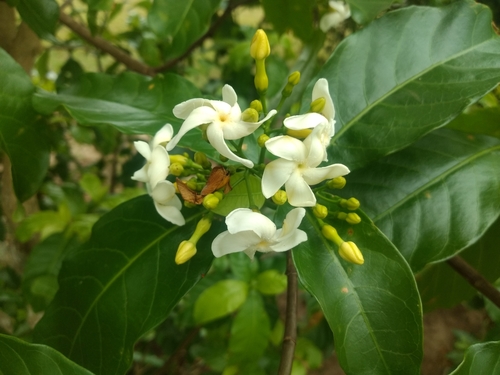
(c) Carel Jongkind, some rights reserved (CC BY-NC)
Summary
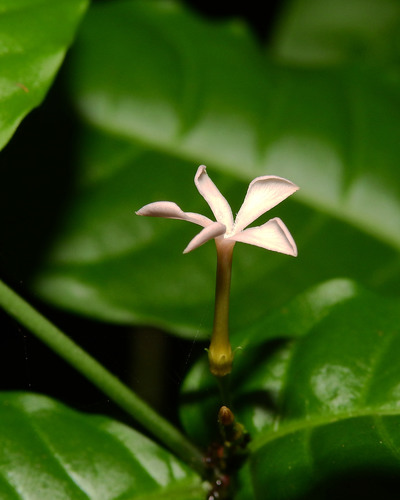
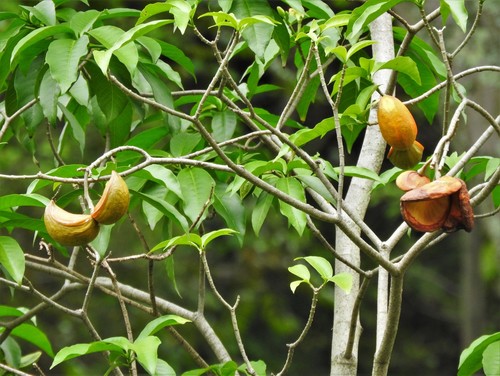
Source: WikipediaHunteria umbellata grows as either a shrub or small tree up to 22 metres (72 ft) tall, with a trunk diameter of up to 40 centimetres (16 in). Its flowers feature a white, creamy or pale yellow corolla. The fruit is yellow and smooth. Its habitat is forests from sea level to 600 metres (2,000 ft) altitude. Its numerous local medicinal uses include for fever, leprosy sores, stomach and liver problems and as an anthelmintic, especially against internal worms. Hunteria umbellata has been used as arrow poison. The plant's hard wood is used in carving and to make small tools. The species is native to an area of tropical Africa from Guinea-Bissau in the west to Angola in the south.
Description
A tropical tree in the Apocynaceae family that grows to about 22 m tall with a trunk reaching 40 cm across, found in rainforests up to 600 m elevation.
Edible Uses
The pulp of the fruit is eaten.
Traditional Uses
The pulp of the fruit is eaten.
This uses section is brief — help expand it
Medicinal Uses
The fruit is used medicinally.
Known Hazards
All parts of the plant are poisonous. The fruits are toxic and are used for criminal purposes - it is rich in latex that is an ingredient of arrow poison.
Distribution
A tropical plant. It grows in the rainforest. It grows up to 600 m above sea level.
Where It Grows
Africa, Angola, Congo DR, Gabon, Ghana, Guinea-Bissau, Nigeria, Senegal, West Africa,
Other Uses
The yellow wood is very hard; fine-grained; and is said to be termite-proof and durable. It is considered one of the best local woods for tool-handles and is also used to make combs, spoons, police batons, carpenter planes, weaving shuttles and other small articles.. Forked stems are used as hut-posts. The wood is used for fuel.
Synonyms
Also Known As
Kanwenakoa, Kanwini
References (2)
- Abbiw, D.K., 1990, Useful Plants of Ghana. West African uses of wild and cultivated plants. Intermediate Technology Publications and the Royal Botanic Gardens, Kew. p 47 (As Hunteria eburnea)
- World Checklist of Useful Plant Species 2020. Royal Botanic Gardens, Kew