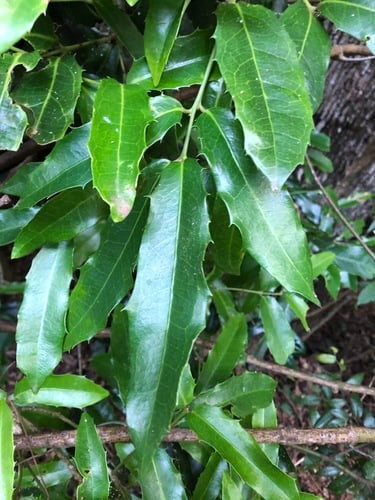
Laurelia sempervirens
Tul.
Peruvian nutmeg, Chilean laurel
iNaturalist· cc-by
(c) aacocucci, some rights reserved (CC BY), uploaded by aacocucci
iNaturalist· cc-by-nc-sa
(c) Nodora L. Moyano, some rights reserved (CC BY-NC-SA), uploaded by Nodora L. Moyano
iNaturalist· cc-by-nc
(c) Maite Muñoz, some rights reserved (CC BY-NC), uploaded by Maite Muñoz
Summary
Source: WikipediaLaurelia sempervirens is a species of evergreen tree in the family Atherospermataceae (formerly Monimiaceae). Common names include Peruvian nutmeg, tihue or trihue (from the Mapuche language), and Chilean laurel or Chilean sassafras. It is endemic to Chile, occurring at 34–41° south latitude. It requires a warm subtropical to tropical climate that is cool but also frost-free or with only very slight winter frosts not below −4 °C (25 °F), with high summer heat, rainfall and humidity. It grows best on well-drained, slightly acidic soils rich in organic matter. This is typical laurel forest habitat. However, the southern hemisphere genus Laurelia is not closely related to the laurels (Lauraceae), despite the similarity. The tree is known as triwe in Huilliche and laurel in Spanish. It is the ritual tree of the Huilliche people of Futahuillimapu.
Description
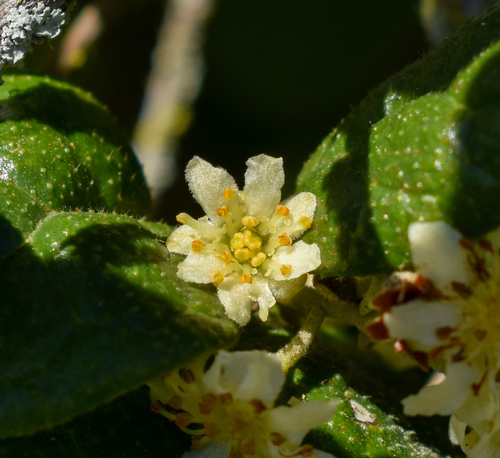
An evergreen shrub. It can grow to 15 m tall. The branches droop. The leaves are bright green and leathery. They have teeth around the edge and produce an aroma when crushed. The flowers are very small.
Edible Uses
The bark and leaves are used as a spice. The fruit and seed are also used.
Traditional Uses
The bark, leaves and fruit are used as a spice. They are a substitute for nutmeg.
This uses section is brief — help expand it
Medicinal Uses
Nervine and skin remedy. Also used in the treatment of colds, paralysis, stomach problems, and venereal disease.
Distribution
A tropical plant. It grows naturally in the mountains in central Chile. Tropical. It can grow in full sun of part shade. It needs to be sheltered from cold drying winds. The soils should be moderately fertile, moist and well-drained. Geelong Botanical Gardens. Mt Lofty Botanical Gardens. Arboretum Tasmania.
Where It Grows
Australia, Britain, Chile*, Europe, Peru, South America, Tasmania,
Cultivation
Generally a sub-tropical tree, found at a latitude of around 37° south, there is a record of a plant growing in Peru at a latitude of 9° south. Succeeds in sun or semi-shade in any moderately fertile soil, including a limey soil, so long as it does not dry out in the growing season. Requires a warm position sheltered from cold winds. The foliage is very aromatic. If required for its wood, it is necessary to cut the tree only when the sap is down. There appear to be two forms of this species. That formerly known as Laurelia serrata (now treated as a synonym) has a more southerly range and yields an inferior timber - on this form the bark is odourless and the wood has an unpleasant smell. The form with the more northerly range has an aromatic bark and the wood is odourless. The tree grows to immense size in the Cordilleran foothills of the south of Chile, and gradually diminishes in size as it is found north of the river Bio Bio. Plants are often dioecious, male and female plants will need to be grown if fruit and seed is required.
Propagation
Sow seed in February or March in a warm greenhouse — germination rates are variable. Prick seedlings into individual pots once large enough to handle and grow on in the greenhouse for at least their first winter. Plant out in late spring or early summer after the last expected frosts, with some cold protection recommended for the first winter or two outdoors. Take cuttings of half-ripe wood, 5–8cm with a heel, in July or August, in individual pots of sandy soil in a frame — keep moist; a fair percentage will root. Layering can be done in spring.
Other Uses
The wood is not durable and is malodorous when cut across the grain. It is used in construction, burns well but gives little heat.
Other Information
It is cultivated.
Synonyms
Also Known As
Chilean nutmeg, Tepa, Tihue
References (11)
- Arch. Mus. Hist. Nat. 8:416. 1855
- Grandtner, M. M. & Chevrette, J., 2013, Dictionary of Trees, Volume 2: South America: Nomenclature, Taxonomy and Ecology. Academic Press p 343
- Heywood, V.H., Brummitt, R.K., Culham, A., and Seberg, O. 2007, Flowering Plant Families of the World. Royal Botanical Gardens, Kew. p 52
- Kermath, B. M., et al, 2014, Food Plants in the Americas: A survey of the domesticated, cultivated and wild plants used for Human food in North, Central and South America and the Caribbean. On line draft. p 474
- Marinelli, J. (Ed), 2004, Plant. DK. p 110
Show all 11 references Hide references
- Phillips, R. & Rix, M., 2002, The Botanical Garden Vol. 1. Trees and Shrubs. MacMillan. p 64
- Ryan, S., 2008, Dicksonia. Rare Plants Manual. Hyland House. p 36
- Seidemann J., 2005, World Spice Plants. Economic Usage, Botany, Taxonomy. Springer. p 198
- Wickens, G.E., 1995, Edible Nuts. FAO Non-wood forest products. FAO, Rome. p 143
- Wiersema, J. H. & Leon, B., 2013, World Economic Plants. A Standard Reference CRC Press. 2nd Ed. p 392
- World Checklist of Useful Plant Species 2020. Royal Botanic Gardens, Kew