Bactris concinna
Mart.
Elegant spinyclubpalm
iNaturalist· cc-by
(c) Jens-Christian Svenning, some rights reserved (CC BY)
iNaturalist· cc-by-nc
(c) Marcus Athaydes, some rights reserved (CC BY-NC)
iNaturalist· cc-by-nc
(c) Marcus Athaydes, some rights reserved (CC BY-NC)
Description
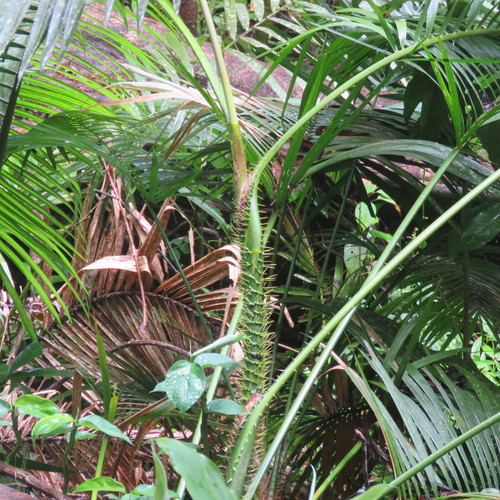
A palm which forms a cluster. The stems can reach 8 m high. The trunks are covered with a dense mat of grey leaf fibres. There are rings of black spines 1.5 cm long. The leaves are 1.3-1.6 m long. The leaflets are regularly spaced and dark green. They grow in a flat plane. The leaf stalk is spiny. The fruit are pointed and in tightly packed bunches. There are 2 small branches with about 40 fruit on each. The fruit are 2.5 cm long and edible. They are dark purple brown.
Edible Uses
The pointed dark purple-brown fruit are eaten fresh and used to make drinks. The palm hearts and cabbage are also edible portions; fruit are sold in markets and are especially popular with children.
Traditional Uses
The fruit are eaten. They are also used for drinks.
This uses section is brief — help expand it
Distribution
A tropical plant. It grows in lowland rainforest. It needs moist soil. It can grow in sun or shade. It grows along the edges of blackwater rivers. It also grow in swamps.
Where It Grows
Amazon, Bolivia, Brazil, Colombia, Ecuador, French Guiana, Peru, South America,
Cultivation
There are three recognized forms of this species; the form concinna has considerably larger fruits than the other two forms.
Other Information
The fruit are sold in markets. They are also especially eaten by children.
Notes
There are 239 Bactris species. There are 75 species in tropical America. Most Bactris have fruit that are edible but many are not attractive.
Synonyms
Also Known As
Achupara, Chontilla, Dabayowe, Huii, Inzupara, Maraja, Marajau, Nejilla, Nu-que, Shinf, Shini, Sii
References (16)
- Balick, M.J. and Beck, H.T., (Ed.), 1990, Useful palms of the World. A Synoptic Bibliography. Colombia p 120
- Daly, D. C., An Index of Common Names of Plants in Acre, Brazil. New York Botanical Garden Universidade Federal do Acre. (As Bactris concinna var. inundata)
- Grandtner, M. M. & Chevrette, J., 2013, Dictionary of Trees, Volume 2: South America: Nomenclature, Taxonomy and Ecology. Academic Press p 56
- Haynes, J., & McLaughlin, J., 2000, Edible palms and Their Uses. University of Florida Fact sheet MCDE-00-50-1 p 3
- Henderson, A., 2000, Bactris (Palmae): Flora Neotropica, Vol. 79, pp. 1-181
Show all 16 references Hide references
- Henderson, A., Galeano, G and Bernal, R., 1995, Field Guide to the Palms of the Americas. Princeton. p 187
- Janick, J. & Paul, R. E. (Eds.), 2008, The Encyclopedia of Fruit & Nuts. CABI p 102 (Also as Bactris concinna var. inundata)
- Johnson, D.V., 1998, Tropical palms. Non-wood Forest products 10. FAO Rome. p 20, 91
- Kermath, B. M., et al, 2014, Food Plants in the Americas: A survey of the domesticated, cultivated and wild plants used for Human food in North, Central and South America and the Caribbean. On line draft. p 115
- Lopez-Diago, D. & Garcia, N., 2021, Wild edible fruits of Colombia. Biota ColomBiana 22 (2) p 31
- Marcia, M. J., et al, 2011, Palm Uses in Northwestern South America: A Quantitative Review. Bot. Rev. (2011) 77:462-570
- NYBG Herbarium "edible"
- Riffle, R.L. & Craft, P., 2003, An Encyclopedia of Cultivated Palms. Timber Press. p 267
- Roa, J. A. G. & Boada, D. S. G., 2018, Fundación para el Fortalecimiento de la Fruticultura y Plantas Alimenticias no Convencionales en Colombia.
- Smith, N., et al, 2007, Amazon River Fruits. Flavors for Conservation. Missouri Botanical Gardens Press. p 56
- Torre, de la L., et al, 2008, Enciclopedia de las Plantas Útiles del Ecuador. Herbario QCA. Pontificia Universidad Católica del Ecuador. p 196