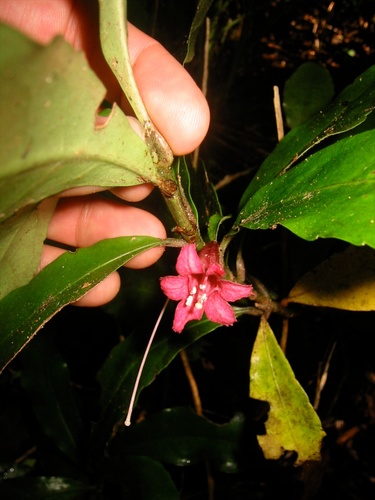
Wittsteinia vacciniacea
F. Muell.
Baw-baw berry
iNaturalist· cc-by-nc
(c) johneichler, some rights reserved (CC BY-NC), uploaded by johneichler
iNaturalist· cc-by-nc
(c) Robert Pergl, some rights reserved (CC BY-NC), uploaded by Robert Pergl
Summary
Source: WikipediaWittsteinia vacciniacea , the Baw Baw berry, is a shrub species in the family Alseuosmiaceae. It is endemic to Victoria, Australia. It grows to about 40 cm high and has leaves which are between 1 and 5 cm long. The fragrant flowers are between 4.5 and 7 mm long and are followed by greenish-white rounded fruits. The species was first formally described by botanist Ferdinand von Mueller in Fragmenta Phytographiae Australiae in 1861. It occurs on the edge of rainforest and in sheltered woodland in the Eastern Highlands of Victoria.
Description
A shrub. It grows 45 cm tall. The leaves are 1-5 cm long. The flowers are 5-7 mm long. They have a scent. The fruit are round and white. They are 5-10 mm long.
Edible Uses
The fruit is edible, though no further details on preparation or use are recorded.
Medicinal Uses
None known.
Distribution
It is a temperate plant. Arboretum Tasmania.
Where It Grows
Australia*, Tasmania,
Cultivation
We have very little information on this species and do not know if it can be grown outdoors in Britain. One report says that it requires greenhouse protection in this country. However, plants tolerate temperatures down to at least -7°c in Australian gardens, though this cannot be translated directly to British gardens due to our cooler summers and colder wetter and longer winters. It would certainly be worthwhile trying it outdoors in the milder areas of the country. It is likely to require a sunny sheltered position.
Propagation
No specific information is available for this species, but seed is best sown in a greenhouse as soon as it is ripe where possible, otherwise in early spring. Prick out seedlings into individual pots as soon as they are large enough to handle and grow on in the greenhouse for at least their first two winters before attempting to establish plants outdoors. Cuttings are also likely to work, best taken in July or August in a frame. As with many members of this family, plants probably have very fine root systems, so great care must be taken when transplanting.
Other Uses
None known.
Notes
An unresolved name in The Plant List.
References (1)
- Plants for a Future database, The Field, Penpol, Lostwithiel, Cornwall, PL22 0NG, UK. http://www.scs.leeds.ac.uk/pfaf/