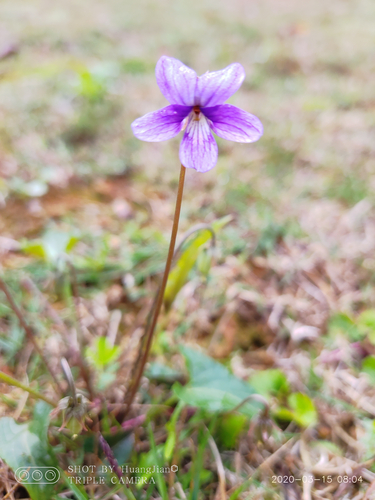
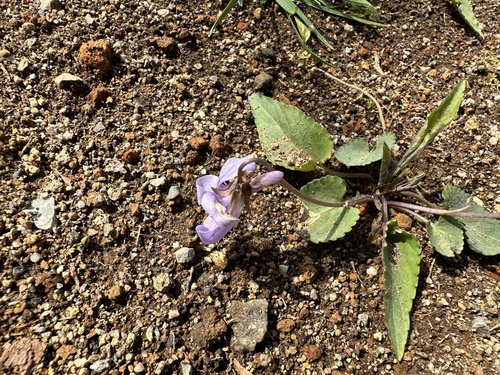
Viola x wittrockiana
Gams
Pansy, Wittrock's Violet
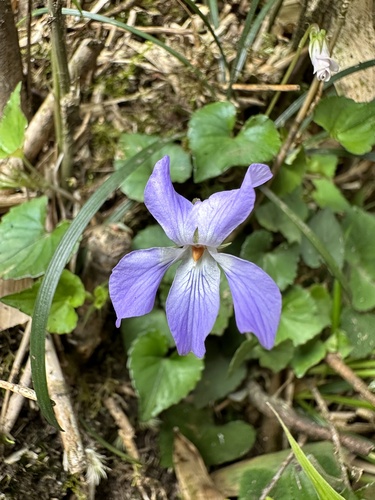
iNaturalist· cc-by-nc
(c) Alexander Baransky, some rights reserved (CC BY-NC)
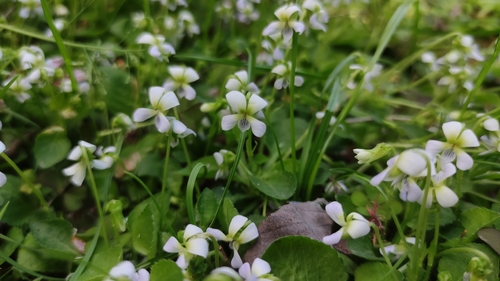
iNaturalist· cc-by-nc
(c) Alexander Baransky, some rights reserved (CC BY-NC)
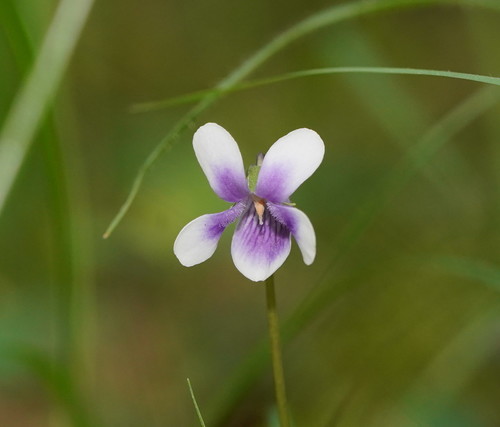
iNaturalist· cc-by-nc
(c) Alexander Baransky, some rights reserved (CC BY-NC)
Summary
Source: WikipediaA hybrid perennial pansy reaching 8 inches tall with equal spread at a medium growth rate. Flowers profusely from June through September. Insect-pollinated with hermaphroditic blooms. Prefers sandy, loamy, or clay soils with good drainage and mildly acidic to neutral pH. Adapts to semi-shade or full sun in moist soil.
Description
An annual herb. The stems are 10-25 cm long. They are branched. The leaves spread along the stem. The lower leaf blades are oval and almost heart shaped at the base. The upper leaves are more narrow with a wedge shaped base. The flowers are flattened and round in outline. They can be 3-6 cm across.
Edible Uses
Young leaves and flower buds can be eaten raw, cooked, or used as a garnish. They have a stronger flavour than most other violets. When added to soups they thicken in a similar way to okra. Caution is advised if the plant produces yellow flowers, as these can cause diarrhoea when eaten in large quantities. The leaves can also be brewed into a tea.
Traditional Uses
The flowers and leaves are eaten in salads, desserts, soups, ice drinks and candied. The fresh or dried flowers can be used for tea.
This uses section is brief — help expand it
Medicinal Uses
None known.
Distribution
A temperate plant.
Where It Grows
Australia, Belgium, Britain, Europe, France, Hawaii, Pacific, USA,
Cultivation
Prefers a cool moist well-drained humus-rich soil in partial or dappled shade and protection from scorching winds. Tolerates sandstone and limestone soils but becomes chlorotic if the pH is too high. Prefers a pH between 6 and 6.5. A hybrid species of garden origin, there are many named forms selected for their ornamental value. There is at least one cultivar selected for its edible qualities. All members of this genus have more or less edible leaves and flower buds, though those species with yellow flowers can cause diarrhoea if eaten in large quantities.
Propagation
Sow seed in autumn in a cold frame for best results; stored seed can be sown in early spring in a cold frame. Prick seedlings into individual pots once large enough to handle and plant out in summer. Note that as a hybrid, this species may not breed true from seed. Divide plants in autumn or just after flowering. Larger divisions can go directly into their permanent positions, though smaller divisions do better potted up and grown on in light shade in a greenhouse or cold frame until established, then planted out in summer or the following spring.
Other Uses
None known.
Notes
There are about 500 Viola species.
Synonyms
References (6)
- Benvenuti, S. & Mazzoncini, M., 2021, The Biodiversity of Edible Flowers: Discovering New Tastes and New Health Benefits. Frontiers in Plant Science Article 569499.
- Facciola, S., 1998, Cornucopia 2: a Source Book of Edible Plants. Kampong Publications, p 245
- G. Hegi, Ill. Fl. Mitt.-Eur. 1:616. 1925
- Plants for a Future database, The Field, Penpol, Lostwithiel, Cornwall, PL22 0NG, UK. http://www.scs.leeds.ac.uk/pfaf/
- Rop, O., et al, 2012, Edible Flowers - A New Promising Source of Mineral Elements in Human Nutrition. Molecules 2012, 17, 6672-6683
Show all 6 references Hide references
- Staples, G.W. and Herbst, D.R., 2005, A tropical Garden Flora. Bishop Museum Press, Honolulu, Hawaii. p 571