Vangueriopsis lanciflora
(Hiern) Robyns
Crooked false medlar, Rhodesian wild medlar
iNaturalist· cc-by
(c) i_c_riddell, some rights reserved (CC BY), uploaded by i_c_riddell
iNaturalist· cc-by
(c) i_c_riddell, some rights reserved (CC BY), uploaded by i_c_riddell
iNaturalist· cc-by-nc
(c) Bart Wursten, some rights reserved (CC BY-NC)
Summary
Source: WikipediaVangueriopsis lanciflora is a species of flowering plants in the family Rubiaceae. The species has the largest distribution area of the genus and occurs in Central and South Tropical Africa (D.R.Congo to Tanzania and South Africa).
Description
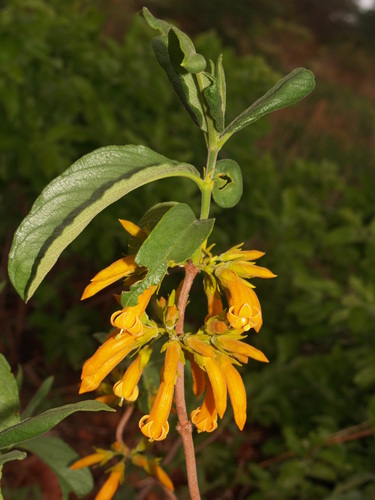
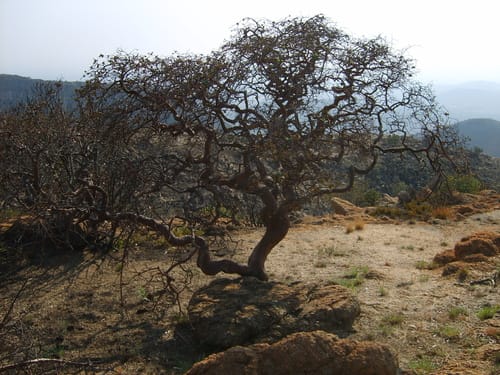
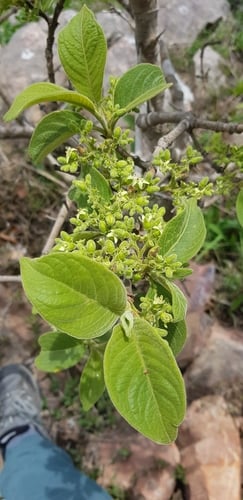
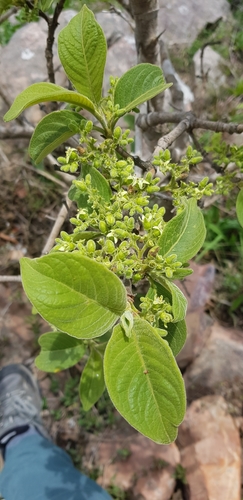
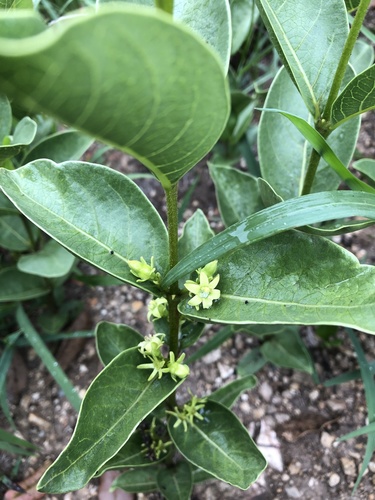
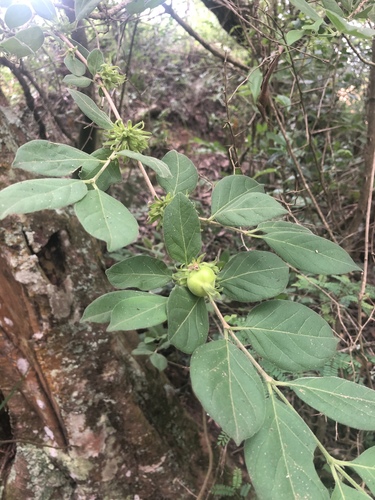
A small spreading tree. It often loses its leaves during the year. It grows up to 12 m tall. The trunk can be 25 cm across. The bark is red or grey. The leaves are simple and opposite. They are 9-15 cm long by 5 cm wide. They are oblong. The leaves are much paler underneath. The young shoots are covered with rusty red hairs. The flower buds can be 2.5 cm long and are velvety. The flowers are yellow and the slender hairy petals bend backwards. The flowers are in dense clusters in the axils of leaves. The fruit are round and lopsided. They are 2.5-4 cm long. They are yellow when ripe and contain 1 or 2 seeds. The fruit are edible.
Edible Uses
The fruit are eaten raw, being sweetest when very ripe and typically left in the sun for a few days to soften.
Traditional Uses
The fruit are eaten raw. They are sweetest when very ripe and are usually left in the sun for a few days to soften.
This uses section is brief — help expand it
Distribution
A tropical plant. It occurs in woodland and wooded grassland. It is often associated with rocky outcrops. It grows in hot arid places. It grows between 900-1,370 m above sea level. It can grow in arid places. It grows in lowland forests. It grows in Miombo woodland.
Where It Grows
Africa, Angola, Botswana, Central Africa, Congo, East Africa, Malawi, Mozambique, Namibia, South Africa, Southern Africa, Tanzania, Zambia, Zimbabwe,
Cultivation
It can be grown from seeds. It can easily be grown from cuttings or large sections of branches.
Other Uses
The wood is used to make spoons. The wood is used for fuel.
Production
In Tanzania ripe fruit are collected from October to December.
Other Information
The fruit is dry with a sweet sour flesh.
Nutrition
| Part | Moisture | kJ | kcal | Protein | Vit A | Vit C | Iron | Zinc |
|---|---|---|---|---|---|---|---|---|
| Fruit | 78 | 349 | 83 | 2 | — | — | — | — |
Synonyms
Also Known As
False wild medlar, Maululu, Mgelelya, Mmupudu, Mngesenya, Msambalawe-lulenga, Mufilu, Mukolobondo, Mumbole, Mumonsomonso, Mungelelya, Musole, Mutufu, Umthofu
References (30)
- Baidu-Forson, J.J., et al ,2014,. Assessment of agrobiodiversity resources in the Borotse flood plain, Zambia. CGIAR Research Program on Aquatic Agricultural Systems. Penang, Malaysia. Working Paper: AAS-2014-12.
- Bircher, A. G. & Bircher, W. H., 2000, Encyclopedia of Fruit Trees and Edible Flowering Plants in Egypt and the Subtropics. AUC Press. p 81 (As Canthium lanciflorum)
- Campbell, B. M., 1987, The Use of Wild Fruits in Zimbabwe. Economic Botany 41(3): 375-385
- Drummond, R. B., 1981, Common Trees of the Central Watershed Woodlands of Zimbabwe, National Herbarium Salisbury. p 206
- Facciola, S., 1998, Cornucopia 2: a Source Book of Edible Plants. Kampong Publications, p 213
Show all 30 references Hide references
- FAO. 1983, Food and fruit-bearing forest species 1: Examples from Eastern Africa. FAO Food and Forestry Paper 44/1 p 135
- Fowler, D. G., 2007, Zambian Plants: Their Vernacular Names and Uses. Kew. p 58
- Fox, F. W. & Young, M. E. N., 1982, Food from the Veld. Delta Books. p 328
- Grivetti, L. E., 1980, Agricultural development: present and potential role of edible wild plants. Part 2: Sub-Saharan Africa, Report to the Department of State Agency for International Development. p 72
- Jardin, C., 1970, List of Foods Used In Africa, FAO Nutrition Information Document Series No 2.p 167
- JSTOR Global Plants edible
- Lovett, J. C. et al, Field Guide to the Moist Forest Trees of Tanzania. p 145
- Malaisse, F., 1997, Se nourrir en floret claire africaine. Approche ecologique et nutritionnelle. CTA., p 69
- Mannheimer, C. A. & Curtis. B.A. (eds), 2009, Le Roux and Muller's Field Guide to the Trees and Shrubs of Namibia. Windhoek: Macmillan Education Namibia. p 466
- Maroyi, A., 2011, The Gathering and Consumption of Wild Edible Plants in Nhema Communal Area, Midlands Province, Zimbabwe. Ecology of Food and Nutrition 50:6, 506-525
- Maroyi, A. & Cheikhyoussef, A., 2017, Traditional knowledge of wild edible fruit in southern Africa: A comparative use patterns in Namibia and Zimbabwe. Indian Journal of Traditional Knowledge. 16(3): 385-392
- Mbuya, L.P., Msanga, H.P., Ruffo, C.K., Birnie, A & Tengnas, B., 1994, Useful Trees and Shrubs for Tanzania. Regional Soil Conservation Unit. Technical Handbook No 6. p 500
- Neudeck, L. et al, 2012, The Contribution of Edible Wild Plants to Food Security, Dietary Diversity and Income of Households in Shorobe Village, Northern Botswana. Ethnobotany Research & Applications 10:449-462
- Njana, M. A., et al, 2013, Are miombo woodlands vital to livelihoods of rural households? Evidence from Urumwa and surrounding communities, Tabora, Tanzania. Forests, Trees and Livelihoods, 22:2, 124-140
- Palgrave, K.C., 1996, Trees of Southern Africa. Struik Publishers. p 876
- Palmer, E and Pitman, N., 1972, Trees of Southern Africa. Vol. 2. A.A. Balkema, Cape Town p 2086
- Peters, C. R., O'Brien, E. M., and Drummond, R.B., 1992, Edible Wild plants of Sub-saharan Africa. Kew. p 177
- Roodt, V., 1998, Trees & Shrubs of the Okavango Delta. Medicinal Uses and Nutritional value. The Shell Field Guide Series: Part 1. Shell Botswana. p 197
- Royal Botanic Gardens, Kew (1999). Survey of Economic Plants for Arid and Semi-Arid Lands (SEPASAL) database. Published on the Internet; http://www.rbgkew.org.uk/ceb/sepasal/internet [Accessed 10th June 2011]
- Ruffo, C. K., Birnie, A. & Tengnas, B., 2002, Edible Wild Plants of Tanzania. RELMA p 710
- Ruiters-Welcome, A. K., 2019, Food plants of southern Africa. Ph.D. thesis. Univ. of Johannesburg p 98
- Scudder, 1962, 1971,
- Tredgold, M.H., 1986, Food Plants of Zimbabwe. Mambo Press. p 135
- Welcome, A. K. & Van Wyk, B.-E., 2019, An inventory and analysis of the food plants of southern Africa. South African Journal of Botany 122 (2019) 136–179
- World Checklist of Useful Plant Species 2020. Royal Botanic Gardens, Kew Van Wyck, B., & Van Wyck, P, 1997, Field Guide to Trees of Southern Africa. Struik. p 274