Vaccinium vacciniaceum
(Roxb.) Sleumer
Tibetan blueberry
iNaturalist· cc-by
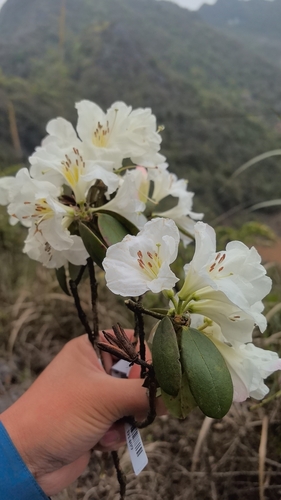
(c) Siddarth Machado, some rights reserved (CC BY), uploaded by Siddarth Machado
iNaturalist· cc-by-nc
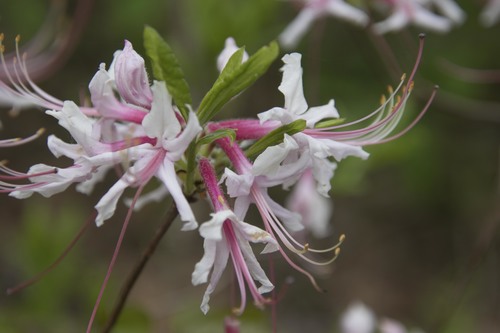
(c) coqwallon, some rights reserved (CC BY-NC)
Summary
An evergreen shrub reaching 0.5m (1ft 8in), remaining leafy year-round with flowers in May. Hermaphrodite flowers attract insects. Prefers light sandy to medium loamy, well-drained soil in mildly acid to very acid conditions. Grows in semi-shade or full sun with moist soil.
Description
A small shrub that can grow attached to trees. It grows 50 cm tall. The leaves are in a ring of 5-8. The leaf blades are oblong to sword shaped and 4-5 cm long by 1-1.5 cm wide. The leaf blades are wedge shaped at the base. The flowers are in groups 2-6 cm long. The flowers are greenish yellow. The fruit is a berry that has about 10 chambers.
Edible Uses
The fruit can be eaten raw or cooked. The flowers have an acid taste and are used in curries.
Traditional Uses
The flowers are acidic and used in curries. The fruit are eaten raw or cooked.
This uses section is brief — help expand it
Medicinal Uses
None known.
Distribution
It is a subtropical plant. It grows in evergreen forests between 2,300-2,400 m above sea level in Tibet. In Sikkim it grows between 1,200-1,800 m above sea level. In the Himalayas in India it grows between 1,200-2,400 m above sea level.
Where It Grows
Asia, Bhutan, China, Himalayas, India, Myanmar, Nepal, Northeastern India, SE Asia, Sikkim, Tibet,
Propagation
Sow seed in late winter in a greenhouse using a lime-free potting mix, barely covering the seed. Stored seed may need up to 3 months of cold stratification. Alternatively, sow fresh seed in a greenhouse as soon as it is ripe. When seedlings reach about 5cm tall, prick them out into individual pots and grow on in a lightly shaded greenhouse position for at least their first winter. Plant out into permanent positions in late spring or early summer, after the last expected frosts. Half-ripe cuttings, 5–8cm with a heel, can be taken in August and rooted in a frame, though this is slow and difficult. Layering can be done in late summer or early autumn (though one source suggests spring is preferable) and takes around 18 months. Division of suckers can be carried out in spring or early autumn.
Other Uses
None known.
Dangerous Lookalikes
This plant can be confused with the following toxic species. Always verify identification carefully before consuming any wild plant.
Deadly Nightshade
Atropa belladonna
Joan Simon from Barcelona, España
Tibetan blueberry
Vaccinium vacciniaceum
(c) Siddarth Machado, some rights reserved (CC BY), uploaded by Siddarth Machado
Deadly Nightshade: Tall herbaceous plant (1-2m), single shiny black cherry-sized berries, star-shaped calyx, large oval leaves, sweet but dangerous taste.
Tibetan blueberry: Low woody shrub, berries in clusters with crown/remnant calyx ring, sweet taste.
Synonyms
Also Known As
Cham, Dieng-soh-lardi, Sano mussikane, Soti-pydung
References (8)
- Ambasta, S.P. (Ed.), 2000, The Useful Plants of India. CSIR India. p 666 (As Vaccinium serratum)
- Calcutta J. Nat. Hist. 8:171. 1847 (Icon. pl. ind. orient. t. 1184. 1847) (As Vaccinium serratum)
- Dobriyal, M. J. R. & Dobriyal, R., 2014, Non Wood Forest Produce an Option for Ethnic Food and Nutritional Security in India. Int. J. of Usuf. Mngt. 15(1):17-37 (As Vaccinium serratum)
- Plants for a Future database, The Field, Penpol, Lostwithiel, Cornwall, PL22 0NG, UK. http://www.scs.leeds.ac.uk/pfaf/ (As Vaccinium serratum)
- Sundriyal, M., et al, 1998, Wild edibles and other useful plants from the Sikkim Himalaya, India. Oecologia Montana 7:43-54
Show all 8 references Hide references
- Sundriyal, M., et al, 2004, Dietary Use of Wild Plant Resources in the Sikkim Himalaya, India. Economic Botany 58(4) pp 626-638
- Wild edible plants of Himachal Pradesh (As Vaccinium serratum)
- www.flowersofindia.net