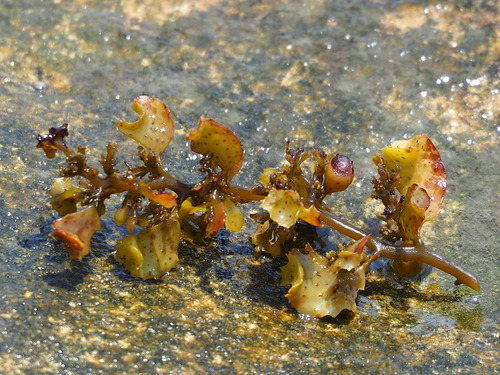
Turbinaria conoides
(J. Agardh) Kutzing
Labi-labi
iNaturalist· cc-by-nc
(c) Nick Helme, some rights reserved (CC BY-NC), uploaded by Nick Helme
wikimedia· cc0
Wikimedia Commons - Friedrich Traugott Kützing (1807–1893)
wikimedia· cc0
Wikimedia Commons - Ethel Sarel Barton (1864–1922)
Description
A tropical seaweed belonging to the Sargassaceae family.
This description is brief — help expand it
Edible Uses
It is eaten in salads or prepared as pickles.
Traditional Uses
It is eaten in salad or as pickles.
This uses section is brief — help expand it
Distribution
A tropical plant.
Where It Grows
Africa, Andaman Islands, Asia, Australia, China, East Africa, Fiji, FSM, India, Indochina, Indonesia, Iran, Japan, Kenya, Madagascar, Malaysia, Mauritius, Malaysia, Micronesia, Middle East, Pacific, Palau, Papua New Guinea, PNG, Philippines, Reunion, Samoa, Saudi Arabia, SE Asia, Seychelles, Singapore, Solomon Islands, Sri Lanka, Taiwan, Tanzania, Thailand, Vietnam,
Notes
There are about 22 Turbinaria species.
Also Known As
Agar-agar lesong
References (10)
- Ambasta, S.P. (Ed.), 2000, The Useful Plants of India. CSIR India. p 656
- Burkill, I.H., 1966, A Dictionary of the Economic Products of the Malay Peninsula. Ministry of Agriculture and Cooperatives, Kuala Lumpur, Malaysia. Vol 2 (I-Z) p 2233
- Cribb, A.B. & J.W., 1976, Wild Food in Australia, Fontana. p 196
- http://www.seavegetables.com
- Kiple, K.F. & Ornelas, K.C., (eds), 2000, The Cambridge World History of Food. CUP p 236
Show all 10 references Hide references
- Poster ISHS Madurai
- Womersley, H.B. S. & Bailey, A., 1970, Marine algae of the Solomon Islands. Philosophical Transactions of the Royal Society of London. B. Biological Sciences 259:257-352
- World Checklist of Useful Plant Species 2020. Royal Botanic Gardens, Kew
- Zaneveld, J.S., 1951, The economic marine algae of Malaysia and their applications. 2 The Phaeophyta. Proceedings of the Indo-Pacific Fisheries Council. 129-33
- Zemke-White, W. L. & Ohno, M., 1999, World seaweed utilisation: An end-of-century summary. Journal of Applied Phycology 11: 369-376