Tuber melanosporum
Vittadini
Black truffle, Perigord truffle
iNaturalist· cc-by-nc-sa
(c) Ian L, some rights reserved (CC BY-NC-SA)
iNaturalist· cc-by-nc
(c) John Plischke, some rights reserved (CC BY-NC)
iNaturalist· cc-by-nc
(c) John Plischke, some rights reserved (CC BY-NC)
Summary
Source: WikipediaTuber melanosporum, commonly called black truffle, Périgord truffle or French black truffle, is a species of truffle native to Southern Europe. It is one of the most expensive edible fungi in the world. In 2013, the truffle cost between 1,000 and 2,000 euros per kilogram.
Description
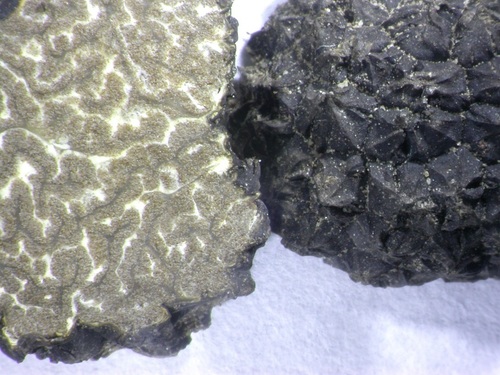
A mushroom. A truffle. It is black inside and outside.
This description is brief — help expand it
Edible Uses
With a price of about 1,000 to 2,000 euros per kilogram, black truffles are the second-most expensive truffles after white truffles and one of the most sought-after edible mushrooms in the world. In cooking, black truffles are used to refine the taste of meat, fish, soups, cheeses, and risotto. Unlike white truffles, the aroma of black truffles does not diminish when they are heated but becomes more intense. They are commonly shaved into or on top of a dish raw or infused with high-quality olive oil or butter.
Distribution
It is a temperate plant.
Where It Grows
Andorra, Asia, Chile, China, Europe, France, Germany, Italy, Japan, Mediterranean, North America, Poland, Portugal, Scandinavia, Serbia, Spain, Sweden, USA,
Synonyms
Also Known As
Caratompola, Heibao kuaijun
References (13)
- Bianchini, F., Corbetta, F., and Pistoia, M., 1975, Fruits of the Earth. Cassell. p 118
- Boa, E. R., 2004, Wild edible fungi and their importance to people. FAO Non Wood Forest Products Booklet 17
- Hall, I. R., et al, 2003, Edible and Poisonous Mushrooms of the World. Timber Press. p 263
- Kaufmann, B. et al, 1999, The Great Encyclopedia of Mushrooms. Konemann. p 236
- Kiple, K.F. & Ornelas, K.C., (eds), 2000, The Cambridge World History of Food. CUP p 1872
Show all 13 references Hide references
- Kybal, J., 1980, Herbs and Spices, A Hamlyn Colour Guide, Hamlyn Sydney p 198
- Mattia, B., et al, 2009, The Cultivation of Truffles in Italy. Acta Botanica Yunnanica. 0253-2700 Suppl. XVI - 021-08
- Mulherin, J., 1994, Spices and natural flavourings. Tiger Books, London. p 61
- Nebel, S., Pieroni, A. & Heinrich, M., 2006, Ta cho`rta: Wild edible greens used in the Graecanic area in Calabria, Southern Italy. Appetite 47 (2006) 333–342
- Pace, G., 1998, Mushrooms of the world. Firefly books. p 240
- Radomir, M., et al, 2018, Conservation and trade of wild edible mushrooms of Serbia – history, state of the art and perspectives. Nature Conservation 25: 31–53
- Schneider, E., 2001, Vegetables from Amaranth to Zucchini: The essential reference. HarperCollins. p 673
- www.plantnames.unimelb.edu.au